

Coordinated attacks across Balochistan affect multiple cities, including Quetta
Kamran Khan says militants are now targeting Quetta’s Red Zone, marking a shift to high-profile attacks in civilian areas.

News Desk
The News Desk provides timely and factual coverage of national and international events, with an emphasis on accuracy and clarity.
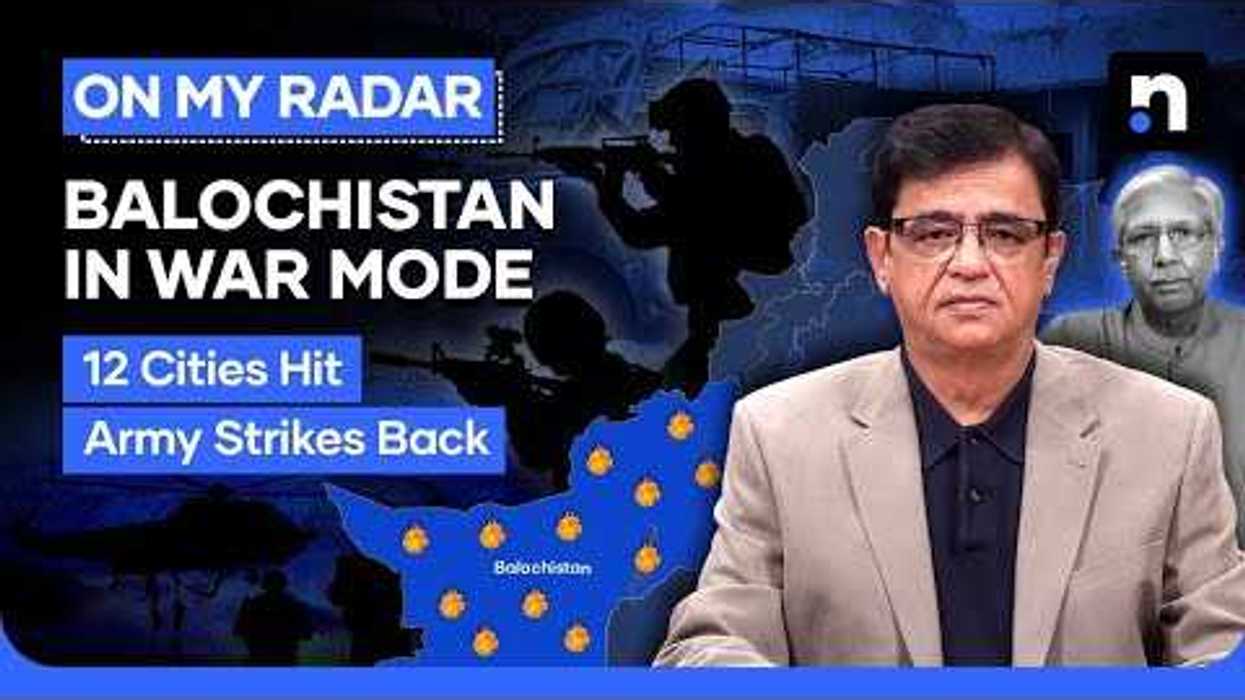
Balochistan witnessed an unprecedented wave of coordinated terrorist attacks on Saturday, as militants struck 12 cities across the province in a single day. The attacks targeted homes, markets, government offices, police stations, and other civilian centers, creating widespread panic and chaos.
Security forces were immediately deployed, and emergency protocols were activated in hospitals, while mobile phone and internet services were suspended and internal routes sealed to contain the situation.
Kamran Khan, in the latest episode of On My Radar, highlighted the severity of the attacks, saying that this was the first time militants had directly targeted Quetta’s Red Zone, signaling a shift from conventional guerrilla operations to highly organized, high-profile strikes designed to demonstrate power in civilian areas.
The intensity of the attacks was evident as terrorists reached Quetta’s Red Zone. Security forces responded swiftly, preventing even greater casualties. According to official reports, 177 terrorists were neutralized, but 17 security personnel and 31 civilians - including women and children - lost their lives.
The Balochistan government has claimed that all affected areas have now been cleared, with combing operations ongoing only in Mastung.
The banned Baloch Liberation Army (BLA), which Pakistan classifies as part of the India-backed “Fitna-e-Al-Hindustan” network, has claimed responsibility. ISPR stated that the attacks on January 31 were orchestrated by foreign-based terrorist leaders who remained in direct contact with the operatives on the ground.
Internationally, the attacks drew condemnation and solidarity from the United States, United Kingdom, European Union, France, Saudi Arabia, UAE, Qatar, Iran and Turkey.
The attacks were meticulously coordinated. In Quetta, militants began striking in early hours of Saturday, targeting key locations including Hazarganji, Sheikh Zaid Hospital, University of Balochistan, Helper Hospital, Imdad Chowk, and the Red Zone.
A vehicle loaded with explosives was detonated at Edhi Chowk, shattering windows in nearby buildings. Multiple police stations, banks, and vehicles were attacked or set ablaze, while armed militants openly checked identity cards in broad daylight.
In other districts, the violence continued: Mastung jail was attacked, freeing 27 prisoners; two banks were set on fire; Pasni witnessed a female suicide bomber targeting the Maritime Security Agency; Qalat and Noshki faced coordinated attacks on police stations, CTD offices, and even the Deputy Commissioner’s residence, with the official temporarily taken hostage; in Kharan, government buildings, banks, and a tribal leader’s residence were attacked, leaving seven dead. Gwadar, Dalbandin, Turbat, Kech, and Sibi also experienced rocket fire, heavy gunfire, and multiple casualties.
Experts say the simultaneous attacks across 12 cities were meant to send a message that militants can strike anywhere, anytime. The BLA has named these operations “Operation Hero F-2,” continuing a series of escalating attacks, with previous operations recorded in August 2024. Data from the Pakistan Institute for Peace Studies show that attacks in Balochistan have risen sharply from 81 in 2021 to 254 in 2025, with multiple attacks on major transport routes such as the Jaffar Express.
Analysts note that the timing of these attacks appears strategic. With unrest in neighboring Iran drawing global attention, militants may have sought to signal that violent resistance persists in Pakistan as well.
Balochistan’s 900-kilometer border with Iran could also indicate an intent to attract international media coverage and the attention of global powers.




Comments
See what people are discussing