

Pakistan reports minor jump in literacy rate; internet penetration doubles
The Household Integrated Economic Survey 2024-25 shows nationwide literacy has increased to 63%

Business Desk
The Business Desk tracks economic trends, market movements, and business developments, offering analysis of both local and global financial news.
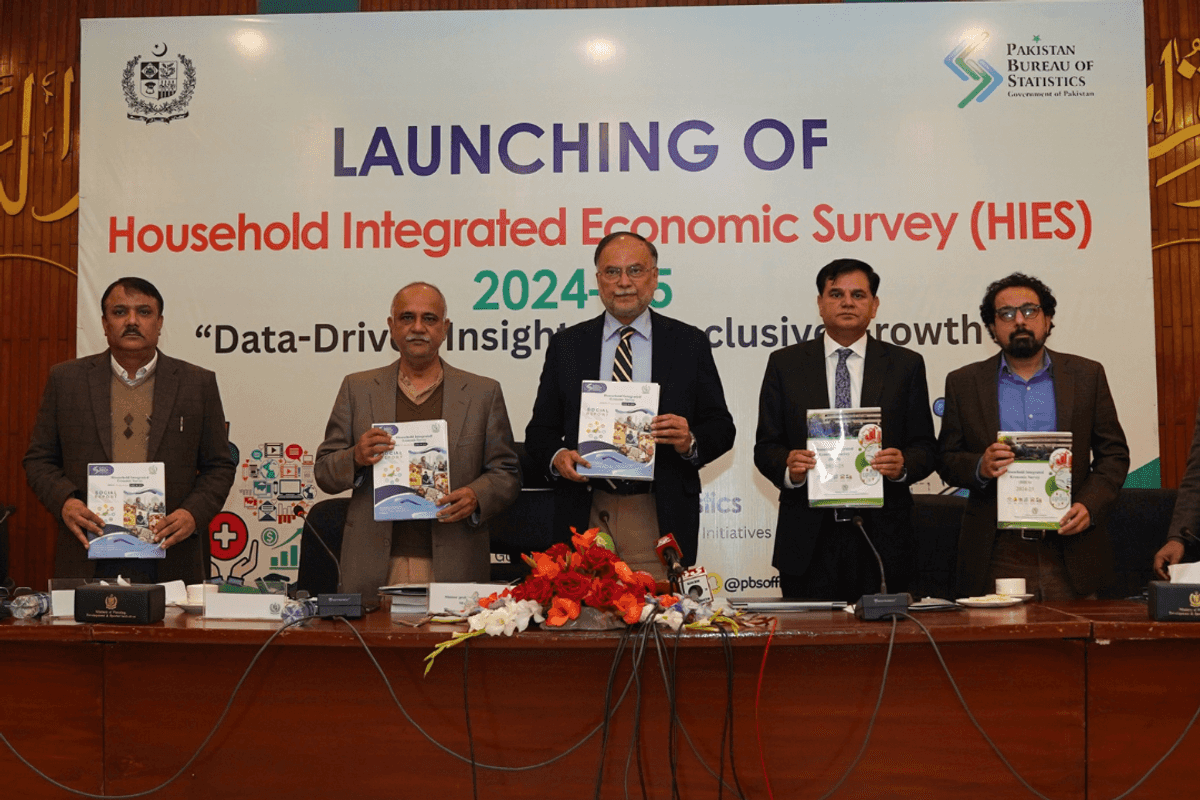
Pakistan's Federal Minister for Planning, Development and Special Initiatives Ahsan Iqbal (center) holds a copy of the Household Integrated Economic Survey 2024-25 on Thursday.
Ministry of Planning, Development & Special Initiatives
Pakistan’s household internet penetration has more than doubled in the past six years, while at least 96% of households now use smartphones, according to a new survey released on Thursday.
The Household Integrated Economic Survey 2024-25 showed that digital access has increased sharply, with household internet access increasing to 70% from 34% in 2019. Individuals using the internet increased to 57% from 17%. Access to mobile phones or smartphones reached 96% of households.
The country’s first-ever fully digital survey to gauge the economic status of households has reported improvements in literacy, internet access, health indicators and household incomes.
According to survey results presented by Deputy Director General Rabia Awan, nationwide literacy increased to 63% from 60%, while the share of out-of-school children declined to 28% from 30%. Gender parity at the primary level improved to 96% from 92%.
Health indicators also improved. Record-based full immunization coverage increased to 73% from 68%. The neonatal mortality rate declined to 35 from 41 per 1,000 live births, while the infant mortality rate fell to 47 from 60. The total fertility rate edged down to 3.6 children per woman from 3.7.
Use of clean fuels — including natural gas, liquefied petroleum gas, biogas, solar energy and electricity — increased to 38% from 35%, the survey found.
HIES 2024–25 also reported increases in household income and consumption. Food accounted for the largest share of household spending at 37%, followed by housing and fuel at 26%, restaurants and hotels at 6.63%, clothing and footwear at 6.28%, and transport at 6.21%.
‘Major step towards improved policy-making’
Federal Minister for Planning, Development and Special Initiatives Ahsan Iqbal, who formally unveiled the survey at a ceremony on Thursday, said it was a major step toward data-driven governance and evidence-based policymaking.
He said the Planning Ministry and PBS had been transformed into modern, data-oriented institutions, adding that longstanding institutional backlogs were being cleared and analytical capacity strengthened.
“This survey will enable more meaningful research and provide valuable insights to policymakers and the business community,” Iqbal said.
The survey covered 32,000 households nationwide and was conducted quarterly, with field operations completed in June 2025. PBS said it used a fully integrated enterprise resource planning system for digital data collection, task management and real-time monitoring. It is the first fully digital HIES conducted after the Digital Population and Housing Census 2023.
Iqbal said Pakistan’s economy suffered major shocks beginning in 2018 and again during the COVID-19 pandemic, which particularly affected the middle class. He said the country was now moving toward recovery and expressed optimism that gross domestic product growth would reach about 4% in the current fiscal year.
He emphasized the need to address what he called an education emergency, noting that Pakistan still has about 25 million out-of-school children. He also stressed that political stability and policy continuity were essential for sustained growth.
HIES has tracked socioeconomic indicators at the national and provincial levels since 1963 and supports monitoring progress on the U.N. Sustainable Development Goals.
The Pakistan Bureau of Statistics said the latest findings provide a strong evidence base for inclusive development policies and reflect progress in education, health, digital access, and living standards across the country.




Comments
See what people are discussing