

IMF, Pakistan reach agreement on $1.21bn disbursement
The IMF and Pakistani authorities conclude Article IV consultation and reach staff-level agreement on EFF and RSF reviews
Haris Zamir
Business Editor
Experience of almost 33 years where started the journey of financial journalism from Business Recorder in 1992. From 2006 onwards attached with Television Media worked at Sun Tv, Dawn Tv, Geo Tv and Dunya Tv. During the period also worked as a stringer for Bloomberg for seven years and Dow Jones for five years. Also wrote articles for several highly acclaimed periodicals like the Newsline, Pakistan Gulf Economist and Money Matters (The News publications)
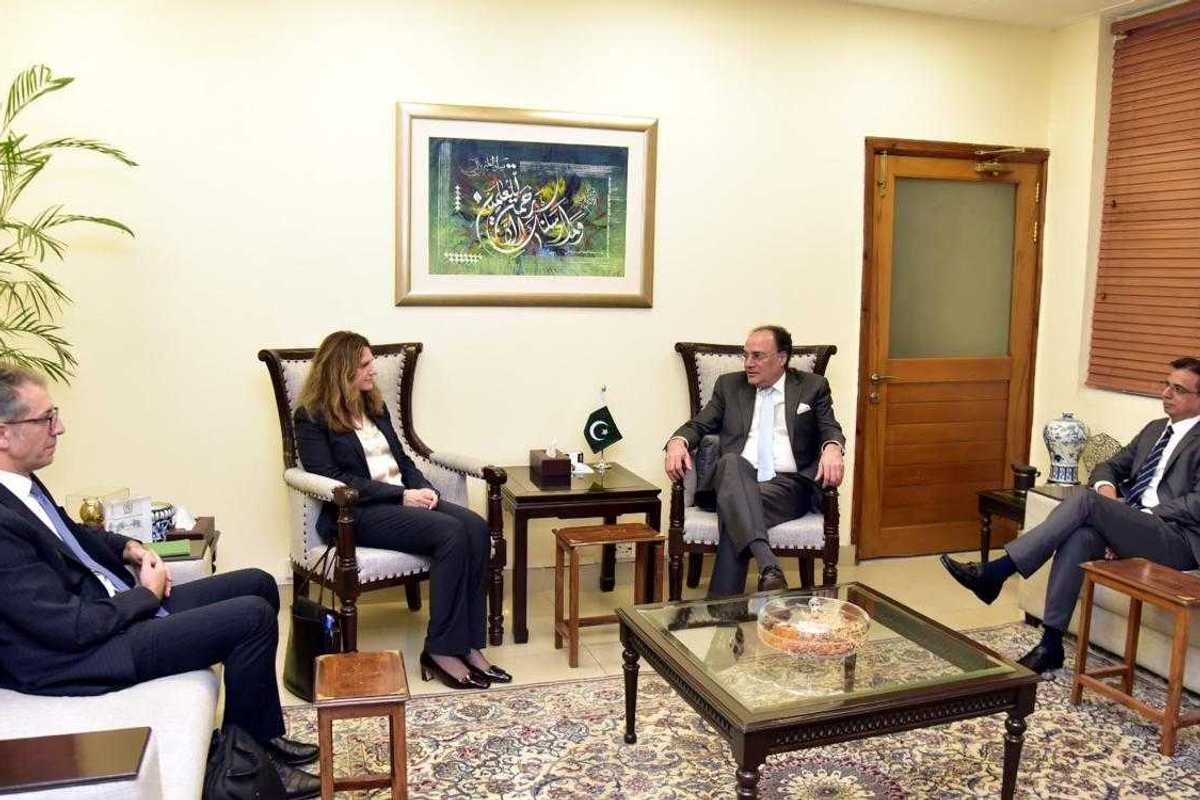
IMF Mission Chief Ms. Iva Petrova held a wrap-up session with the Federal Minister for Finance and Revenue, Senator Muhammad Aurangzeb, at the Q Block Pak Secretariat, Islamabad, on October 7, 2026.
Picture Courtesy: Ministry of Finance
The International Monetary Fund (IMF) and Pakistani authorities reached a staff-level agreement on Thursday after completing discussions under the 2026 Article IV consultation, the fourth review of the 37-month Extended Fund Facility (EFF), and the third review of the 28-month Resilience and Sustainability Facility (RSF).
What macroeconomic indicators and fiscal targets were outlined in the IMF agreement?
After two weeks of consultations in Karachi and Islamabad led by IMF Mission Chief Iva Petrova from September 23 to October 7, the staff-level agreement opens access to about $1.21 billion in total financing, subject to formal approval by the IMF Executive Board. The disbursement comprises roughly $1.0 billion (SDR 760 million) under the EFF and $210 million (SDR 154 million) under the RSF, bringing cumulative drawdowns under both arrangements to approximately $5.7 billion.
Mission Chief Petrova noted that Pakistan successfully preserved macroeconomic stability despite external shocks from the Middle East war and energy market disruptions, with real GDP growth reaching 3.6 percent for FY26, headline inflation moderating to 10.3 percent in September, and gross foreign exchange reserves rising to $21.5 billion.
To maintain long-term debt sustainability, the agreement requires steadfast execution of the FY27 budget, anchored by a primary surplus target of 2.0 percent of GDP supported by risk-based audits, digital invoicing, and third-party data integration.
Social protection mechanisms will be strengthened by increasing health and education spending to 2.8 percent of GDP in FY27 and expanding targeted cash transfers, while broad, high-cost fuel support schemes are set to be promptly phased out in favor of time-bound, targeted social assistance.
How does the agreement address energy sector reforms and structural priorities?
The policy framework commits the State Bank of Pakistan to maintaining an appropriately tight monetary policy stance to guide inflation back to target levels while preserving exchange rate flexibility as an economic shock absorber. In the energy sector, the IMF emphasized timely tariff adjustments, circular debt prevention, cost recovery across gas networks, and expanding private sector participation in power distribution to enhance operational efficiency.
Structural priorities reviewed under the Article IV consultation focus on reforming state-owned enterprise (SOE) governance, reducing trade barriers, improving anti-corruption institutions, and enhancing market competition. Climate adaptation objectives under the RSF mandate integrating climate risk assessments into public investment frameworks, reforming irrigation water pricing, establishing energy efficiency standards, and accelerating transport decarbonization.
The agreement is scheduled for formal submission to the IMF Executive Board for final approval in the coming weeks.




Comments
See what people are discussing