

Indian police detain 'Cockroach' movement leaders and thousands of protesters in Delhi security crackdown
Indian security forces detained Cockroach Janta Party founder Abhijeet Dipke and thousands of demonstrators in New Delhi during a nationwide protest demanding the resignation of Chief Election Commissioner Gyanesh Kumar over controversial voter roll revisions

News Desk
The News Desk provides timely and factual coverage of national and international events, with an emphasis on accuracy and clarity.
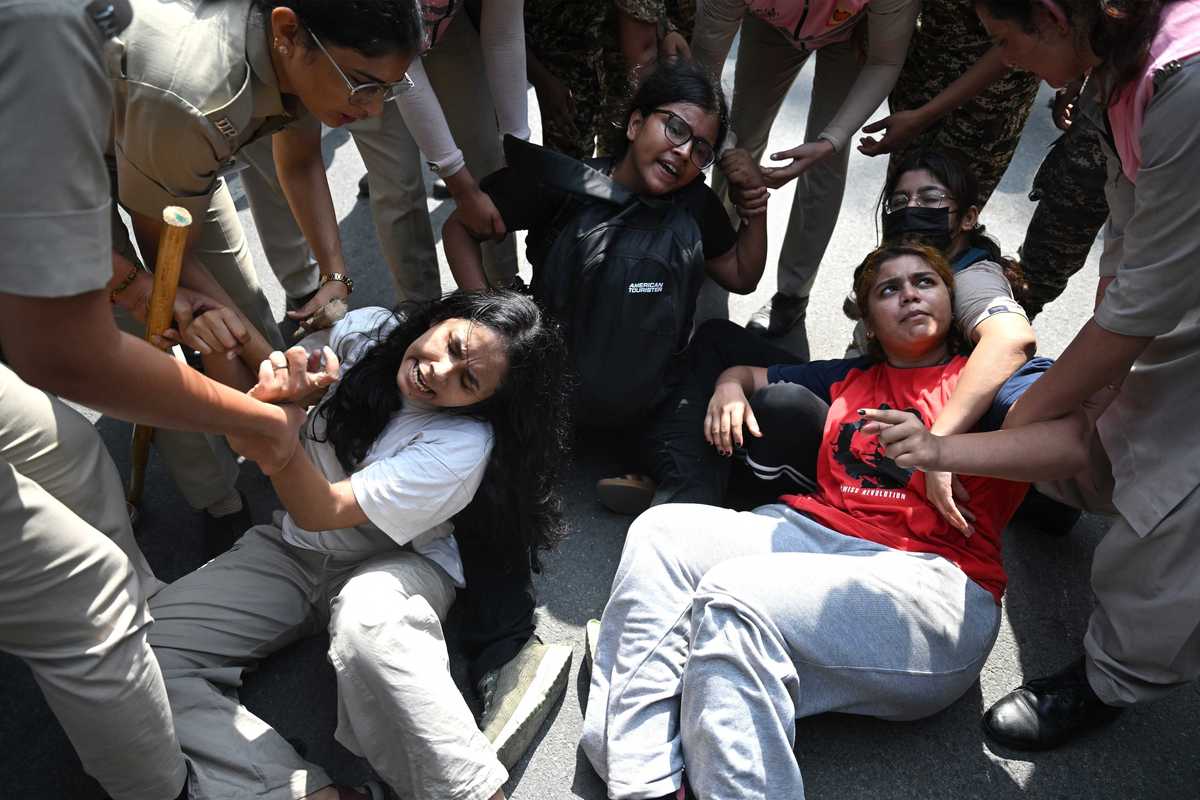
Police personnel detain supporters of the Cockroach Janata Party (CJP) during a protest demanding the resignation of India’s Chief Election Commissioner Gyanesh Kumar over alleged voter roll irregularities linked to the "special intensive revision" (SIR), in New Delhi on October 10, 2026.
AFP
Indian authorities deployed over 25,000 security personnel across New Delhi on Saturday, October 10, 2026, detaining thousands of demonstrators and locking down key transport networks to foil a massive rally organized by the youth-led "Cockroach" movement against the Election Commission of India.
Why are youth protesters demanding the resignation of Chief Election Commissioner Gyanesh Kumar?
The demonstration represents the culmination of weeks of opposition mobilization against Chief Election Commissioner Gyanesh Kumar and the Election Commission of India following the exclusion of over 133 million names during a national voter roll revision. Opposition leaders and civil society groups allege that the revision disenfranchised legitimate constituents ahead of crucial state assembly elections in Uttar Pradesh, while the ruling Bharatiya Janata Party and the Election Commission assert the process aimed solely to remove duplicate entries and ineligible voters.
The Cockroach Janta Party, founded in May 2026 by political communications strategist Abhijeet Dipke as a satirical youth movement, previously mobilized mass rallies in July that resulted in the resignation of Education Minister Dharmendra Pradhan over entrance exam scandals. Re-emerging under the campaign "Chalo Jantar Mantar," the movement demanded the immediate suspension of the voter revision drive and the resignation of CEC Gyanesh Kumar, drawing support from opposition leaders including Rahul Gandhi, Arvind Kejriwal, and Mamata Banerjee.
How did police enforce the security lockdown and how did international bodies react?
Delhi Police intercepted CJP founder Abhijeet Dipke alongside senior leaders Saurav Das and Ashutosh Ranka upon their arrival at Indira Gandhi International Airport, holding them in police custody prior to a scheduled magistrate appearance. To prevent assembly at Jantar Mantar, authorities shut down nearly 50 metro stations, canceled over 200 incoming trains, suspended mobile internet services across designated detention zones, and converted eight sports complexes into makeshift holding facilities.
The intense security lockdown drew international scrutiny, with the United Nations Human Rights Office urging Indian authorities to respect peaceful assembly rights and release arbitrarily detained citizens. India's UN mission in Geneva rejected the UN comments as misplaced interference in domestic judicial and law enforcement processes, while ruling BJP spokespersons stated that law enforcement successfully prevented mob anarchy in the capital.
According to reporting by The Hindu and The Guardian, CJP legal representatives have filed petitions seeking the release of detained leadership as protests continue across various state capitals.


Comments
See what people are discussing