

Economic crisis, protests and external pressure push Iran into political crossroads
Kamran Khan says full-scale regime change is unlikely, but protests and foreign support make it far from negligible

News Desk
The News Desk provides timely and factual coverage of national and international events, with an emphasis on accuracy and clarity.
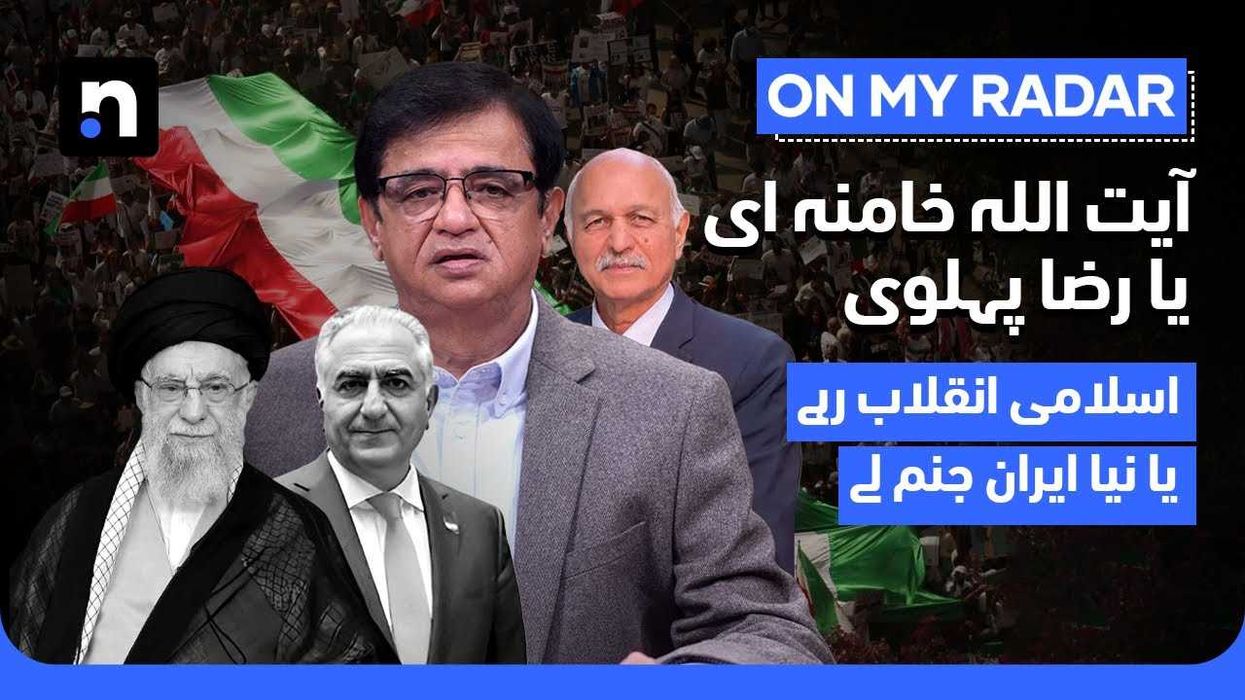
Iran, home to approximately 90 million people, is facing one of the most tumultuous periods in its modern history. Massive street protests, widespread economic despair, and heightened international attention have combined to create a volatile environment reminiscent of the unrest that led to the 1979 Islamic Revolution.
However, unlike that revolution, which brought Ayatollah Khomeini to power, today’s unrest is centered on a combination of economic collapse, public anger, and the potential reemergence of Iran’s exiled crown prince, Reza Pahlavi, as a symbolic opposition figure.
In the latest episode of On My Radar, Kamran Khan highlighted the gravity of Iran’s crisis, noting that the country is at a crossroads where multiple forces—domestic unrest, foreign influence, and economic collapse—are intersecting in ways not seen since the 1979 revolution.
Khan emphasized that while a full-scale regime change remains unlikely, the combination of mass protests and external support has made the possibility far from negligible.
The protests erupted amid a severe economic downturn. The Iranian rial recently plummeted to 1.4 million per U.S. dollar, sparking strikes and widespread market closures in Tehran and other major cities. Unlike previous movements dominated by students or youth, these protests have drawn participation from merchants and business owners, signaling that the unrest has broadened across social and economic strata.
Government crackdowns - including a five-day internet blackout, suspension of international calls, and mass arrests - have only intensified public anger and raised fears of further escalation.
Violence has been widespread. Human Rights Activists in Iran (HRAI) reported that nearly 500 people have died and over 10,600 have been arrested in just the past two weeks.
While the Iranian government has not released official death tolls, Tasnim News Agency reported that by January 11, 114 security personnel - including police, members of the Islamic Revolutionary Guard Corps (IRGC), and other paramilitary forces - had been killed, with the highest number of fatalities (30) recorded in Isfahan province.
The protests also carry a political dimension. Reza Pahlavi, the 65-year-old son of the late Shah Mohammad Reza Pahlavi, has emerged as a symbolic figure for opposition forces. International Persian-language media, satellite channels, and social media have amplified his messages, further strengthening narratives critical of Supreme Leader Ayatollah Ali Khamenei. Analysts note that Pahlavi’s influence is far greater among the Iranian diaspora than inside the country, where organizational capacity for opposition remains limited.
Iran’s political environment is further complicated by external pressures. Former U.S. President Donald Trump has publicly noted that Iran “crossed a red line” following the mass killings of protesters and is reportedly considering military, cyber, and diplomatic measures.
According to The Wall Street Journal, potential actions could include covert cyber operations, additional economic sanctions, and support for anti-government online networks prior to any military intervention. U.S. and Israeli involvement adds a complex layer to the already volatile domestic situation.
Economic grievances are at the heart of the unrest. The collapse of the rial, rising inflation, and persistent economic uncertainty have left Iranians feeling powerless. Kamran Khan, in his discussion on OMR, pointed out that this economic frustration, rather than pure political ideology, has been the most significant driver of protests, turning them into a nationwide movement that transcends generational and occupational lines.
Israel has reportedly been running a coordinated digital campaign in Persian to amplify anti-Khamenei narratives, including the promotion of Reza Pahlavi. The campaign includes deepfake videos and fake social media accounts, continuing a strategy that began after Pahlavi’s visit to Israel in early 2023. Israeli Prime Minister Benjamin Netanyahu has expressed hope that the Iranian people will soon be free from oppression, envisioning a future where Israel and Iran could collaborate as regional partners.
Within Iran, the power dynamics remain heavily skewed in favor of the regime. Supreme Leader Khamenei derives authority not from popular support but from religious legitimacy and control over state institutions, including the IRGC, which wields influence over the military, the economy, oil trade, real estate, and construction.
There is no organized internal opposition capable of challenging this structure. Analysts note that Pahlavi’s current support is largely symbolic and reactionary, reflecting dissatisfaction with the existing regime rather than widespread advocacy for monarchy.
Looking ahead, three scenarios could shape Iran’s near-term future. First, the Khamenei government could survive temporarily, responding to protests with increased repression domestically and more aggressive posturing internationally.
Second, the regime could collapse, leaving the IRGC and Islamic military structures in control under a new supreme leader. Third, a breakthrough scenario could emerge in which violent protests, widespread strikes, and fractures within security forces lead to the formation of a national interim coalition, with Reza Pahlavi potentially serving as a temporary symbolic figure. In all scenarios, economic conditions, public support, and the IRGC’s actions will be decisive.
Bloomberg analysts have noted that the current unrest represents the most precarious moment for Iran since 1979. Should the protests result in the dismantling of the religious-political system, the consequences could reverberate across global politics and energy markets. Brent crude prices have already risen more than 5 percent, reaching $63 per barrel, reflecting fears of prolonged instability in one of the world’s key oil-producing regions.
For now, Iran remains in flux. Reza Pahlavi’s international stature and symbolic role contrast sharply with Khamenei’s entrenched domestic control, highlighting the complex interplay of internal dissent, economic despair, and geopolitical maneuvering.
Whether the unrest will lead to reform, regime continuity, or a historic breakthrough remains uncertain, but the stakes for Iran, the region, and global markets have never been higher.

Comments
See what people are discussing