

Pakistan accounts for 48% of region’s extreme poor: World Bank
Poverty increased after repeated economic and climate shocks, while higher fuel costs and regional disruption are putting further pressure on household incomes
Haris Zamir
Business Editor
Experience of almost 33 years where started the journey of financial journalism from Business Recorder in 1992. From 2006 onwards attached with Television Media worked at Sun Tv, Dawn Tv, Geo Tv and Dunya Tv. During the period also worked as a stringer for Bloomberg for seven years and Dow Jones for five years. Also wrote articles for several highly acclaimed periodicals like the Newsline, Pakistan Gulf Economist and Money Matters (The News publications)
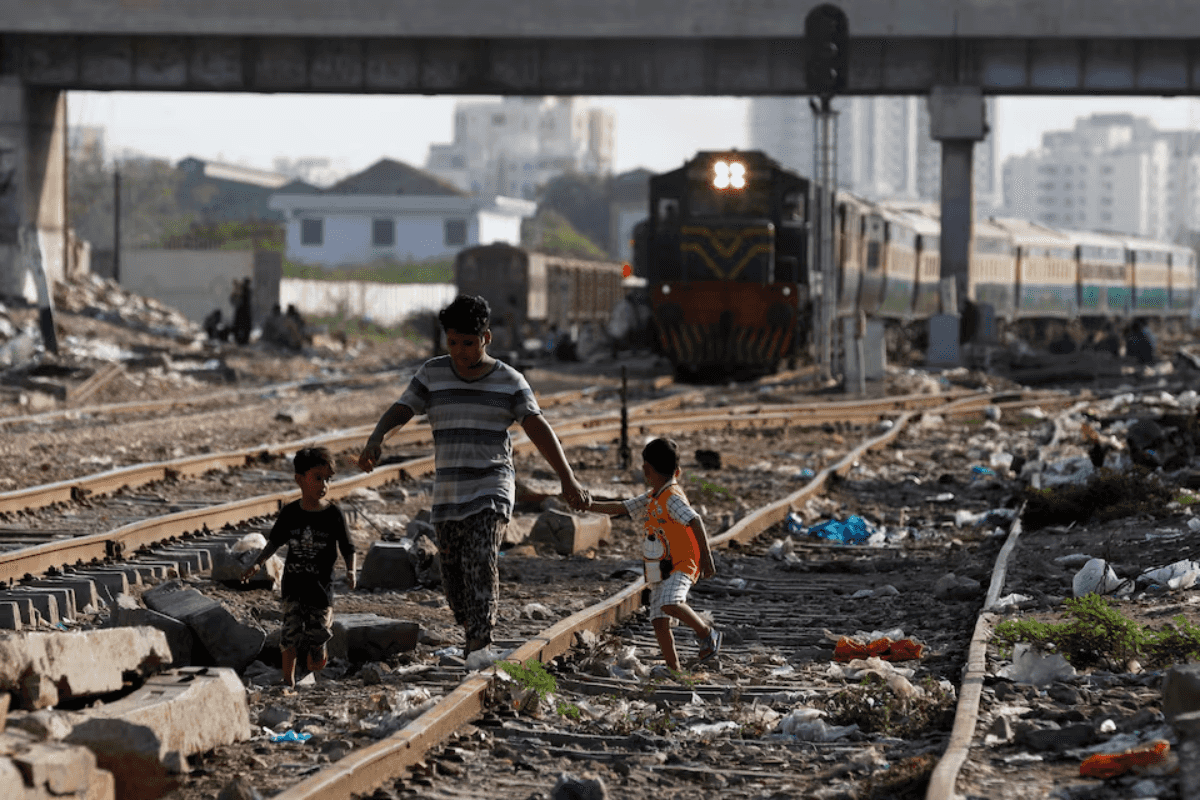
About 48% of MENAAP residents living below the international poverty line of USD 3 a day are in Pakistan.
Reuters
Pakistan accounts for nearly half of the people living in extreme poverty across the Middle East, North Africa, Afghanistan and Pakistan region, according to the World Bank, after years of economic and climate shocks pushed more people below international poverty thresholds.
About 48% of MENAAP residents living below the international poverty line of USD 3 a day, measured in 2021 purchasing-power-parity terms, are in Pakistan.
Afghanistan, Syria and Yemen together account for another 47% of people below the same threshold.
The World Bank said MENAAP is the only region where poverty remains above pre-pandemic levels and continues to increase.
In 2024, 14.3% of the region’s population lived below the USD 3-a-day line, compared with 10.4% globally. At the USD 4.20-a-day threshold, the regional poverty rate stood at 26.9%, against 18.9% worldwide.
The findings are contained in the World Bank’s October 2026 MENAAP Economic Update, From Divide to Opportunity: AI, Jobs, and Growth.
Why has poverty risen in Pakistan?
Pakistan’s poverty rate rose by 6.4 percentage points at the USD 3-a-day line and 3.2 percentage points at the USD 4.20-a-day line between 2018/19 and 2024/25, as the pandemic, the 2022 floods, high inflation, currency depreciation and prolonged economic adjustment weakened household incomes and employment opportunities.
Across MENAAP, substantial progress in reducing poverty during the 2000s and 2010s had already begun to stall around 2019 before reversing after the pandemic, the World Bank said.
Poverty has also become increasingly concentrated in fragile and conflict-affected economies, where displacement, weak labor markets and damage to household assets and basic services have made recovery more difficult.
Food insecurity remains another pressure. The World Bank said significant shares of the populations of Afghanistan, Djibouti, Lebanon and Pakistan face crisis-or-worse food security conditions, with the most severe conditions concentrated in Gaza and Yemen.
Governments across the region are trying to protect households from higher prices while also responding to humanitarian needs arising from conflict.
Pakistan has introduced targeted fuel and farm assistance to cushion vulnerable households and sectors from higher costs, according to the report.
Fuel costs and regional disruption add pressure
Higher energy prices are putting additional strain on household incomes.
Gasoline prices have increased by 40% or more in Lebanon, Pakistan, Syria and the United Arab Emirates since the start of the regional conflict, while diesel prices have risen by more than 40% in Pakistan and the West Bank and Gaza.
The World Bank said higher fuel costs have contributed to protests in some MENAAP economies, including Pakistan.
As an oil importer, Pakistan is also vulnerable to further increases in global oil and other commodity prices. Such shocks can increase inflation, reduce the government’s fiscal space and raise external financing costs.
Remittances present another potential transmission channel.
A prolonged slowdown in tourism, construction and related services in Gulf economies could weaken demand for migrant workers and reduce income flows to labor-sending economies, particularly Pakistan and parts of the Levant, the World Bank said.
Climate risks add another layer of vulnerability. A stronger-than-usual El Niño pattern is forecast for late 2026, potentially bringing heat stress, erratic rainfall, drought, localized flooding and crop losses.
Pakistan faces particular risks from changes in monsoon conditions, according to the report.
Pakistan growth seen at 3.7% in FY26
Despite the pressure on households, Pakistan’s economy continued to expand.
The World Bank estimates growth increased to 3.7% in fiscal 2026 from 3.2% in fiscal 2025, supported by resilience in services, manufacturing and livestock production.
Higher commodity and transport costs continued to put pressure on inflation and the external account, although continued domestic activity helped offset those effects.
The report also pointed to Pakistan’s gradual move into higher-technology manufacturing exports.
Tunisia and Morocco lead MENAAP, with high-technology products accounting for more than 7% and 5% of manufacturing exports, respectively, followed by Egypt and Pakistan.
The World Bank said the trend reflects gradual movement toward more knowledge-intensive production and participation in global technology value chains, including goods linked to digital technologies and artificial intelligence.
Financial markets have also recovered from the initial regional security shock.
Sovereign bond spreads widened across most MENAAP economies in March before narrowing again. By early September, Pakistan’s spreads were below their February 27 levels, placing it among the countries with the largest declines in the region.
Pakistan’s equity market also fell sharply in March before recovering to near its January level, according to the report.
MENAAP now accounts for around 14% of the world’s extreme poor, second only to Sub-Saharan Africa.
The World Bank also noted that transport, aviation, shipping, petrochemicals and much of industrial activity remain dependent on hydrocarbons, while natural gas remains important for power generation in Europe and several MENAAP economies.
That dependence leaves oil-importing economies such as Pakistan exposed to renewed energy and commodity-price shocks.



Comments
See what people are discussing