

Erratic rainfall and drought conditions slow Pakistan’s agriculture growth to 1.5%
Central bank report cites water shortages, rising temperatures, and policy uncertainty as key factors affecting farm output in FY25

Haris Zamir
Business Editor
Experience of almost 33 years where started the journey of financial journalism from Business Recorder in 1992. From 2006 onwards attached with Television Media worked at Sun Tv, Dawn Tv, Geo Tv and Dunya Tv. During the period also worked as a stringer for Bloomberg for seven years and Dow Jones for five years. Also wrote articles for several highly acclaimed periodicals like the Newsline, Pakistan Gulf Economist and Money Matters (The News publications)
Reuters/File
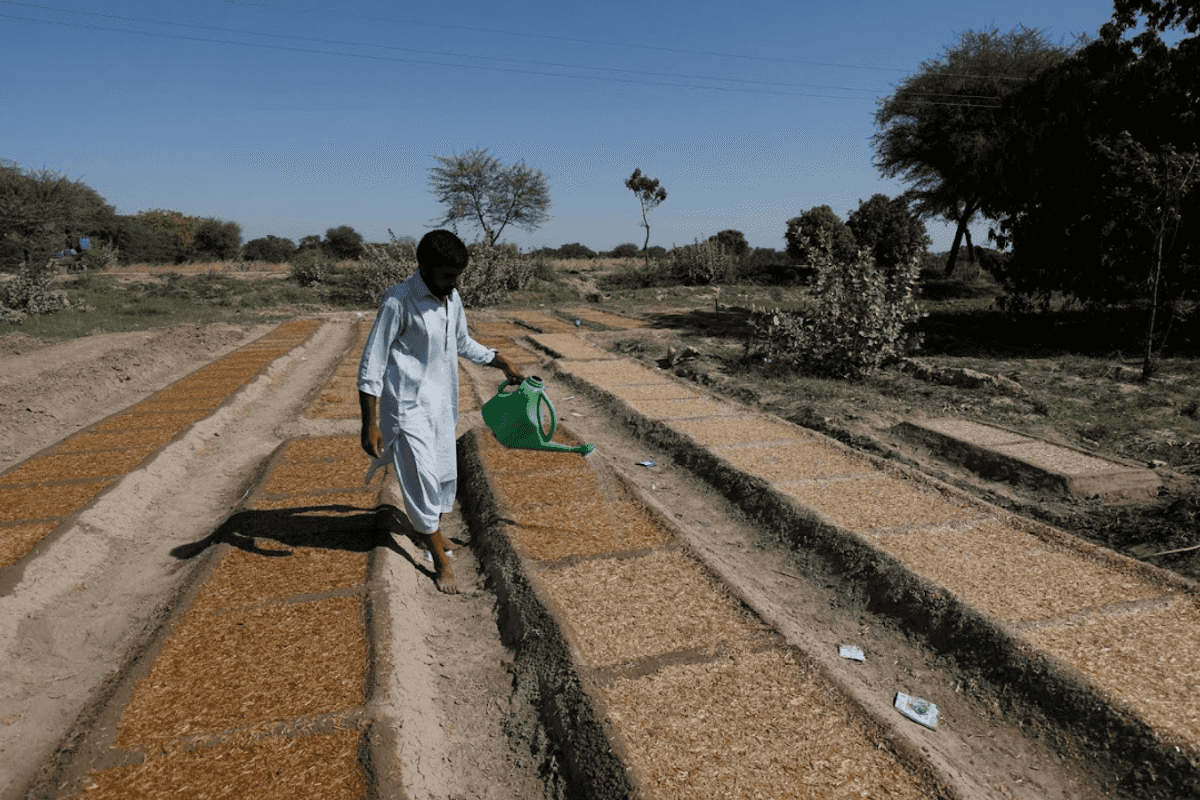
Pakistan’s agriculture sector grew by only 1.5% in fiscal year 2025, a sharp slowdown from 6.4% in the previous year, as erratic rainfall, water shortages, and policy uncertainty weighed on crop yields, according to the State Bank of Pakistan’s (SBP) Annual Report 2025.
The report said the deceleration stemmed largely from unfavorable weather conditions, lower input usage, and the government’s decision to phase out the minimum support price (MSP) system for key crops such as wheat, cotton, and sugarcane. The policy shift toward a market-based pricing approach created volatility and uncertainty, prompting many farmers to scale back cultivation of major crops.
As a result, the area under cultivation fell for all key crops except rice and sugarcane, while production of cotton and maize dropped sharply. Cotton ginning output also declined in line with reduced cotton availability.
At the same time, the SBP noted strong gains in “other crops”, which grew by 19.6%, up from just 0.1% a year earlier, driven by higher output of fruits, vegetables, oilseeds, green fodder, and tobacco. Many farmers shifted toward more profitable options such as sesame seed, rapeseed, mustard, and vegetables.
This growth, coupled with higher value addition in livestock, helped offset declines in major crops and cotton ginning. The forestry and fishing subsectors also posted gains during the year.
Water and weather conditions
The SBP said irrigation water withdrawals fell in FY25 compared to the previous year. During the Kharif season, the Indus River System Authority (IRSA) released supplies as planned, but provinces utilized less water between August and September 2024 due to heavy rainfall.
Rainfall patterns were erratic: record precipitation in April 2024—the highest since 1961—was followed by below-normal rainfall until July. August saw significantly above-average rainfall, while September again recorded below-normal levels.
The dry spell persisted through the Rabi season, except for slightly above-normal rainfall in November. Canal water shortages were estimated at 18%, exceeding the anticipated 16%, creating drought-like conditions in rain-fed regions and reducing yields.
Pakistan’s agriculture relies heavily on the Indus Basin Irrigation System (IBIS)—one of the world’s largest canal networks—which now faces mounting pressures from water scarcity, inefficient canal operations, climate change, and geopolitical risks, the report noted.
Temperature and climate risks
Average temperatures remained above normal for most of FY25. The year 2024 was the warmest on record globally, and 2025 is expected to follow closely.
The SBP warned that continued warming could further disrupt sowing cycles, lower productivity, and worsen soil moisture deficits, especially in already water-stressed regions.
The report stressed the need to develop climate-resilient crop varieties and improve irrigation efficiency to mitigate future risks.
Government support and mechanization
Despite these challenges, the government continued supporting farmers through targeted initiatives, including the Kissan Card, Livestock Card, Green Tractor Scheme, and the Wheat Subsidy Program.
The SBP also noted a 20% increase in agricultural machinery imports during FY25, indicating rising mechanization, supported by the Prime Minister’s Youth Business and Agricultural Loan Scheme.
While these measures helped sustain farm activity, the central bank cautioned that without improved water management, climate adaptation, and consistent price policy, agricultural growth could remain vulnerable to shocks in the years ahead.



Comments
See what people are discussing