

Pakistan equities close 0.4% higher in seesaw week
The week saw record dip and recovery in market due to security situation, IMF loan deal

Business Desk
The Business Desk tracks economic trends, market movements, and business developments, offering analysis of both local and global financial news.
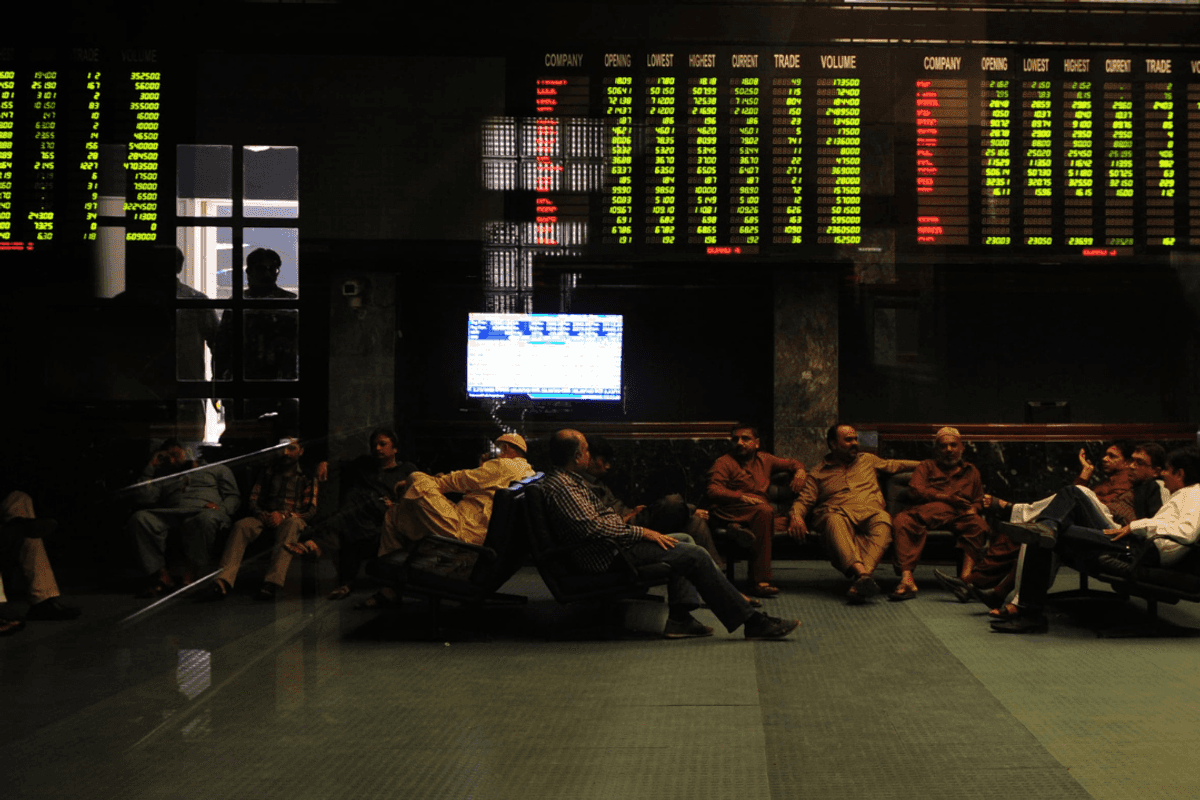
Average volumes of shared traded during the week stood at 1,826 million, up by 34.5%
Pakistan’s stock market witnessed a roller coaster ride during the outgoing week – moving both ways on account of profit taking and investments in key stocks.
The week started with the benchmark KSE-100 Index falling by almost 3% only to rebound by 4.44% the following day.
The rebound was supported by easing geopolitical and domestic political tensions, progress on the International Monetary Fund’s loan agreement, and buying investor interest with the onset of the results season.
The index closed the week at 163,806 points, up by 708 points 0.4%.
The sectors that contributed positively were banks, up 904 points; power, 204 points; and technology, 108 points.
Meanwhile, sectors which made dents in the overall trend were fertilizer, which fell by 296 points, E&P’s 222 points and investment banks 99 points.
Average volumes arrived at 1,826 million shares, up by 34.5% while the average value traded settled at $198 million, up 1.4%. One notable event during the outgoing week was the trading of 3 billion shares in a single session – the highest value ever.
An analyst from Arif Habib Ltd said that in the coming week, certain scrips are expected to remain in focus as the results season progresses. Moreover, the investors will also be keeping an eye on the meeting of the IMF Executive Board, which is likely to approve the agreement reached with Pakistan.
These developments will strengthen investor sentiment.
The KSE-100 Index is currently trading at a PER of 8.5x against its 15-year average of 8.59x, offering a compelling dividend yield of 5.5% versus the historical average of 6.11%.
"We foresee the momentum in the KSE-100 to continue given successful staff-level agreement of the IMF’s second review, minimal flood impact and improved credit ratings by global agencies amid falling fixed income yields", said an analyst of AKD Securities.
Investor sentiment is expected to further improve on the likelihood of foreign portfolio and direct investment flows, driven by improved relations with the US and KSA.
This outlook is supported by the lack of alternative investment avenues and the attractive valuation of local equities, he said.
An analyst from Spectrum Securities said the market will continue to be impacted by the tense border situation with Afghanistan. While the possibility of large-scale conflict is limited, this may lead to another wave of terrorism inside the country.
At the same time, border closure and blocking of trade routes will have negative economic consequences on domestic output. The curtailment of exports to Afghanistan may severely impact the domestic transportation business that relies heavily on the movement of transit trade between the two countries.
The analyst added that the market will be closely watching Q1/Q3 earnings being announced by companies. The investors' sentiment will fluctuate based on whether companies are maintaining their earnings/sales growth and margins in the backdrop of slow GDP growth and higher taxes/energy costs.
Positive changes on the fundamental side will drive the share price upward and lead to re-rating.
Last week, the index tested its 30-day moving average after a gap of more than 3 months. This low, near 157,000, is now major support level for the index. Any further break will expose the 153,000-155,000 range.





Comments
See what people are discussing