

Pakistan's electric vehicle push could reshape auto market, but challenges remain
Kamran Khan says the new auto policy can end nearly four decades of protectionism in Pakistan's automobile industry

News Desk
The News Desk provides timely and factual coverage of national and international events, with an emphasis on accuracy and clarity.
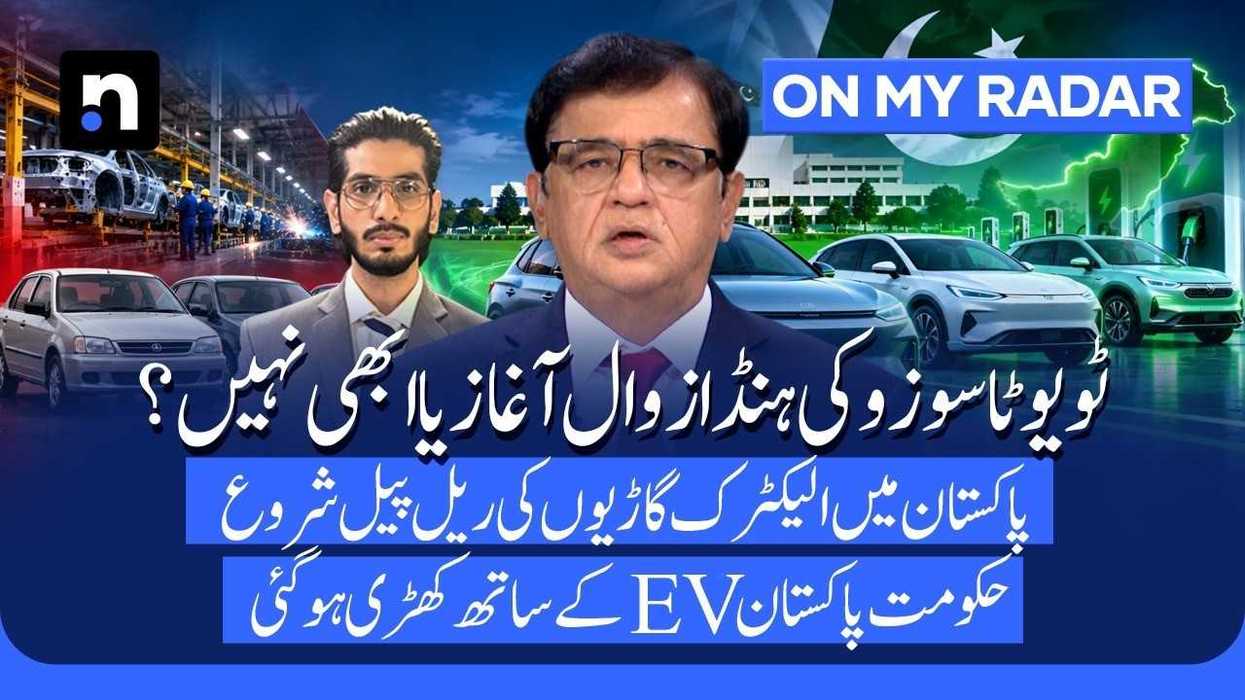
Pakistan's push towards electric vehicles could reshape an automobile market dominated for decades by a handful of established manufacturers, offering consumers lower running costs and more advanced features. However, the transition will depend on whether the government can make charging facilities accessible, keep vehicles affordable for the middle class and ensure that new investments translate into genuine local manufacturing.
Kamran Khan said in the latest episode of On My Radar that the government's new auto policy could mark a turning point for Pakistan's automotive industry by opening up a market that has remained heavily protected from foreign competition for nearly four decades.
Suzuki, Toyota and Honda have long dominated the market, with their local operations relying largely on assembling imported components rather than manufacturing vehicles from the ground up. High import duties on fully built vehicles helped shield these companies from competition, leaving consumers with limited choices, relatively basic features and high prices. The Suzuki Alto, for instance, costs around Rs3.2 million, with buyers also facing additional premiums commonly known as 'own money'.
The new policy seeks to change that landscape through a revised tax structure. Battery electric vehicles will attract a sales tax of just 1%, while range-extender vehicles will face a 6% rate and plug-in hybrids 9%. Conventional petrol and hybrid vehicles, meanwhile, will be subject to sales tax ranging from 18% to 25%, alongside an Automotive Development Levy based on engine capacity. An additional Federal Excise Duty (FED) of 4.5% to 20% will also apply.
The revised incentives could make electric vehicles available in Pakistan for less than Rs3.5 million, potentially bringing them within reach of a wider segment of consumers.
The biggest attraction, however, is the potential reduction in monthly running costs. While purchasing a vehicle involves a one-time expense, fuel costs continue to weigh on household budgets. With petrol selling at around Rs325 per litre and uncertainty over international oil prices amid conflict in the Middle East, motorists have little reason to expect substantial relief.
A car travelling 1,500 kilometers a month at an average fuel efficiency of 14 kilometers per liter would consume around 107 liters of petrol, costing approximately Rs35,000 at current prices. Covering the same distance in an electric vehicle would cost about Rs9,000 in electricity, translating into monthly savings of roughly Rs26,000.
That amounts to more than Rs300,000 annually and approximately Rs1.6 million over five years. Electric vehicles also eliminate routine engine oil changes and reduce the need for conventional engine maintenance. Households with rooftop solar installations could further reduce charging costs by using electricity generated during daylight hours.
Electric vehicles are also bringing features that have traditionally been restricted to expensive variants of conventional cars. Large infotainment screens, cameras, advanced safety systems and other technology are increasingly available in newer models. For consumers concerned about long-distance travel, plug-in hybrids offer another option, combining electric power for city driving with petrol engines for longer journeys.
BYD's Sealion 6, a plug-in hybrid, is expected to be the first locally produced vehicle at the Chinese company's manufacturing facility in Pakistan. BYD has also overtaken US-based Tesla to become the world's largest electric vehicle manufacturer by annual sales and production.
For consumers facing high petrol prices, electric vehicles could therefore offer a compelling alternative. But their adoption raises a practical question, particularly in cities such as Karachi: how will people living in apartment buildings charge their cars?
A substantial proportion of Karachi's population lives in flats and apartment complexes, where vehicles are parked in shared spaces or on streets while electricity meters are located inside individual apartments, sometimes several floors above ground. The absence of charging points, difficulties in securing building management approval and the lack of convenient arrangements for separate electricity connections could make home charging difficult. Similar apartment-living patterns are also expanding in Lahore and Islamabad.
The government aims to establish 3,000 charging facilities across Pakistan by 2030. Hubco Green has already activated 27 charging stations nationwide and plans to install another 40 to 50. However, a much wider network will be needed to support mass adoption.
Builders should be required to incorporate charging points into parking facilities in new developments, while existing apartment buildings need simpler arrangements for dedicated electricity connections. Petrol stations should also be equipped with charging facilities. Without such measures, electric vehicles risk becoming an option largely available to people living in houses with private parking.
Affordability presents another major obstacle. Whether electric or petrol-powered, new vehicles remain beyond the financial reach of much of Pakistan's middle class.
Although the State Bank has reduced its policy rate to 12%, bank financing for vehicle purchases remains expensive. The new policy proposes increasing the financing limit for electric vehicles from Rs3 million to Rs10 million and extending the repayment period from three to five years. However, it remains unclear whether these measures will make electric vehicles genuinely accessible to middle-income households.
Most middle-class Pakistanis continue to rely on the used-car market, a trend likely to persist in the coming years. The government must therefore ensure that incentives for electric vehicles do not push up prices in the second-hand petrol-car market. Levies imposed on new vehicles should not be passed on to used-car buyers.
Imports of used vehicles should also be brought under a transparent commercial framework rather than being channeled through loopholes in the gift scheme. Such a system could help keep prices competitive while ensuring that the government receives its due tax revenue.
The demand is already evident in import figures. Pakistan imported just 48 used vehicles in May, but the number rose to more than 2,200 in September, indicating substantial consumer demand that could be accommodated through a regulated and transparent import system.
The broader economic case for electric vehicles is equally significant. Local automobile assemblers spent more than $2.12 billion importing vehicle kits during the previous fiscal year, marking a record high. In September alone, Pakistan imported around 5,000 fully built vehicles, including more than 1,500 BYD Atto 3 units.
At the same time, the country's current account deficit exceeded $870 million during the first quarter of the current fiscal year, while its oil and gas import bill stood at $16.86 billion in the previous fiscal year. A prolonged conflict involving Iran could push that bill towards $20 billion.
This is where electric vehicles could deliver substantial benefits to Pakistan's economy. Achieving the government's target of having electric vehicles account for 30% of the country's vehicle fleet by 2030 could generate annual savings of around $1 billion in fuel imports.
However, the transition also presents a foreign exchange challenge. Pakistan is spending dollars today to import vehicles and their components, while the benefits of reduced oil consumption will accrue gradually over the coming years.
The emergence of local manufacturing facilities offers a potential way forward. BYD's $150 million plant in Gharo is expected to begin operations in December, with an initial annual production capacity of 25,000 vehicles. Chery and Master Motors have also established a $150 million facility at Port Qasim, while Changan, MG and Haval are among other companies expanding their local assembly and production operations.
However, the extent of local investment and manufacturing remains an important consideration. The plants have so far been financed by Pakistani business groups and banks rather than through equity investments by the foreign manufacturers themselves. Their initial operations will also rely heavily on imported components.
To ensure that these projects help conserve foreign exchange reserves, tax incentives must be linked to measurable commitments to localize production. Companies benefiting from preferential tax rates should be required to manufacture batteries and other vehicle components in Pakistan within clearly defined timelines, rather than relying indefinitely on imported kits for assembly.
The government should also maintain an appropriate difference between duties on imported vehicle kits and fully built cars. This would encourage manufacturers to expand domestic production instead of relying primarily on importing finished vehicles for local sales.
In the initial stages, electrification efforts should focus more heavily on motorcycles, rickshaws and buses, which serve as the primary modes of transport for millions of Pakistanis. Reducing fuel consumption in these segments could deliver more immediate and widespread benefits to ordinary households.
Export commitments must also be enforced. The new auto policy sets a target of generating more than $6 billion in exports over five years. The government must ensure that this ambition translates into actual production and overseas sales rather than remaining another commitment on paper.
Electric vehicles could become an important part of Pakistan's economic and transport future, offering lower running costs, modern features and reduced dependence on imported fuel. Their arrival could also introduce meaningful competition into an automobile market that has remained dominated by a few established players for decades.
But the success of this transition will depend on addressing three fundamental challenges: making charging facilities accessible to apartment residents, keeping used vehicles affordable for the middle class and ensuring that foreign investment leads to genuine manufacturing and technology transfer in Pakistan.




Comments
See what people are discussing