

Wilmar-Unity dispute exposes alleged Rs54 billion accounting irregularities
Kamran Khan examines fraud allegations, regulatory failures and a business dispute now before courts

News Desk
The News Desk provides timely and factual coverage of national and international events, with an emphasis on accuracy and clarity.
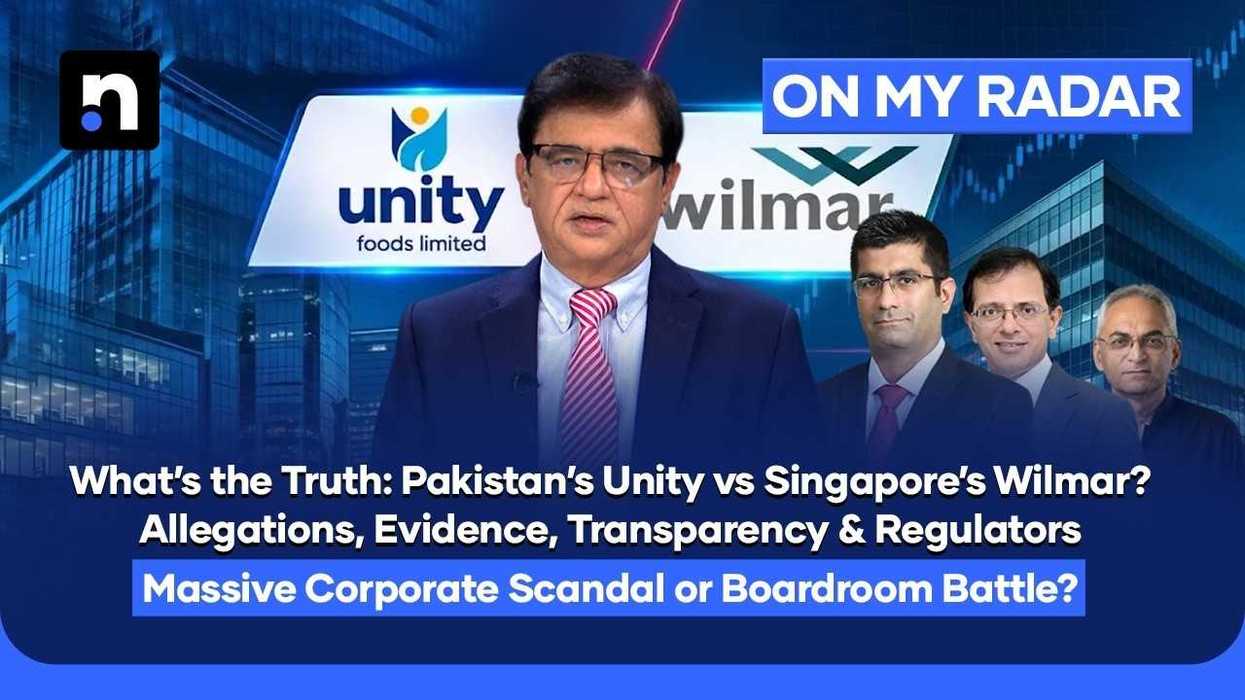
A major corporate dispute between Singapore-based agribusiness giant Wilmar and Pakistan's Unity Foods has escalated into a criminal investigation over alleged accounting irregularities and financial losses of up to 54 billion rupees ($193 million), raising questions about corporate oversight, regulatory enforcement and the protection of shareholders.
In the latest episode of his show "On My Radar," Kamran Khan examined allegations made by Wilmar, the response presented by Unity's former management in court and the regulatory history of the company.
The Federal Investigation Agency's (FIA) Corporate Crime Circle in Karachi registered a case on Aug. 29, 2026, following a reference from the Securities and Exchange Commission of Pakistan (SECP) and complaints by Wilmar. The company's nominated director had submitted nine separate complaints to the regulator between Feb. 15 and March 4.
The case includes charges under sections 406, 420 and 477-A of Pakistan's Penal Code, relating to criminal breach of trust, cheating and falsification of accounts.
The allegations include a 44.7-billion-rupee discrepancy between Unity's published financial statements and its internal SAP records. Wilmar also alleges that 5.3 billion rupees was transferred as loans to the chief executive's mother without supporting bank records or board approval.
Other allegations include the unexplained use of 2.87 billion rupees from 3.75 billion rupees raised through a 2019 rights issue, advance payments of 2.6 billion rupees to two unidentified parties through Sunrise Foods, and a 5.2-billion-rupee difference between recorded and actual inventory.
Wilmar has also alleged irregularities involving nearly 5 billion rupees in old receivables for which there was no evidence of goods being delivered. Another allegation concerns 12.45 billion rupees in Unity bank deposits pledged against loans taken by former subsidiary companies.
However, these remain allegations, and no court has ruled on their validity. The 44.7-billion-rupee figure represents an accounting discrepancy, not established theft. Several of the amounts cited in the complaints may also overlap, making it inaccurate to add them together and describe the total as a proven 54-billion-rupee fraud.
How the partnership broke down
Wilmar began investing in Unity in 2020 and purchased another 277 million shares for 6.89 billion rupees in March 2024. It now holds approximately 42% of the company's shares, while the Amin family owns 24% and public investors hold about 34%.
According to the SECP, Wilmar has invested approximately $250 million in the company.
On Dec. 21, 2025, Wilmar and Farukh Amin signed an agreement under which Wilmar took over Unity's management control. Amir Shehzad, who had previously served as a director of Unity and Sunrise Foods, became CEO but resigned on Feb. 13, 2026.
According to Wilmar's lawyer, the dispute emerged on Feb. 12 when the chief financial officer allegedly refused to sign the company's financial statements. The lawyer also pointed to unexplained discrepancies involving approximately 3 billion rupees in receivables.
Wilmar subsequently reported a loss of $150 million in its financial statements. Its position is that Unity's audited accounts showed profits and cash in bank accounts, but the company was later found unable to meet its payments to banks.
However, questions have also been raised about Wilmar's own oversight. Its nominated director was on Unity's board, raising questions about whether the company had access to financial records and why the alleged irregularities were not identified earlier.
Wilmar had also assumed management control in December 2025. The responsibilities of the new management during this period are now another important aspect of the dispute. Amir Shehzad is among those named as accused in the case.
Questions over regulatory oversight
The dispute also highlights years of legal proceedings between Unity Foods and the SECP.
The regulator had issued notices to the company since 2018, while Unity repeatedly challenged regulatory actions in the high courts. During this period, the company continued raising money from shareholders and borrowing from banks.
The controversy raises questions about whether the SECP used all its available legal powers and why any regulatory shortcomings remained unresolved over the eight-year period.
Unity's board subsequently collapsed, leaving only two directors despite a legal requirement for at least seven. On Sept. 3, the SECP directed the company to fill the vacant positions.
On Oct. 30, the Sindh High Court, with the parties' consent, ordered that Wilmar should have a majority on the board, with Amin agreeing to cast his vote to facilitate the arrangement.
Unity's position and competing interpretations
Amin, Unity's former CEO, and his associates have rejected the fraud allegations. Their lawyer argued in court that the matter involved a commercial disagreement between two shareholders rather than criminal activity.
However, Unity's complete position has not yet been presented publicly. Amin has not issued a detailed public statement, and the former management has not held a news conference. The company's arguments have so far largely emerged through its lawyers in court proceedings.
Unity was among Pakistan's major agricultural commodities and cooking oil companies. It generated approximately 450 billion rupees in combined revenue over the past five years and employed around 4,000 people.
The program also examined Wilmar's previous disputes with other major commodity companies. Khan said the findings showed that the Singapore-based multinational had faced other contentious business situations. However, those cases neither establish nor disprove the allegations against Unity.
Experts remain divided over whether the case is primarily a shareholder dispute or involves criminal wrongdoing.
One view is that the matter is essentially a commercial disagreement. Supporters of this position point to four company petitions already pending in court and say Amin has offered to buy or sell shares in the company.
They also question the decision to register a criminal case, pursue arrests and seek the inclusion of names on the Exit Control List (ECL) without first hearing Unity's complete position.
The opposing view is that the allegations go beyond a shareholder dispute and warrant criminal investigation.
Supporters of this position point out that money raised through the 2019 rights issue came from ordinary investors, who still hold approximately 34% of Unity's shares. They also say the alleged accounting irregularities were identified not only through Wilmar's complaints but also during the SECP's investigation.
Banks, including BankIslami, are also among the creditors potentially affected by the alleged irregularities.
What does the law say?
Under Pakistani law, authorities are not required to hear an accused person's position before registering a first information report (FIR). The accused gets an opportunity to defend themselves during the investigation, bail proceedings and trial.
However, Unity's prolonged legal battles with the SECP over regulatory notices remain an important part of the controversy.
Tax expert Asad Ali Shah and Topline Securities CEO Muhammad Sohail also participated in the program's discussion, alongside Unity Foods non-executive director Farukh Amin.
The available record suggests that the dispute has two overlapping dimensions: a commercial conflict between major business partners and a criminal investigation into alleged financial irregularities.
Ultimately, the allegations will have to be tested against documentary evidence and established through legal proceedings, rather than accepted on the basis of either Wilmar's international reputation or Unity's denial.



Comments
See what people are discussing