

Why gold plunged and what comes next?
Investors must not panic and should wait.

Moiz Ur-Rehman
A multidisciplinary economist, legal thinker, and broadcast journalist with over five years of experience at the intersection of finance, policy, and media. I have academic grounding; in law, economics, and hospitality management, to accessible, high-impact storytelling for business audiences across Pakistan and beyond.
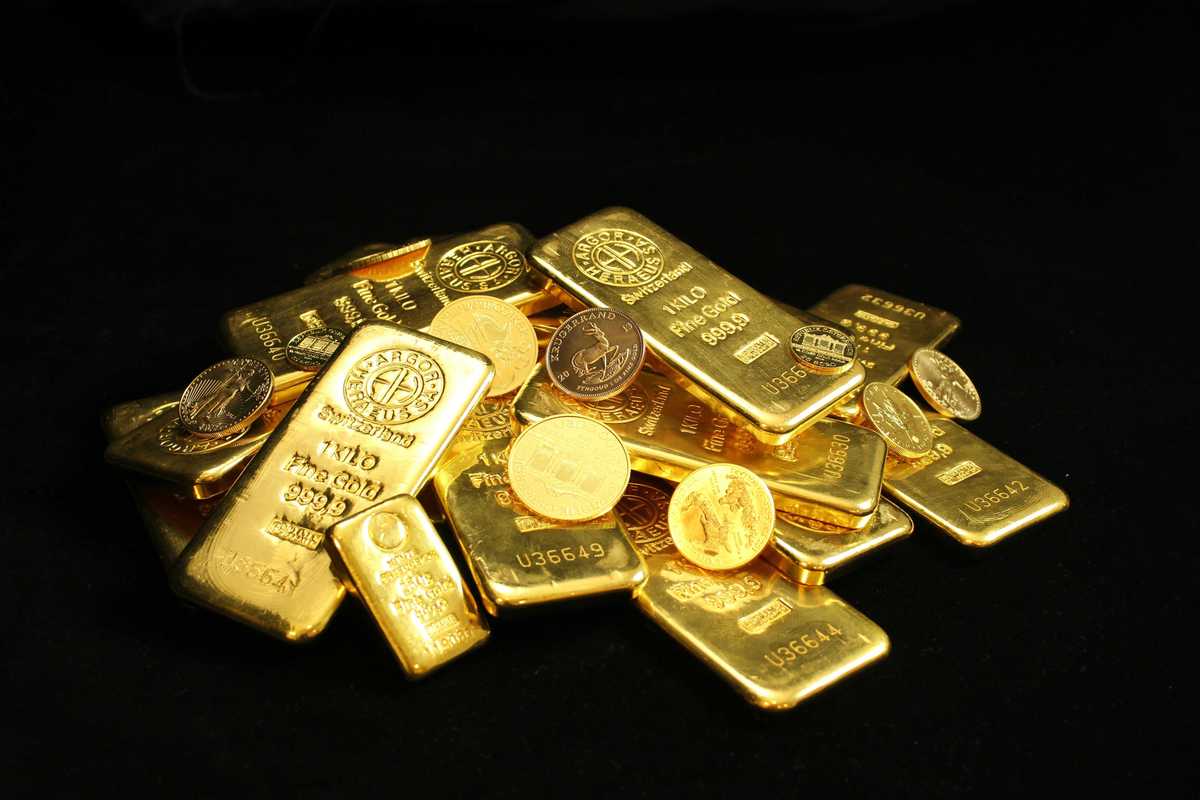
Gold and silver round coins.
Gold did not fail as a store of value
Until yields and the dollar ease, gold will likely stay hostage
Investors should hold on to gold positions for long
In January’26, gold touched a record near USD 5,600 an ounce and there were towering claims projecting it to touch up to even USD 8,000. This week it is trading around USD 4,100 per ounce, roughly 27 percent lower, and a Reuters poll of analysts says it is on course for its steepest annual fall in 11 years. That is odd on its face. Since US and Israeli strikes on Iran began on 28 February’26, the world has seen a war, a disrupted Strait of Hormuz and oil above USD 100, which has reversed a bit in the last36 hours. Gold is supposed to thrive on exactly that. Instead, it has behaved like a casualty. In this piece we explain why this happened, and what could possibly come next?
Why a war made gold fall
Gold did rise at first: spot gold traded at about USD 5,378 on 2 March’26, the first session after the war began. But the fear that lifted it soon turned into something less friendly to bullion, which is inflation. Threats to Gulf energy supplies sent crude sharply higher, with Brent touching nearly USD 117 in late October, and costlier oil seeps into prices everywhere. That forced markets to rethink interest rates. Instead of cutting, the Federal Reserve raised rates in September, held at 3.75–4.00 percent on 28October’26, and markets still price another hike for December’26. The threat of higher inflation bringing tighter monetary conditions is what led the gold to fall at a very rapid pace, and this chain explains most of the damage, through three channels.
The inverse relationship: yields, the dollar and gold
If we talk about bond yields, gold pays no interest; a government bond does. When yields rise, the income you give up by holding gold rises too. What matters most is the real yield, the return after inflation. Picture a choice between a gold bar in a locker and a safe Treasury paying 5 percent: as the bond’s payout climbs, fewer people want the bar. The 30-year US yield peaked near 5.7 percent in early October, close to a 24-year high.
When it comes to the “mighty” dollar; gold is priced in dollars everywhere, so a stronger dollar makes it dearer for anyone holding euros, yuan or rupees, and demand cools. The war has also reinforced the dollar’s role as the crisis currency: oil, shipping and insurance are all priced in it, so frightened investors and governments scramble for dollars first, selling other assets, gold included, to get them. Jim Wyckoff of American Gold Exchange commented that high yields and a strong dollar made a “perfect storm” for metals.
Then comes another major factor; uncertainty, crowding and forced selling. Fear alone does not lift gold; it depends where the fear flows. This time it flowed into the dollar and Treasuries. Gold had also become a crowded trade after its record run, so
profit-taking, ETF outflows and margin calls magnified the fall. Reuters linked last Friday’s slide to sales of tech and AI stocks and a fresh need for cash.
The rule of thumb here is that when yields go up, gold goes down; when dollar is up, gold is down; however, when both ease, gold usually recovers.
The buyers who didn’t blink, and the seller who did
Let’s talk about the star buyer first, China. The People’s Bank of China has added gold for 23 straight months, including 23 tonnes in September’26, its biggest monthly buy since October 2023, per the World Gold Council. Its China research head, Ray Jia, calls the PBoC “one of the most active gold-purchasing central banks globally.” The aim is diversification: less reserve wealth in dollar assets that can be sanctioned or frozen, with gold still only about 8 percent of Chinese reserves.
Now let’s reverse the scene. One of the world’s most active buyers, Turkey turned a major seller when the war sent energy prices soaring and pressured the Turkish lira. The World Gold Council named it the largest official seller of the first quarter, with reported holdings down 79 tonnes and roughly 80 more monetised through swaps, cash used to defend the lira and meet dollar demand. This was an emergency, not a verdict on gold: Turkey did the same in 2023, then rebuilt, and began rebuilding again once markets calmed in the spring. Central banks overall sold 30 tonnes in March’26 but bought 289 in the second quarter, up 62 percent on the year.
If we talk about the eurozone, the euro area is less a buyer than a custodian. Germany (3,350 tonnes) and Italy (2,452) hold the world’s second- and third-largest stockpiles, and neither has meaningfully changed its holdings. Gold’s rise has made it politically charged: a proposed Italian budget amendment declaring the Bank of Italy’s gold the property of “the Italian people” drew two objections from the ECB over central bank independence before Rome and Frankfurt reached an understanding.
Let’s now rekindle our focus to the developing world and look at India. For importers, gold drains dollars. On 10 May’26, Indian Prime Minister Narendra Modi asked Indians “not to buy gold for weddings for one year,” alongside calls to use less fuel and skip foreign holidays, since oil and gold are both paid for in dollars and the rupee was under strain. Arihant Capital’s Arpit Jain noted such appeals have historically had “limited long-term impact.” Goldman Sach’s Tony Kim adds that countries like India, defending their currencies to secure energy, are not prioritising gold.
Is the dollar’s reserve status under threat?
Well definitely not dethroned, but surely diluted. The ECB’s report found gold made up about 27 percent of global official reserves at the end of 2025, against 22 percent for US Treasuries, though it stressed that rising prices did much of the work; at 2023 prices,
Treasuries would likely still lead. Dollar assets overall remain around 42 percent of reserves. The reasons to diversify are plain. Freezing Russia’s reserves in 2022 showed that money held in another country’s system can be switched off, while gold held at home carries no counterparty risk. Add America’s large deficits and heavy Treasury issuance, and reserve managers want something that isn’t anyone’s liability. A 2026World Gold Council survey found 74 percent of central banks expect the dollar’s share of reserves to fall over five years, and the Official Monetary and Financial Institutions Forum(OMFIF) reported that, for the first time, more banks plan to cut dollar exposure than raise it. Yet the Iran war also showed the dollar’s grip: when stress hits, everyone needs dollars to pay for oil and service debt. Central banks can buy gold and still need dollars.
Where hedge funds are placing their bets on gold and bonds
On gold, speculators are heading for the exits. CFTC (U.S. Commodity Futures Trading Commission) data show speculative net long positions in COMEX (Commodity Exchange, Inc.) gold fell to about 186,000 contracts in the week to 27 October’26, and Saxo, a Danish investment bank says that hedge funds have sold gold futures nine weeks running. Longer-horizon holders look steadier: the World Gold Council reported only a modest fall in professional asset managers’ positions since mid-October, while pointing to a rotation into bonds.
On bonds, the story flipped within weeks. In early October, traders were extending short bets on Treasuries as long yields neared a 24-year high. Then, on 22nd October'26, treasuries had their best day in over a year as shorts were covered, and call premiums rose above puts for the first time in seven months which was a sign that traders were positioning for further gains. Hedge funds’ share of the Treasury market has more than doubled to about 9 percent, and the IMF warns it is “susceptible to a disorderly unwind.” In China, funds are loading up on 30-year government bonds as stocks slump.
What the outlook depends on
Five variables will decide gold’s next leg.
1. Oil and the war.
The oil-to-yields chain is gold’s biggest drag. Reports of talks between Iranian negotiators and Qatari mediators helped gold rebound 2.3 percent on 3 November, but conditions are unresolved. A de-escalation that cools oil would ease it as seen in the scenario after an emphatic Democrats win in the US-mid terms after which the markets have been pricing in a scenario with little threat of a full-blown war between Iran and the US and we saw gold climb instantly by 3% on Wednesday and it is further upto USD 4,121 per Ounce as we type this.
2. The Fed.
JPMorgan Private Bank expects further hikes in December and early 2027, and its Yuxuan Tang argues gold finds a stable floor only once rates peak. The 6 November US jobs report is the next test.
3. Fiscal worries.
Julius Baer’s Carsten Menke says persistent US deficits and debt remain supportive over the long run, and that the 3 November midterm elections are unlikely to change that.
4. Central banks.
Goldman Sachs expects official buying of about 50 tonnes a month this year, against 17 before 2022, and its metals-trading head Tony Kimsees an “elongated pause” before new records. But energy importers may keep sitting out while oil stays high.
5. Liquidity shocks.
A wobble in AI stocks can force funds to sell gold for cash, as last Friday showed.
Forecasters have been trimming. A Reuters poll of 30 analysts puts the 2026 average at USD 4,495 and 2027 near USD 4,650, and Standard Chartered expects consolidation before a recovery as de-dollarisation and currency debasement return to focus. Goldman’s USD 4,900 year-end target now looks a long way off, while UBS still sees USD 5,000 in 2027, betting that central-bank demand will outweigh the rate drag. The key advice however as per experts is to hold on to gold it’s part of your portfolio. While talking to Nukta; Shan Saeed who’s a Malaysia based Economist at IQI Global advised holding on to gold positions for long on the premise of USD eventually losing out to gold because the latter is a limited stock while currencies can always be printed and also due to China’s actions to launch the Yuan as a global trading currency. He also pointed out to copper being another investable commodity due to higher demand on the back of the rapid development of data centers and the sprawl of electrical vehicles as their batteries require copper.
The bottom line
Gold did not fail as a store of value; it was caught by a war whose main economic effects were costlier oil, higher yields and a stronger dollar. Central banks with room to spare keep buying; those under currency pressure sell. Until yields and the dollar ease, gold will likely stay hostage to the bond market, though the longer-term case, built on debt, sanctions and diversification, remains intact.





Comments
See what people are discussing