

PCB's new central contracts explained: Salaries, categories and match fees
The PCB has overhauled its central contracts with five format-based tracks, new salaries and revised NOC rules

Sports Desk
The Sports Desk is the editorial team responsible for covering the latest news, updates, and analysis from the world of sports. Our team of experienced writers and journalists bring you in-depth coverage of local and international sports events, player profiles, and expert opinions.
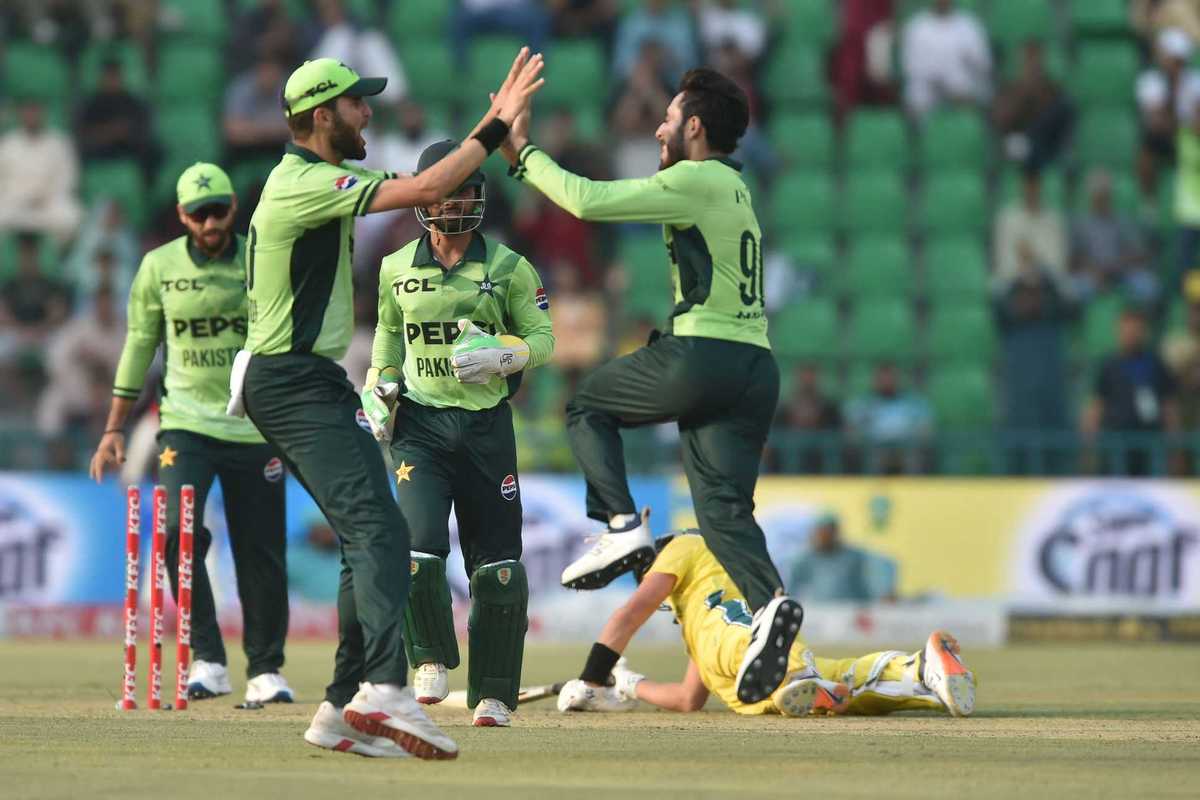
Arafat Minhas (right) and team captain Shaheen Afridi celebrate the wicket of Australia's Marnus Labuschagne during the third and final ODI match between Pakistan and Australia at Gaddafi Stadium in Lahore, Pakistan, on June 4, 2026.
AFP
The Pakistan Cricket Board (PCB) has overhauled its central contracts system, introducing a format-based structure that takes effect on July 1, 2026 and runs until June 30, 2027. Players will be placed into five tracks according to their format specialisation, with salaries and overseas league opportunities varying across each group.
What is the new PCB central contracts structure?
The PCB's new central contracts system places players into five tracks: AB, A, BC, C and D. Track AB covers players who feature in both Tests and ODIs, Track A is for Test specialists, Track BC covers white-ball players across ODIs and T20Is, Track C is for T20 specialists, and Track D is a pathway for emerging cricketers.
How much will players earn under the new contract tracks?
The first four tracks are each divided into two tiers, which determine monthly retainers. Domestic participation requirements, international availability and No Objection Certificate (NOC) criteria remain identical within each track regardless of tier.
According to ESPNCricinfo, players in the top tier of Track AB will receive PKR 4.8 million per month, with the second tier earning PKR 3.8 million. Track A Test specialists will be paid PKR 4 million and PKR 3.6 million respectively. Track BC players will earn PKR 3.4 million and PKR 2.6 million, while Track C T20 specialists will receive PKR 2.6 million and PKR 2 million. Emerging players in Track D will be paid PKR 1 million per month.
Match fees are also linked to a player's track. Tracks AB and A both attract PKR 1.5 million per Test, though Track AB players earn more in limited-overs cricket: PKR 750,000 per ODI and PKR 500,000 per T20I. Track BC players receive the same limited-overs fees, with a Test match fee of PKR 900,000 if selected. Track C players earn PKR 500,000 for both ODIs and T20Is, and PKR 700,000 for Tests.
How does the new structure compare with the previous model?
The new system replaces the slab-based contract structure that remains in place until the end of June. A direct comparison is difficult because players are now grouped by format specialisation rather than broad performance categories.
Under the previous structure, monthly retainers for categories B, C and D stood at approximately PKR 4.5 million, PKR 2 million and PKR 1.3 million. The PCB did not award any player the top category A contract during the current cycle. The new Track AB top-tier retainer of PKR 4.8 million is around PKR 1.8 million lower than the former category A figure.
Match fees were previously uniform across all categories, at PKR 1.25 million for Tests, PKR 650,000 for ODIs and PKR 420,000 for T20Is. Under the revamped structure, fees vary by track, with Test fees rising to as much as PKR 1.5 million and T20I fees reaching PKR 500,000 for players in selected categories.
What are the overseas league rules under the new PCB contracts?
The PCB has relaxed restrictions for T20 specialists by removing the cap on the number of overseas leagues Track C players can participate in, allowing them to supplement their earnings through franchise cricket. Track BC players may participate in two overseas leagues in addition to the PSL.
Track AB players will be permitted to feature in one overseas T20 league per contract cycle. Test specialists in Track A will not be allowed to play overseas white-ball leagues apart from the PSL, though they can compete in red-ball competitions in leading cricket nations. All centrally contracted players must remain fully available for the PSL and pass mandatory fitness checks before receiving NOCs.
Who is eligible for a PCB central contract?
Only male players who have featured in at least four Tests, six ODIs or six T20Is in the previous 12 months are eligible for senior category contracts. Track D has no such requirement, as it serves as a development pathway.
Eligible players must pass a three-stage evaluation covering medical and fitness assessments, minimum domestic participation and a performance benchmark. Track AB players must appear in at least four first-class and four List A matches, while Track A cricketers must play a minimum of six first-class games in a 12-month period. Similar participation thresholds apply for white-ball and T20 specialists.
Fitness screening will take place every four months. Annual contract reviews will weight performance heavily, with 85 percent of a player's evaluation determined by performances in international and domestic cricket and adherence to fitness standards, and selectors' assessments making up the remaining 15 percent.
What bonuses are on offer for ICC tournament success?
The new structure includes performance-based incentives, with victories over higher-ranked opponents attracting greater rewards. Players will receive a bonus worth 500 percent of their match fee for winning an ICC event.
Pakistan have not won a global title since the 2017 Champions Trophy. The PCB has indicated that the new structure is intended to reward sustained excellence and encourage players to prioritise international commitments over franchise cricket.





Comments
See what people are discussing