

Pakistan's military says good governance central to security, calls for political debate on reforms
DG ISPR says good governance is central to security, backing political reforms while defending its Balochistan operations

News Desk
The News Desk provides timely and factual coverage of national and international events, with an emphasis on accuracy and clarity.
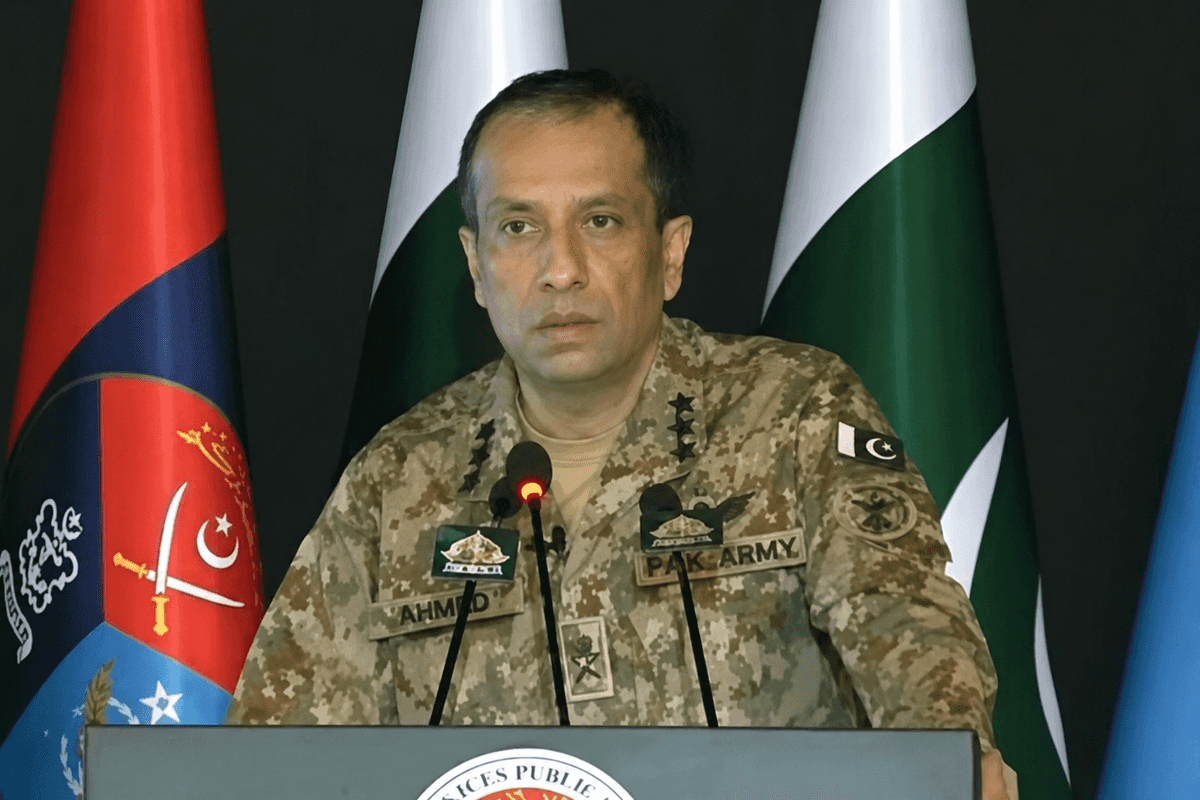
Inter-Services Public Relations (ISPR) Director General Lieutenant General Ahmed Sharif Chaudhry addresses a press conference on Friday.
Screengrab
Pakistan's military on Friday said strengthening governance through constitutional and political reforms was essential to improving the country's security, while defending its counterterrorism campaign.
Inter-Services Public Relations (ISPR) Director General Lieutenant General Ahmed Sharif Chaudhry made the remarks at a news conference.
He also rejected claims that security in Balochistan province was worsening.
Why does Pakistan's military say governance is key to security?
Chaudhry said effective governance was indispensable to addressing Pakistan's security challenges, adding that military operations alone could not resolve the country's broader structural issues.
He cited the National Action Plan, the counterterrorism framework adopted after the 2014 Peshawar school attack, noting all major political parties had supported its 14-point agenda for over a decade. Objectives such as disrupting terrorist financing and reforming education depended largely on civilian governance, he said.
What did Chaudhry say about the interior minister's "collapsed" governance remark?
Responding to a question about Interior Minister Mohsin Naqvi's remarks a day earlier that Pakistan's governance system had "collapsed," Chaudhry said those comments represented the minister's personal opinion and were not for the military to address.
Naqvi, speaking at Pakistan's first Economic Summit in Islamabad on Thursday, said the existing administrative system could no longer cope with the country's economic and governance challenges. He called for new administrative units or provinces to improve governance.
Without commenting directly on Naqvi's assessment, Chaudhry said good governance remained central to Pakistan's long-term security and stability. "Good governance is quintessential for Pakistan," he said. Asked how such governance could be achieved, he said the matter fell within the domain of elected political leaders and should be addressed through constitutional and democratic processes.
Could Pakistan create new provinces or administrative units?
Chaudhry suggested Pakistan's administrative structure merited debate, noting the population had grown from roughly 65 to 70 million in the early 1970s to more than 250 million today while the number of provinces had remained unchanged.
"If good governance requires an administrative reset, then let that happen. If it requires changes, then let that happen," he said. He added that any reforms should reflect the will of the people and be pursued through constitutional and legal means.
What did Chaudhry say about Kashmir?
Responding to a question on the situation in Azad and Jammu Kashmir (AJK), Chaudhry reiterated Pakistan's longstanding position on the disputed Himalayan region, describing it as inseparable from Pakistan.
He said the country's stance had remained unchanged over generations. He also said violence and coercion could not override constitutional processes, adding that anyone responsible for criminal acts would be held accountable under the law regardless of political circumstances.
How many counterterrorism operations has Pakistan conducted this year?
On the security situation, Chaudhry rejected efforts to create the impression that Balochistan's security environment was deteriorating, saying forces had intensified operations against militant groups across the province.
Security forces, intelligence agencies, police and other law enforcement bodies carried out 40,348 intelligence-based operations across Pakistan so far this year, including more than 31,000 in Balochistan alone. These operations killed 2,084 confirmed militants, averaging about 10 a day, with nearly 200 operations conducted daily.
What do the latest militancy figures show?
Pakistan has recorded 3,145 terrorism-related incidents so far in 2026, including 1,971 in Khyber Pakhtunkhwa, 1,148 in Balochistan and 26 elsewhere in the country, Chaudhry said. Militant attacks killed 819 people this year, including 303 military personnel, 194 police and law enforcement members, and 322 civilians.
He said 28 suicide bombings had occurred this year, alleging most were carried out by Afghan nationals or individuals linked to Afghanistan's security establishment.
Comparing figures with last year, Chaudhry said security forces killed 2,597 militants during 2025, and operations were continuing to produce results despite five months remaining in the year. He added that the ratio of militants killed to security personnel lost had steadily improved since 2024, now standing at roughly 2.5 militants killed for every security force member lost.
Why have militant attacks risen despite intensified operations?
Chaudhry said militant groups had shifted greater emphasis toward terrorism after other elements of their strategy failed. He added that more proactive operations also inevitably resulted in more frequent engagements between security forces and militants. He reiterated that Pakistan would not negotiate with militant groups, saying those who refused to abide by the Constitution and the law would continue to face military action.
The briefing came as Pakistan's security forces continue nationwide counterterrorism operations under the Azm-e-Istehkam campaign, launched to combat a resurgence in militant violence, particularly in Khyber Pakhtunkhwa and Balochistan.
What did Chaudhry mean by a "hard state"?
Chaudhry argued that Pakistan needed to evolve into what he described as a "hard state," saying the term should not be interpreted as military rule or armed forces' dominance.
Rather, he said, it referred to a system in which the Constitution and the rule of law were applied equally to all citizens without discrimination or privilege. He said this would create the conditions for stronger internal security, political stability and more effective governance.





Comments
See what people are discussing