

Pakistani startup World Context supplies robot training data to US AI firms
World Context is positioning Pakistan in the U.S. robotics supply chain, turning industrial labor into training data for machines

Haris Zamir
Business Editor
Experience of almost 33 years where started the journey of financial journalism from Business Recorder in 1992. From 2006 onwards attached with Television Media worked at Sun Tv, Dawn Tv, Geo Tv and Dunya Tv. During the period also worked as a stringer for Bloomberg for seven years and Dow Jones for five years. Also wrote articles for several highly acclaimed periodicals like the Newsline, Pakistan Gulf Economist and Money Matters (The News publications)
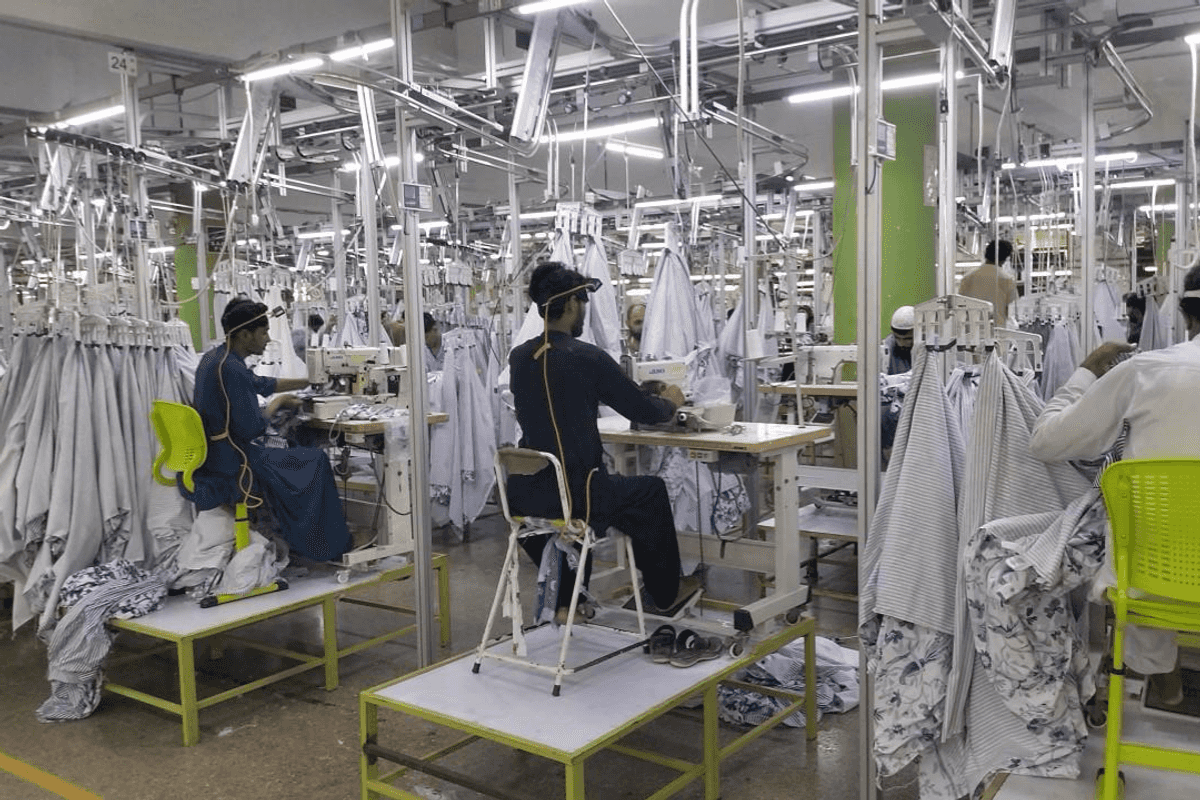
Pakistani startup World Context turns factory work into robot training data
Pakistani startup World Context turns factory work into robot training data
Thousands of Pakistani factory workers are becoming an unlikely part of America’s race to build more capable robots.
Instead of replacing their work with machines, Pakistani startup World Context is paying industrial workers to perform tasks they already know while cameras and sensors record their movements. The company then packages that physical-world data for robotics companies and research teams seeking to train AI systems to operate machines.
Founded in January 2026, World Context currently works with about 8,000 factory workers across industries including tooling, textiles, electronics, automotive, heavy industry, health care, logistics and specialty manufacturing, according to the company.
Founder and Chief Executive Officer Sherdil Ali Khan said the startup is building a data supply chain between Pakistan and the United States and aims to strengthen technology trade between the two countries.
Workers are paid roughly twice their previous wages and are equipped with smart gloves as well as head-, foot- and wrist-mounted cameras, Khan said. The equipment captures detailed movements such as gripping, pressing, adjusting, assembling and manipulating objects — physical skills that remain difficult for robots to learn.
The business is based on a growing challenge for robotics companies. While AI systems can generate and process enormous amounts of digital data, teaching machines to operate in the physical world requires millions of examples of humans performing real tasks.
Pakistan has a potential advantage in that market: a large industrial workforce with experience across a wide range of manufacturing environments.
Industrial workplaces contain variations that can be difficult to reproduce through simulation, including the weight of an object, the friction of a surface, the precise force needed to fit two parts together and the small adjustments workers make when something does not go according to plan.
World Context is seeking to capture those interactions through recorded human movement.
The company said every recording is made under a written contract, audited for quality and documented for provenance. It packages the resulting datasets for robotics companies and research teams in the United States and elsewhere.
World Context also accepts custom orders, allowing robotics teams to request datasets tailored to specific tasks, environments and data types. Samples and pricing are available on request.
“We’re betting on robots. Intelligent machines will become ubiquitous,” Khan said. “We reinforce the intelligent machine supply chain with Pakistani motion data, thereby helping create frontier superintelligence.”
Khan said data collected from Pakistani factories has already been used by U.S. robotics companies, potentially giving Pakistan a role in supplying the physical-world information needed to train increasingly capable machines.
“From Pakistani laborers, superintelligence learns dexterity, precision and balance,” he said.
The model creates an unusual economic loop. Technology that could eventually automate physical work is simultaneously creating demand for workers who can demonstrate that work for machines to learn.
World Context has effectively created a new category of industrial employment in which workers are paid not only to manufacture products but also to demonstrate, record and document the physical tasks they already know how to perform.
That could give Pakistan an entry point into a rapidly expanding part of the global AI economy.
While the United States and other major AI economies are investing heavily in computing infrastructure, AI models and robotics, access to high-quality physical-world data remains a challenge for companies developing machines that must operate outside digital environments.
For Pakistan, Khan sees that data as its potential entry point.
“The chain of compute, data, models and applications is the superintelligence supply chain,” he said. “Pakistan’s entry point into that chain is data. World Context opened it.”
The company’s broader bet is that as intelligent machines become more capable, the value of the human data used to teach them will increase as well.
That could create an unusual outcome for Pakistan’s industrial workforce: some workers whose jobs may eventually be automated could first become the people teaching the machines how to do those jobs.





Comments
See what people are discussing