

Punjab audit flags over $160 million in financial irregularities
Kamran Khan examines unpaid scholarships, questionable loans and government spending in Punjab

News Desk
The News Desk provides timely and factual coverage of national and international events, with an emphasis on accuracy and clarity.
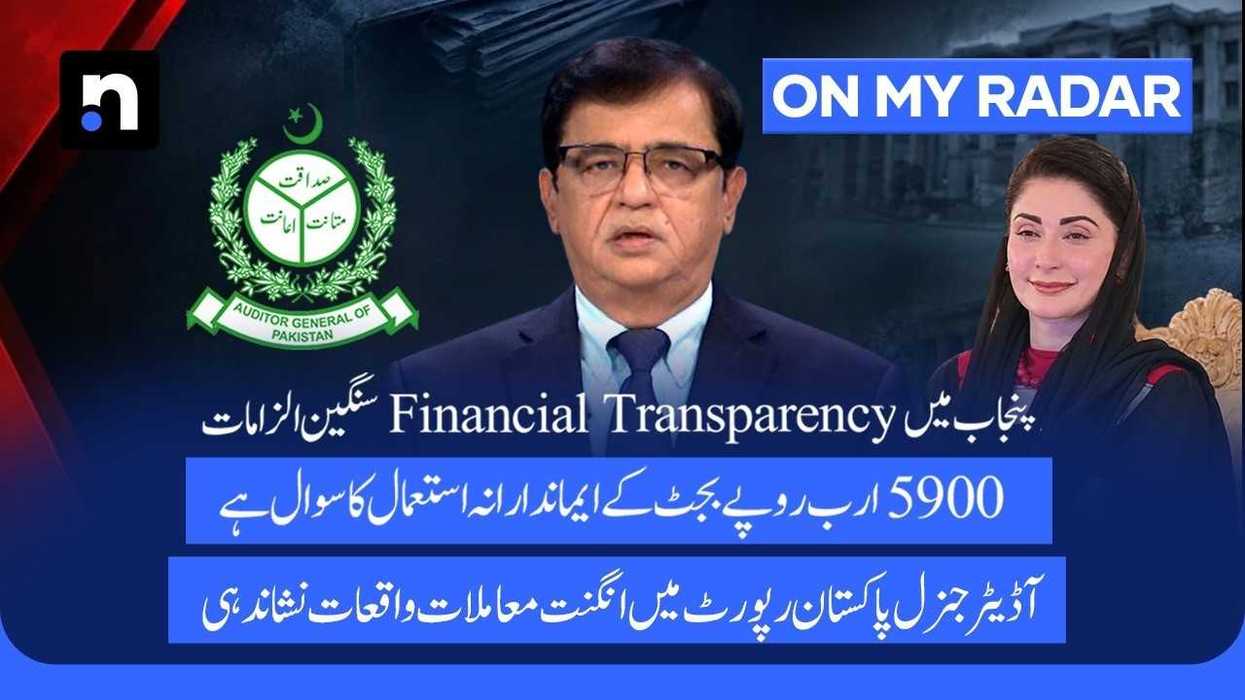
An official audit of Pakistan's Punjab province has identified more than 46 billion rupees ($160 million) in financial irregularities, raising questions about government spending, unpaid student scholarships, outstanding loans to state-owned companies and the use of public funds, Kamran Khan said Monday.
In the latest episode of his program On My Radar, Khan said the amount of irregularities identified in individual chapters of the Auditor General of Pakistan's report exceeded the 5.25 billion rupees disclosed in its summary by more than 40 billion rupees. Most of the difference involved the Punjab Finance Department.
The report examined only 200 of Punjab's more than 5,000 government offices, covering about 19% of auditable expenditure. More than 3,000 smaller audit objections were listed without detailed explanations. Khan questioned what might remain undiscovered in the unaudited 81%.
Punjab received 4.39 trillion rupees under the National Finance Commission award and has a total budget of 5.904 trillion rupees. Khan said the findings raised questions about financial transparency in a province frequently presented as a model of governance.
The audit, prepared under Articles 168 to 171 of Pakistan's Constitution, is an official review of government accounts. Khan said departments were given opportunities to respond before publication, but the report repeatedly described their explanations as "not acceptable." Several departments did not respond.
Loans, electricity duties and missing scholarships
Among the major findings were 146 billion rupees in outstanding loans to eight waste management companies, including 106 billion rupees owed by Lahore's waste management company. None repaid any principal, interest or penalties during the 2024-25 financial year, yet they received another 21.5 billion rupees in loans. Auditors were not provided with their audited financial statements.
Two state-owned industrial development companies owed more than 25 billion rupees, with over 18 billion rupees in overdue installments. Despite reporting profits of more than 3.5 billion rupees over two years, Punjab Industrial Estates Development and Management Company did not repay its loans and received another 150 million rupees. An 860 million rupee penalty for delayed payments also remained uncollected.
The report identified 139 billion rupees in electricity duties due to the provincial government. Power companies adjusted 96 billion rupees against departmental bills and other accounts, while the remaining 43 billion rupees had remained unresolved since 2016.
Another concern involved the government's online E-Pay system, which collected 352 billion rupees in 2024-25 without reconciliation against records maintained by the State Bank of Pakistan, One Link and government accounting offices. The Finance Department also released 10 billion rupees in emergency funds through its SAP financial software that were not included in the published budget.
The audit raised questions about the Zewar-e-Taleem scholarship program for girls in 16 underdeveloped districts of southern Punjab. Although 4.58 billion rupees was transferred to a commercial bank account of the Punjab Social Protection Authority, 317,506 girls never received their monthly stipend of 1,000 rupees. Auditors were not provided with an account of the expenditure.
The report also found that 334.2 million rupees meant for pensions and social security contributions of security and sanitation workers was spent on office expenses without prior approval. Another 394.3 million rupees in penalties collected from contractors was also used for office expenses instead of being deposited in the treasury.
Security guards at 354 basic health units received 32,000 rupees each, although the government was charged 33,806 rupees per guard. The resulting deductions totaled 5.136 million rupees.
Under the Ramazan Nigehban package, suppliers received an additional 125 million rupees, while an inapplicable tax was charged on flour, rice and gram flour. In Hafizabad, 58% of distributed food packages went to families not registered with the Benazir Income Support Program, including police sub-inspectors, revenue officials and court employees.
At Isa Khel Cadet College in Mianwali, checks were allegedly signed with blank spaces for payment amounts, which were subsequently increased to withdraw an additional 4.8 million rupees. Instead of a criminal case, the response was a promise to return the money in installments.
Health contracts and public funds
The audit also identified irregularities in health department contracts. In a 410 million rupee security contract, one company was disqualified over a certificate that had been accepted just four months earlier. Two other companies submitted identical rates and divided the contract. Auditors said the company had been "deliberately" rejected to favor the other bidders.
Sir Ganga Ram Hospital and Fatima Jinnah Medical University spent more than 910 million rupees deposited by contractors as security. More than 750 million rupees had not been returned, while nearly 140 million rupees was refunded without supporting records.
Three major Lahore hospitals, the Punjab Institute of Cardiology, Lahore General Hospital and Jinnah Hospital, used 450 million rupees worth of gloves, catheters and tubes on patients without mandatory laboratory testing. The Punjab Institute of Cardiology also administered medicines that were due to expire within days to patients whose treatment was expected to continue for 90 days.
The report found that Lahore General Hospital purchased an anesthesia injection for 950 rupees, compared with a wholesale price of 380 rupees and a retail price of 447 rupees. Five major government hospitals also earned 680 million rupees in bank profits on public funds but did not deposit the money into the provincial treasury.
The Punjab Police deposited more than 510 million rupees in public revenue from petrol stations, shop rentals, service centers and driving schools into its welfare accounts instead of the provincial treasury, spending more than 150 million rupees. The Punjab Food Authority also opened four bank accounts without Finance Department approval, holding 1.92 billion rupees, and approved 455 million rupees in employee allowances.
Questions over Gulfstream jet and government spending
Beyond the audit report, Khan questioned the Punjab government's purchase of a Gulfstream G500 aircraft costing 10 billion to 11 billion rupees. The purchase was not formally announced, and details emerged through aircraft tracking and a government recruitment advertisement for a pilot. Chief Minister Maryam Nawaz later confirmed the price.
The government approved a supplementary grant of 861.5 million rupees for operating the aircraft, including pilot and engineer training in the United States and insurance. Government documents cited in the program said the jet consumes about 2,100 liters of fuel per hour. Khan estimated that each hour of flight costs taxpayers about 700,000 rupees.
In September 2026, the aircraft flew to London for the chief minister's daughter's graduation ceremony. Following public criticism, 27.1 million rupees was deposited into the government treasury. The government confirmed that Maryam Nawaz had paid the amount personally.
Khan questioned the legal basis for using a government aircraft for private travel and whether the payment would have been made without public criticism.
The program also highlighted a sharp increase in lawmakers' salaries. Under legislation approved in December 2024, members of the Punjab Assembly saw their monthly salaries rise from 76,000 rupees to 400,000 rupees, while ministers' salaries increased from 100,000 rupees to 960,000 rupees.
More than 2,800 public health facilities have also been named after members of the ruling Sharif family. These include 2,500 Maryam Nawaz Health Clinics and 316 Maryam Nawaz Hospitals. Other projects include the Nawaz Sharif Flyover in Rawalpindi, Nawaz Sharif IT City in Lahore and several proposed medical and educational institutions named after members of the family.
Khan recalled that Pakistan's Supreme Court ruled in 2018 that public money could not be used to promote political leaders. Former Punjab Chief Minister Shehbaz Sharif was ordered to return 5.5 million rupees in that case.
Government's position
Khan said the government had not denied the aircraft purchase, supplementary grant, London trip or promotional naming of public facilities, but had offered justifications.
The government's position is that the aircraft belongs to Punjab rather than the chief minister personally, other provinces have purchased helicopters worth 16 billion rupees, and the previous aircraft was more than 25 years old. It also says health facilities have been upgraded and advertising campaigns are intended to inform the public.
Khan asked when the 317,506 girls would receive their scholarships, whether the Gulfstream was purchased through an open tender, what action had been taken over questionable payments and contracts, and why companies failing to repay existing loans continued receiving new ones.
He also questioned when workers' pension deductions and public revenue held in police accounts would be returned to the treasury and under what law public institutions were being named after one political family.
Khan said the findings were based on the Auditor General's report, provincial cabinet decisions, assembly legislation, departmental confirmations and government acknowledgments, rather than political allegations. He said the Punjab government had not publicly rejected the report or challenged its findings in court, adding that the program's platform was open to an official response.
He also questioned why only 19% of government expenditure had been audited and whether the failure to examine the remaining 81% reflected negligence or concealed further irregularities.
"Accountability does not come through slogans and advertisements, but through accounts," Khan said, arguing that a government demanding austerity from citizens should first explain how it spends public money.




Comments
See what people are discussing