

Fazl’s Sargodha march ends in Multan Road standoff; JUI-F claims arrest, police deny
JUI-F ends highway sit-ins, announces nationwide protests amid leadership arrests and a 30-day ban on Fazlur Rehman entering Sargodha

News Desk
The News Desk provides timely and factual coverage of national and international events, with an emphasis on accuracy and clarity.
Murtaza Dar
Editor, Lahore
Murtaza is a journalist and digital strategist with over two decades of experience in the media industry, having held leadership positions in Pakistan’s leading media organizations
Juipakofficial/X
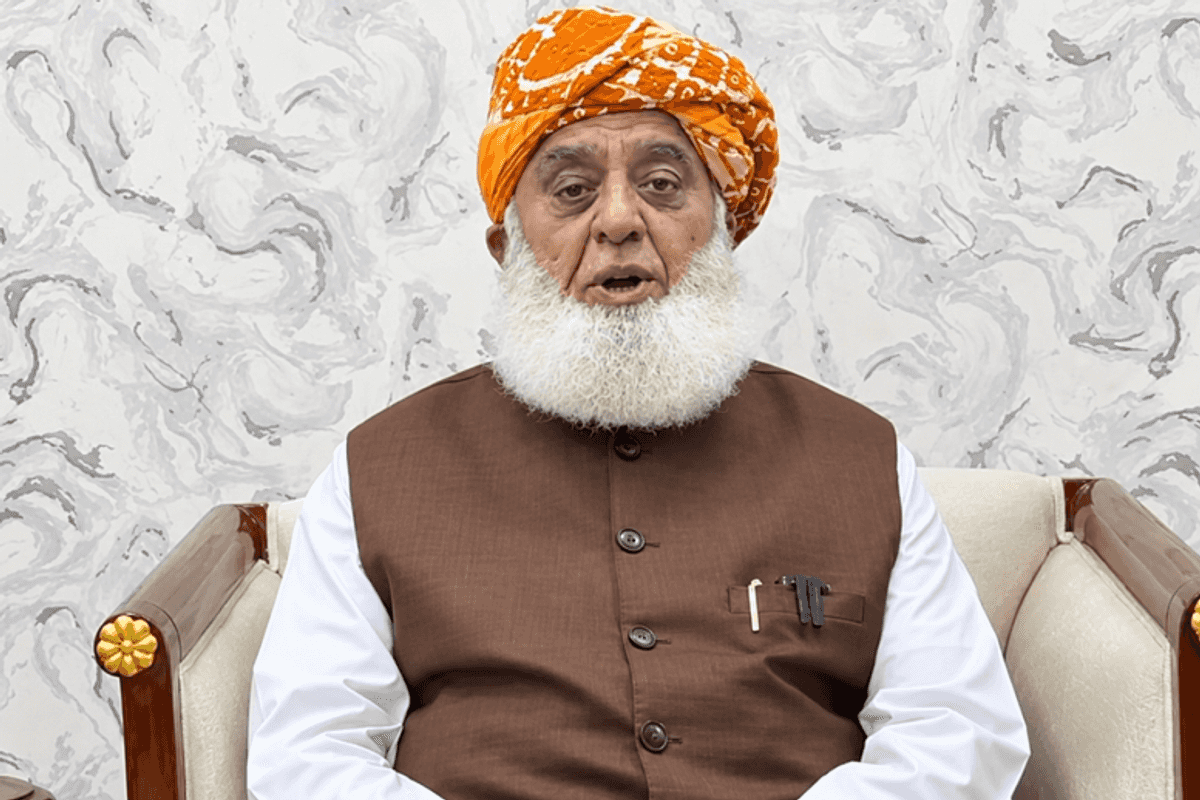
Maulana Fazlur Rehman’s attempt to reach a Jamiat Ulema-e-Islam-Fazl (JUI-F) conference in Sargodha ended in a prolonged standoff on Lahore’s Multan Road, with the party subsequently calling off its highway sit-ins across the country and announcing nationwide protests after Friday prayers amid conflicting claims over whether the JUI-F chief had been arrested.
The Sargodha administration had barred Fazlur Rehman and eight other JUI-F leaders from entering or staying in the district for 30 days. Defying the restriction, the JUI-F chief left his residence in a private housing society on Multan Road in a convoy headed for Sargodha, having earlier claimed that shipping containers had been placed at the entrance to his residence to prevent him from leaving.
Authorities subsequently blocked Multan Road between the housing society and Thokar Niaz Baig, bringing traffic to a standstill. Hundreds of vehicles remained stranded for hours from midday, including school buses carrying children, forcing some parents to walk to Thokar Niaz Baig to pick up their children after waiting for nearly eight hours.
How did the Multan Road standoff and Fazlur Rehman’s public address unfold?
Addressing party workers near Thokar Niaz Baig, Fazlur Rehman accused the administration of deliberately blocking his way and insisted that he be allowed to proceed to Sargodha.
“We should be allowed to go to Sargodha, otherwise the entire country will remain closed,” he told supporters, urging them to remain steadfast.
Negotiations between Fazlur Rehman, police officials, and the district administration continued for several hours. DIG Operations Faisal Kamran was present at Thokar Niaz Baig, where a heavy police contingent had been deployed throughout the day.
Speaking directly to assembled supporters at the gathering, Fazlur Rehman saluted the courage and resolve of party workers across Pakistan and declared that the protest campaign launched on Thursday would continue through an organized, consultative strategy rather than an emotional reaction.
"First of all, I salute you, your steadfastness, your courage, and the determination and bravery of Jamiat Ulema-e-Islam workers across the entire country," Fazlur Rehman told the gathering. "I announce that the series of protests begun today will, Insha'Allah, continue and remain ongoing."
During his speech, Fazlur Rehman informed the crowd that the Inspector General (IG) of Police and the Capital City Police Officer (CCPO) had arrived at the scene to take him into custody, urging supporters to remain calm, disciplined, and composed.
"Do not get carried away by emotion. Our party workers have always been people of wisdom and restraint," he said. "Just now, the IG Sahib and CCPO Sahib came to me.
They have placed me under arrest, and I am now in their custody. Wherever they take me, they will take me. Rest assured, we will face these circumstances with complete steadfastness."
Dismissing arrests as an ineffective tactic against his party, Fazlur Rehman told authorities that JUI-F workers were prepared to court arrest voluntarily and vowed that the government would "not be able to digest" his detention.
"Arrests cannot block our path. Why do you go to the trouble of arresting us? We will walk to the gates of your jails and offer ourselves for arrest," he declared.
"We belong to a history where our elders kissed the gallows—and when the gallows stopped, they were hanged from trees. Your jails will run out of space, but our workers will never run out."
What directives did JUI-F chief issue for Friday’s demonstrations?
Concluding his address to the crowd, Maulana Fazlur Rehman instructed JUI-F workers and sit-in participants nationwide to disperse from major roads and highways for the night and mobilize after Friday prayers.
"I announce to the entire country that you should postpone your sit-ins wherever they are at this moment. Tomorrow is Friday," he told supporters. "After Friday prayers, protest demonstrations will be held across the entire country, and Jamiat Ulema-e-Islam’s local chapters will organize these demonstrations in their respective areas and determine their modalities."
Following the directive, traffic on key national arteries began clearing as sit-in participants dispersed ahead of Friday afternoon’s scheduled rallies.
Why do conflicting claims persist over Fazlur Rehman’s arrest and court proceedings?
The standoff near Thokar Niaz Baig eventually ended with Fazlur Rehman returning to his residence along with his convoy, after which traffic police reopened Multan Road in both directions.
However, the situation took another turn after midnight when JUI-F Lahore Deputy Secretary Information Hafiz Zain claimed that Fazlur Rehman had been arrested near Thokar Niaz Baig, holding Lahore CCPO Bilal Siddique Kamyana and DIG Operations Faisal Kamran responsible.
Lahore police rejected the claim. DIG Operations Faisal Kamran stated that Fazlur Rehman had not been arrested and had returned to his residence with his convoy, adding that traffic on Multan Road and the motorway was flowing normally.
Earlier, the matter of his movement also came up before the Lahore High Court (LHC), where JUI-F had filed a petition alleging that Fazlur Rehman was being unlawfully confined.
A government lawyer told the court that the JUI-F chief had neither been arrested nor placed under house arrest, stating that he had left his residence to offer condolences and that police possessed photographs and video footage documenting his movements. The court directed the authorities to produce the material.
Why did Sargodha bar Fazlur Rehman and eight JUI-F leaders from entering?
The shift in protest strategy followed widespread highway blockades and demonstrations on Thursday after Punjab authorities barred Fazlur Rehman and eight other religious leaders from entering Sargodha for 30 days, citing public order concerns.
Sargodha Deputy Commissioner Hussain Ahmad Raza Chaudhary issued the entry ban order on November 25, following a report from the district police chief. According to the notification, the nine leaders were likely to make provocative and objectionable speeches that could threaten public safety and disrupt law and order if allowed to enter or remain in the district.
Besides Fazlur Rehman, the entry ban covers Maulana Naseer Ahmad Abrar, Maulana Amjad Khan, Maulana Safi Ullah, Professor Ghazanfar Aziz, Maulana Muhammad Noor Khan Hans, Maulana Muhammad Zakria Shah, Maulana Muhammad Yahya Abbasi, and Maulana Jamal Abdul Nasir.
The restrictions prohibit all nine leaders from entering, residing, or remaining within Sargodha's administrative boundaries. The directives took immediate effect and will remain in force for 30 days from November 25 under Section 7(1) of the West Pakistan Maintenance of Public Order Ordinance, 1960.
Where were highway blockades held and which leaders were detained?
JUI-F supporters staged sit-ins and blocked major arteries in several parts of the country on Thursday after Fazlur Rehman issued a video statement urging supporters across all provinces to take to the streets and block major roads, highways, and motorways.
JUI-F Senator Attaur Rehman blocked the Lahore–Islamabad Motorway near the Bhera Interchange, prompting the Motorway Police to suspend traffic at the location. Party messages also reported traffic disruptions on the Dera Ismail Khan–Mianwali road near Chashma, the National Highway in Sujawal, and the Jamrud–Torkham road in Khyber district, while a demonstration was staged at Sohrab Goth in Karachi.
The party separately accused the Punjab administration of obstructing its planned conference in Sargodha by closing access routes and preventing supporters from reaching the venue.
JUI-F spokesperson Aslam Ghouri questioned the motorway closures, noting that authorities had cited fog despite clear weather, while urging workers to remain peaceful and avoid provocation.
While travelling with his caravan, Fazlur Rehman alleged that party workers were being arrested and subjected to violence across Punjab—citing Khushab, Mianwali, and Bhakkar—and accused the government of selectively enforcing Section 144 against the opposition.
"There is no Section 144 for them, yet Section 144 is imposed everywhere for us," he said. "The law is supposed to be equal for everyone, not permissible for them and prohibited for us. These powers are being misused, and we will confront them."
The unrest also followed the detention of several senior JUI-F figures ahead of the planned Sargodha gathering. Party spokesperson Aslam Ghouri stated late Wednesday that Punjab Police had arrested Member of the National Assembly Maulana Abdul Ghafoor Haideri, Punjab JUI-F chief Maulana Amjad Khan, and Jamiat Talaba Islam central president Malik Owais, demanding their immediate release and questioning whether Haideri’s detention had been authorized by the National Assembly speaker.
Sargodha Regional Police Officer Sohail Sikhera confirmed the detention of Haideri, Amjad Khan, and Malik Owais, stating that they had been served notices over violations of Section 144, which prohibits public gatherings in the division. Although Fazlur Rehman ultimately failed to reach Sargodha, JUI-F has said its scheduled conference and protests will proceed.
Tensions between Fazlur Rehman and the federal government have been mounting since mid-October, when he criticized the imposition of governor’s rule in Khyber Pakhtunkhwa.
Last week, security provided by police and the Federal Constabulary to Fazlur Rehman and his family was withdrawn, while his son, Asad Mahmood, was summoned by the National Accountability Bureau (NAB) in connection with a case involving appointments in Pakistan Post.
Attention now shifts to Friday afternoon demonstrations across major cities and the upcoming Lahore High Court proceedings.


Comments
See what people are discussing