

Pakistan’s JF-17 thunder jets rise as global contenders after 2025 India clash
Kamran Khan says JF-17’s combat success boosted Pakistan’s credibility and export prospects

News Desk
The News Desk provides timely and factual coverage of national and international events, with an emphasis on accuracy and clarity.
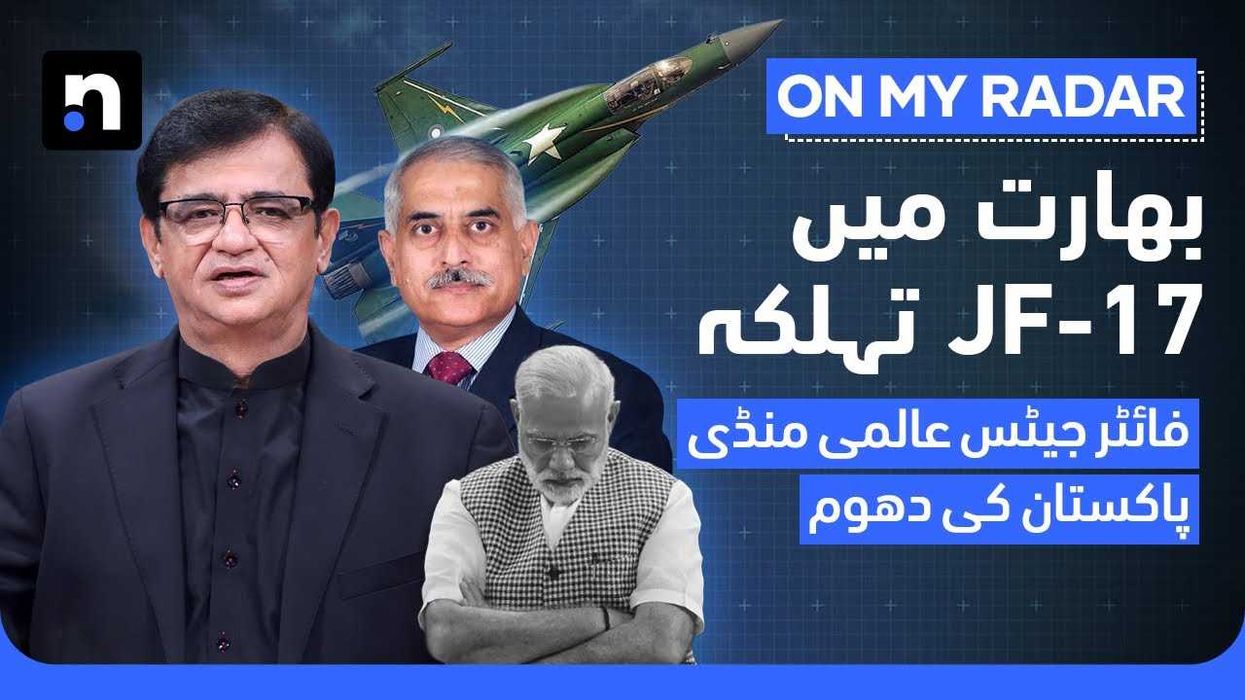
Pakistan’s JF-17 Thunder fighter jets, co-developed with China at the Pakistan Aeronautical Complex in Kamra, have emerged as a standout in the global defense market following their performance in the May 2025 conflict with India.
Praised for their affordability, versatility, and modern combat capabilities, these jets have drawn interest from several countries across the Middle East, Central Asia, Africa and Southeast Asia, signaling Pakistan’s rising influence in international defense exports.
Kamran Khan, in the latest episode of On My Radar, highlighted that the JF-17’s battlefield success against more expensive and advanced aircraft has not only enhanced Pakistan’s military credibility but also opened doors for lucrative export deals.
“The JF-17 has proven itself as a reliable, cost-effective fighter, making it a viable option for nations seeking modern air capabilities without the prohibitive costs of Western jets,” he noted.
Defense Minister Khawaja Asif confirmed an arms agreement with Saudi Arabia and added that, aside from Bangladesh, eight to ten other countries are currently in talks to acquire the fighter jets. “The JF-17 Thunder is no longer just a national asset for the Pakistan Air Force; it is now central to our growing defense export strategy,” he stated.
Equipped with long-range beyond-visual-range (BVR) missiles and a modern AESA radar system, the lightweight, multi-role JF-17 can simultaneously track and engage multiple targets. Its capabilities were prominently showcased at the Dubai Airshow 2025, gaining international attention after the crash of India’s Tejas aircraft at the same event.
Once considered secondary to Western and Russian fighter jets, the JF-17’s reputation soared following its operational performance in the February 2019 and May 2025 conflicts, where it successfully engaged advanced French Rafale aircraft.
Pakistan has already exported the jet to Azerbaijan, Myanmar, and Nigeria, while the confirmed $4 billion Saudi deal includes $2 billion in aircraft acquisitions and another $2 billion for training, equipment, maintenance, and logistical support.
Countries such as Bangladesh, Iran, Indonesia, Iraq, and Libya have also shown interest. Asif added that these orders are so significant that Pakistan may not need IMF assistance in the near term.
In recent diplomatic developments, Air Chief Marshal Zaheer Baber Sidhu met with Saudi Air Chief Turki bin Bandar bin Abdulaziz in Riyadh and Bangladesh Air Chief Marshal Hasan Mahmood Khan in Islamabad, with both parties expressing strong interest in acquiring the JF-17. International observers have also noted Indonesia’s presidential visit to Pakistan, during which JF-17 jets escorted his aircraft - a clear signal of growing regional interest.
The JF-17 program traces its origins to the 1990s when Pakistan sought alternatives after the U.S. declined to provide F-16s under the Peace Gate Amendment. A partnership with China was formalized through MoUs in 1995, 1998 and 1999, leading to the first prototype in 2003 and official induction into the Pakistan Air Force in 2010. Production of the advanced Block III variant began in 2020 at the Kamra Aeronautical Complex.
Experts emphasize that the JF-17’s appeal lies in its combination of Chinese technology, lower costs, export flexibility, political neutrality, and accessible spare parts. Pakistan’s structured upgrade and maintenance programs further boost the aircraft’s value for mid- to low-budget air forces. Its promotion as a complete defense package—including training, logistics, and maintenance—offers an alternative to high-end jets like the Eurofighter Typhoon, F-15, Saab Gripen, or Rafale.
The JF-17 Thunder has transitioned from a domestic defense tool into a symbol of Pakistan’s expanding defense export capabilities. Its battlefield success, strategic marketing and diplomatic traction highlight the aircraft’s growing role in Pakistan’s foreign policy, defense strategy and economic planning.

Comments
See what people are discussing