


News Desk
The News Desk provides timely and factual coverage of national and international events, with an emphasis on accuracy and clarity.
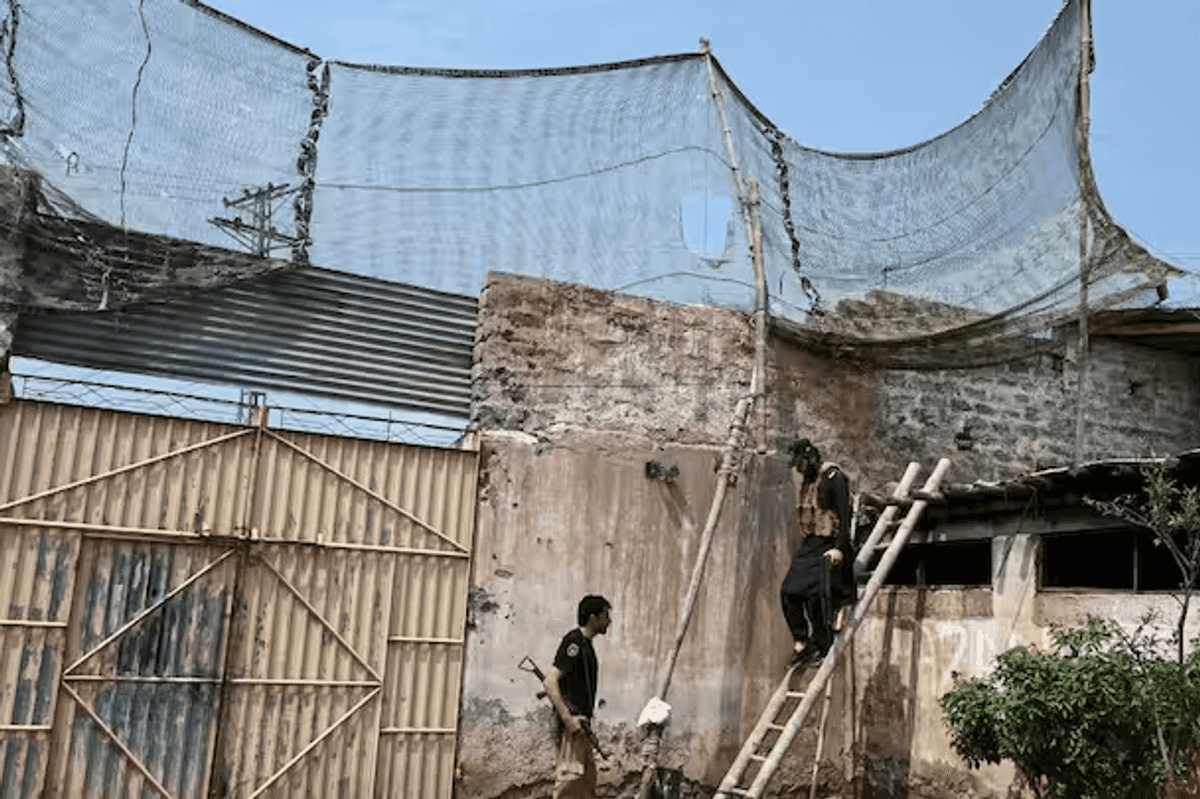
A security officer fortifies a police post against militant drone attacks in Bara, Khyber Pakhtunkhwa, on August 4, 2026.
AFP
Pakistan police in Khyber Pakhtunkhwa province are installing Ukraine-style nets across police buildings to counter drone attacks by Tehreek-i-Taliban Pakistan militants along the Afghan border.
The mesh, borrowed from Ukrainian battlefield tactics, aims to entangle drones and catch falling munitions as the TTP increasingly uses cheap, easily available quadcopters to strike security checkpoints.
Why are Pakistan police installing Ukraine-style nets?
The nets act as a low-cost barrier against militant drones, entangling rotors or catching falling munitions such as mortars and grenades above police compounds. Made from extra-durable thread, they hang several metres above ground, forming a canopy between rooftops and roadside walls. The design mirrors netting used to protect frontline Ukrainian cities.
"These drones are easily available in markets, and with a bit of modification a kit for dropping shells can be installed. So it is quite easy and everyone has access to them," Khyber District police officer Waqar Ahmad told AFP. "We have started installing these... nets to protect our personnel from aerial attacks and to reduce the risk of attacks involving drones."
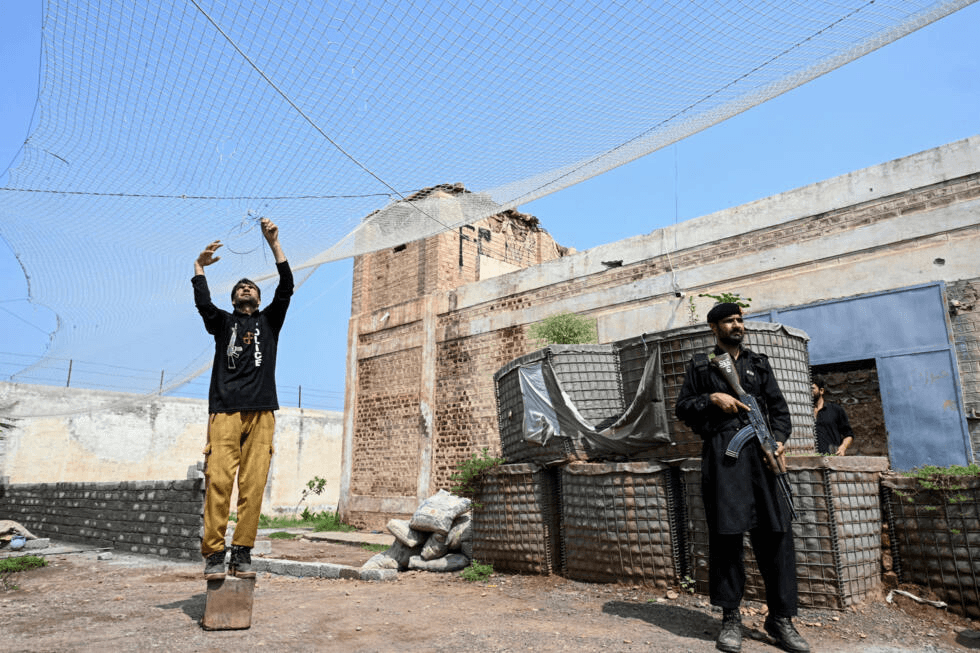 Security personnel fortify a police post against militant drone attacks in Bara, Khyber Pakhtunkhwa, August 4, 2026.AFP
In some frontline Ukrainian cities, nets are hung high and wide across long stretches of road, forming corridors like spiders' webs to thwart aerial attacks. Draped over the facade of several police premises in KP, which borders Afghanistan, the nets now sit alongside concrete blocks and other barriers as a new line of defence.
How big is the TTP drone threat in Khyber Pakhtunkhwa?
KP is experiencing a growing insurgency by the Tehreek-i-Taliban Pakistan, with dozens of police killed in attacks on checkpoints this year. The group has deployed drones extensively in attacks since 2024, and police are still playing catch-up. About 30 percent of police stations still lack their own counter-drone devices, a senior officer in the provincial capital Peshawar told AFP.
Drones are readily available at specialized electronics shops across the province. AFP found them in around a dozen such stores in shopping malls in Peshawar alone. They have become a vital part of the TTP's attack toolkit, used both to strike targets and for surveillance.
Another senior officer from KP said the militants use drones to monitor "every movement" of their operations, "which creates serious difficulties for us in countering them". The TTP says it has also turned to drones as an alternative to suicide bombers. "A suicide attacker could only reach the gate, whereas a quadcopter can penetrate inside military and police compounds," a TTP commander, who did not give his name, told AFP, referring to a drone propelled by four rotors. The group has "thousands" of drones, he added.
How are police responding to the drone threat?
Police are racing to harness the same technology, running training courses and stocking up on machines and counter-drone devices such as handheld jammers.
Last month, KP police's UAV Division held the force's first-ever drone course, with 52 participants. The push reflects how far behind militant capability the force had fallen.
Has the netting reduced drone attacks in Khyber Pakhtunkhwa?
For Muhammad Aamir, a policeman posted at a checkpoint along a road in the province, the nets, alongside boundary walls, have "considerably" reduced the risk of drone attacks and hand grenades being lobbed at the building. "These incidents caused significant damage and casualties among the police and other security forces. However, the situation has improved now," the 38-year-old told AFP.
But with attacks continuing to claim lives, locals say police need to do more to protect them. "We want some peace and security in this area. Either the police post should be removed from this location, or the authorities should eliminate the threat posed by the Taliban from this area," said 48-year-old corn seller Gul Haleem.





Comments
See what people are discussing