

Pakistan’s defense exports seen as potential growth engine through 2030
Ktrade says expanding military partnerships and long-term contracts could boost forex inflows, technology investment and geopolitical influence

Business Desk
The Business Desk tracks economic trends, market movements, and business developments, offering analysis of both local and global financial news.
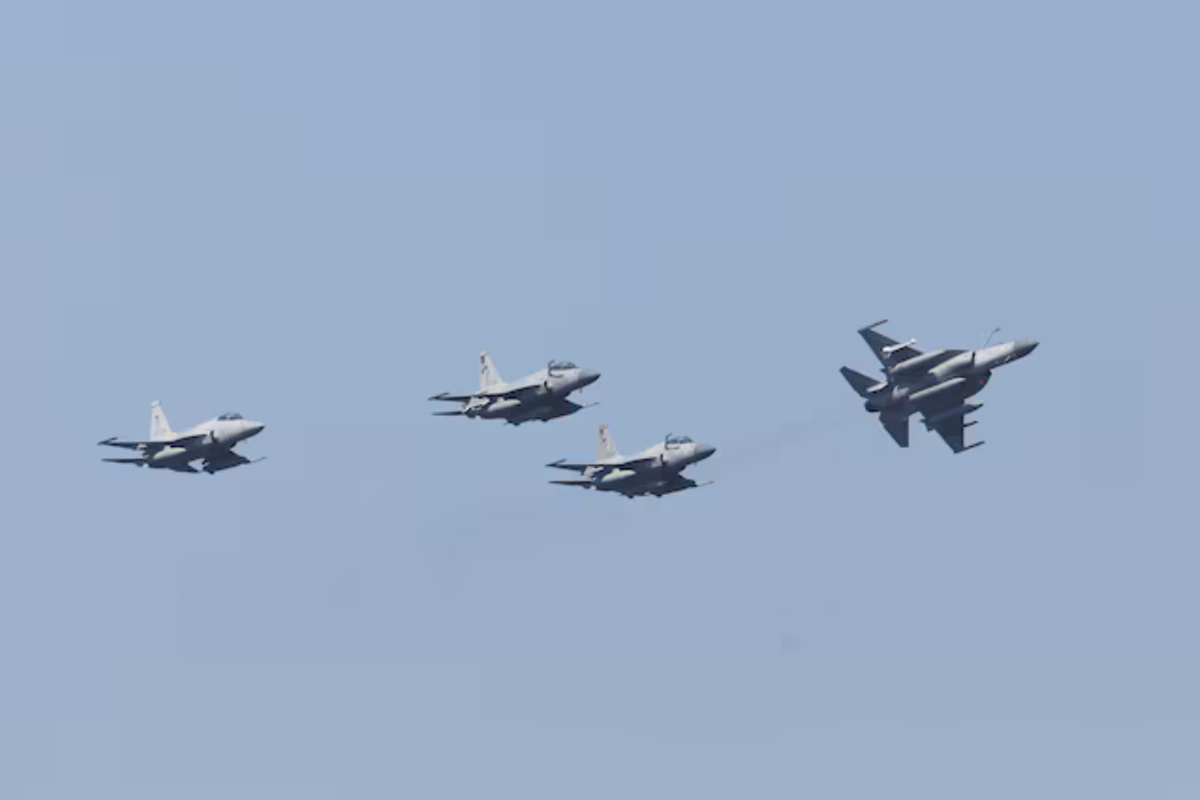
Pakistan Air Force's JF-17 Thunder jets fly past during the sea phase of Pakistan Navy's Multinational Exercise AMAN-23, in the North Arabian Sea near Karachi, Pakistan, February 13, 2023
Reuters
Pakistan’s expanding defense partnerships and rising global military spending could emerge as a major economic driver between 2026 and 2030, reshaping both its geopolitical standing and external account position, according to Ktrade.
A pivotal moment came in September last year, when Pakistan and Saudi Arabia formalized their longstanding security cooperation through the Strategic Mutual Defense Agreement (SMDA).
The pact declares that any aggression against either country will be treated as an attack on both, transforming decades of informal coordination into a binding security commitment.
The country’s defense exports are not limited to military fighter jets but also span military tank (Al-Khalid tank), drones, armored vehicles, naval systems, and ammunition/small arms, reflecting a portfolio of military equipment of various use cases and capabilities.
Long-term contracts
Pakistan’s defense exports have immense potential to include sustainable after-sales services, which form a critical component of long-term partnerships.
This is a key point; defense equipment sales are not just a one-off gain. Most often these contracts are recurring and long term.
These services encompass comprehensive maintenance, repair, and overhaul (MRO) support, provision of maintenance and test equipment, and training services for pilots and technical personnel.
By offering these capabilities, Pakistan ensures the operational readiness of exported platforms while creating opportunities for recurring revenue streams through upgrades, spare parts supply, and follow-on sales.
This approach also strengthens military-to-military ties, increases interoperability, and opens avenues for future defense deals with new as well as existing partner nations. We think this could be a major game changer which could structurally lift Pakistan’s geopolitical influence and diplomatic standing.
A good example of such an impact is of Turkey which has strong influence in Africa and Central Asia due to its defense sales.
Pakistan's foreign exchange reserves increased by 28.1% year-over-year to $21.02 billion in 2025 ($15.9 billion with SBP and $5.1 billion with banks), driven by sustained inflows from multilateral and bilateral lenders alongside robust workers' remittances.
Current goods and services exports stand at $36.9 billion, positioning defense deals as a potentially transformative contributor to overall export performance.
Implications for external account
The defense export pipeline holds substantial implications for Pakistan's external account position.
These potential deals represent approximately 82.4% of the State Bank of Pakistan's current foreign exchange reserves and 3.7% of GDP. If successful, these contracts would generate significant foreign exchange earnings that could help address Pakistan's historical external financing constraints. This will also help in structural efforts to diversify and boost export sectors beyond traditional textiles and agriculture.
Success in this sector could also catalyze investments in supporting industries including component suppliers, avionics manufacturers, and training services, creating employment opportunities across the economy.
Indigenous production of defense equipment would eventually also help reduce dependence on overseas exports and alleviate pressure on the current account which comes from the import of defense equipment.
Lastly, a strong defense tech industry will also have positive impact on the overall technology sector. Many important technology innovations have come out of defense R&D spending.
"We are specially positive on industries such as robotics and AI and think that the focus on defense will increase investment in data centers and tech infrastructure'", said Ktrade report.
Domestic defense industry
Pakistan’s defense sector is positioned for growth, driven by both domestic production capabilities and increasing export opportunities. Key players include:
Pakistan Aeronautical Complex (PAC): The production of JF-17 fighter jets, K-8 Advanced training jet and Mushshak lightweight trainer aircraft is expected to benefit significantly from rising export volumes, positioning PAC Kamra as a key player in regional defense aviation.
Pakistan Ordnance Factories (POF): With a focus on ammunition and small arms, POF has immense potential to capitalize on international demand, leveraging Pakistan’s established manufacturing expertise.
Heavy Industries Taxila (HIT): Specializing in tanks and armored vehicles, HIT’s products are increasingly sought after in markets requiring robust land defense solutions.
Supporting industries
The growth of Pakistan’s defense exports also stimulates related sectors.
Manufacturers of avionics, engines, and avionics systems are likely to see expanded opportunities as defense contracts increase.
Pilot training, maintenance, and logistics support provide recurring revenue streams, creating long-term business sustainability beyond the initial sale of military hardware.
Besides a positive impact on overall macroeconomic situation (higher forex reserves, dollar inflows, higher exports, stable currency and higher GDP growth), a focus on technology will have greater spillover to the private sector and would accelerate the countries position in new technology verticals such as AI, robotics and space technology.
"We think these sectors would become more prominent over the next three year," the report said.
"We think there would be higher investment in data centers, AI and overall digitalization. Pakistan has shown that it can combine Chinese technology with western operating systems and this indigenization of technology can be very valuable in many sectors. We think the market is currently not fully appreciating the magnitude of potential impact from these developments and this could be a source of surprise for the overall economy and also the stock market."
Pak-Saudi defense deal
In September, Pakistan and Saudi Arabia formalized their longstanding defense partnership through the Strategic Mutual Defense Agreement (SMDA), a landmark pact declaring that any aggression against either nation will be considered an attack on both. This agreement transforms decades of informal cooperation into a binding commitment that significantly reshapes regional security dynamics.
The SMDA encompasses comprehensive defense collaboration, including intelligence sharing, joint military exercises, capacity building, defense production, and technology transfer.
For Pakistan, the agreement enhances its strategic standing and diplomatic leverage while also opening doors to potential Saudi investment. It firmly links Pakistan's security role to Gulf regional dynamics, expanding its influence beyond South Asia.
For Saudi Arabia, the pact provides crucial diversification of security partnerships beyond traditional Western alliances, particularly amid growing concerns about the reliability of U.S. security assurances. The agreement offers Riyadh an additional deterrence layer during a period of heightened regional instability, exemplified by the ongoing Gaza conflict and an Israeli strike on Qatar that intensified Gulf states' security anxieties.
The SMDA's significance has be been attracting interest from other partner nations. Turkey has expressed interest in joining as a third partner, which would further strengthen the alliance and contribute to broader regional stability.
Additionally, Jordan has demonstrated keen interest in enhanced military collaboration with Pakistan. In December, Jordan's Joint Chief of Staff visited Pakistan's military headquarters to discuss strengthening bilateral military ties and addressing shared security concerns.
This evolving security architecture represents a significant shift in Middle Eastern and South Asian geopolitics, with Muslim-majority nations increasingly seeking independent security arrangements. The SMDA and its potential expansion signal a new phase of regional cooperation that could reshape traditional geopolitics, according to the report.




Comments
See what people are discussing