

Pakistan’s manufacturing sector slides as private investment halves in six years
Kamran Khan says policy instability and high energy costs are driving capital out of local manufacturing

News Desk
The News Desk provides timely and factual coverage of national and international events, with an emphasis on accuracy and clarity.
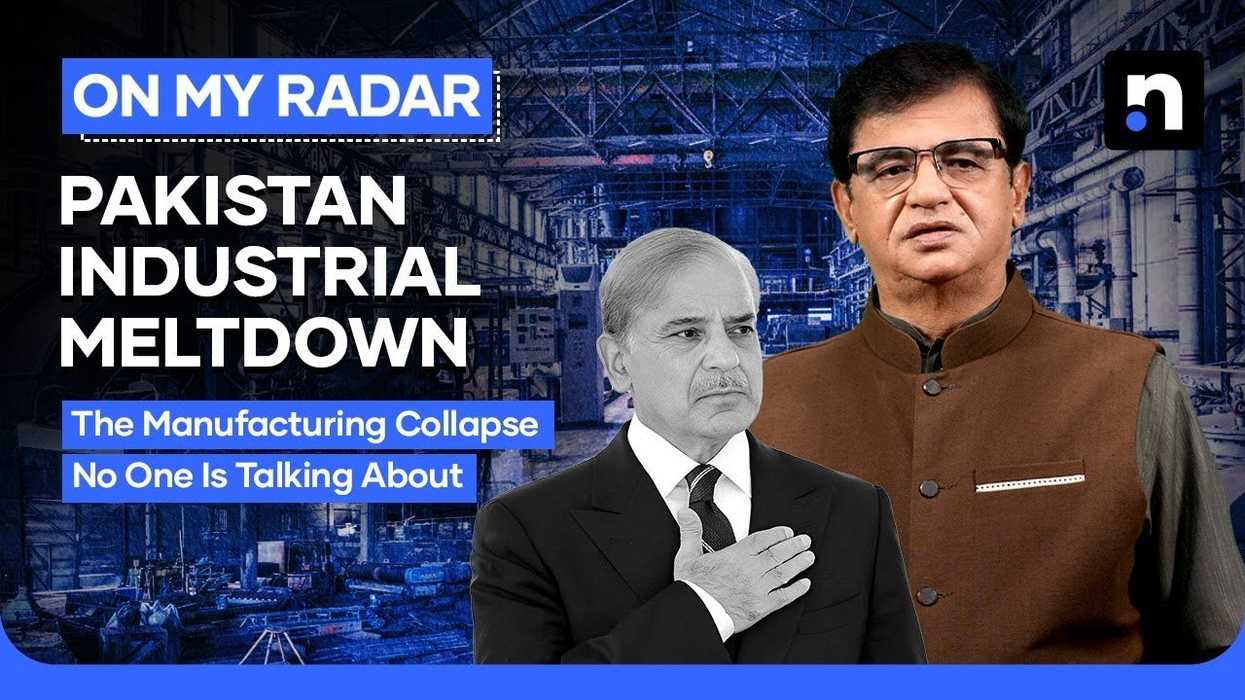
Pakistan’s large-scale manufacturing sector is facing a sustained decline as private investment has nearly halved over the past six years, raising concerns about jobs, exports and long-term economic growth.
Kamran Khan highlighted the trend during a recent episode of his program “On My Radar,” describing the sector as a picture of “mourning machines and grieving capital.”
Manufacturing is widely regarded as a backbone of any economy, converting raw materials into national output, employment and exports. In Pakistan, however, that engine is losing momentum.
According to figures cited by Khan, private investment in manufacturing stood at PKR 706 billion in 2019. By 2025, it had dropped to just PKR 377 billion, a decline of about 46%.
Foreign direct investment, he said, has also largely dried up, falling to roughly $1.5 billion to $2 billion annually across the economy, levels analysts consider insufficient for an emerging market of Pakistan’s size.
Khan said the core issue is not simply slower growth but a reversal of capital flows. Investment that once went into domestic manufacturing is now moving abroad.
He attributed this shift to inconsistent government policies, rising energy tariffs, a complex tax structure, declining business confidence and prolonged economic uncertainty.
Research by the Lahore Chamber of Commerce and Industry and Business Recorder shows that new investment in manufacturing is now insufficient to even offset annual depreciation of existing plants and machinery.
In practical terms, Khan explained, an industry valued at PKR 10 billion with an average depreciation cost of 7% would require at least PKR 700 million in new investment each year just to maintain its capital base.
Pakistan is failing to meet even that threshold, meaning firms are consuming existing industrial capital rather than upgrading or expanding it.
As a result, while factories and plants still physically exist, their machinery efficiency, technology levels, labor productivity and overall production capacity are steadily declining.
Khan described this process as de-industrialization, a term used to describe the erosion of a country’s manufacturing base over time.
He said Pakistan’s slide is closely linked to repeated crises over the past four years, including political instability, sharp economic volatility and a steep depreciation of the rupee of up to 190%.
The country also faced critically low foreign exchange reserves, recurring default fears, repeated International Monetary Fund programs, inflation peaking near 38% and policy rates rising to as high as 22%.
In such an environment, Khan said, long-term planning becomes nearly impossible for investors, who cannot reliably estimate future energy costs or borrowing expenses.
The IMF itself has acknowledged that in 2023 and 2024, heavy government borrowing crowded out private-sector credit, making loans prohibitively expensive for businesses.
High and unpredictable energy tariffs have further undermined competitiveness. Industries have faced costly electricity due to capacity payments to independent power producers and gas shortages for captive power plants.
As profit margins shrank, Pakistan’s exports became less competitive regionally, effectively eliminating the business case for new investment in sectors such as textiles and engineering.
Economists also point to frequent changes in tax policy, including super taxes, import restrictions on machinery and raw materials, and an opaque regulatory environment.
Khan noted that a single notification from the Federal Board of Revenue can upend an entire business model, deterring long-term commitments.
In contrast, countries such as Bangladesh and Vietnam have seen rising private investment in manufacturing, enabling them to double exports in textiles, garments and electronics.
Analysts attribute their success to lower energy costs, better logistics and greater continuity in economic policy.
According to the International Finance Corporation and the World Bank, Pakistan needs to raise its investment-to-GDP ratio to between 25% and 30% to achieve sustained development.
Instead, the ratio has hovered around 13% over the past five years, compared with an average of 32% in Bangladesh and 38% in Vietnam.
The consequences, Khan warned, are severe. Pressure is mounting on exports, employment and revenue collection.
Manufacturing has historically provided jobs for the middle class and semi-skilled youth, particularly in cities such as Karachi, Faisalabad, Lahore and Sialkot.
Without new industrial investment, job creation stalls, tax revenues shrink and the burden shifts toward indirect taxes that fuel inflation.
Khan said the drop in private investment from PKR 706 billion to PKR 377 billion should be treated as a warning.
Economic stability alone, he argued, will not be enough unless Pakistan adopts a balanced investment agenda focused on rebuilding its industrial base.



Comments
See what people are discussing