

PTI seeks clarity in Pakistan’s counterterror approach after military flags KP militancy surge
PTI leaders urged a long-term approach, saying militancy can’t be ended by force alone

Kamran Ali
Correspondent Nukta
Kamran Ali, a seasoned journalist from Khyber Pakhtunkhwa, Pakistan, has a decade of experience covering terrorism, human rights, politics, economy, climate change, culture, and sports. With an MS in Media Studies, he has worked across print, radio, TV, and digital media, producing investigative reports and co-hosting shows that highlight critical issues.
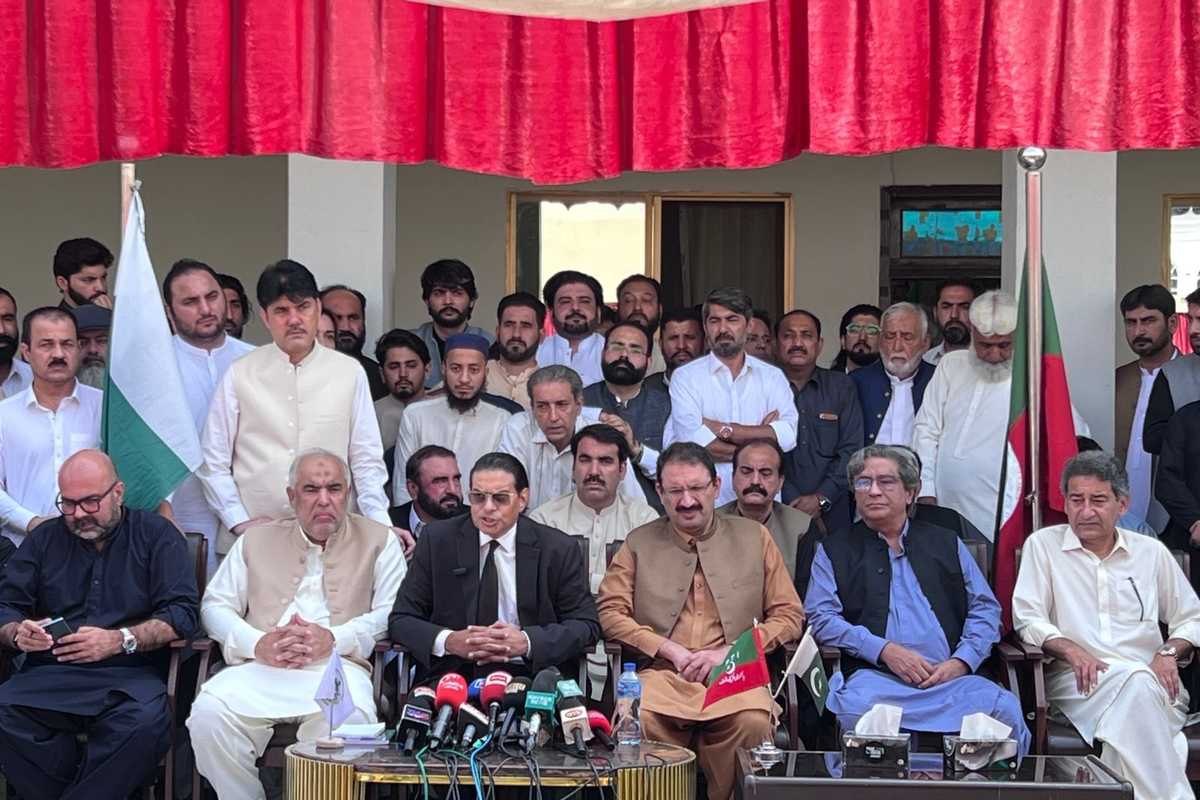
PTI leaders address a press conference.
Nukta
Pakistan’s main opposition party, the Pakistan Tehreek-e-Insaf (PTI), has disputed observations by the country’s military linking it to terrorism, saying the party neither supports nor engages in militant activity. PTI urged authorities to take the public into confidence before launching any new counterterrorism initiatives.
The clarification followed a press briefing by military spokesperson Lt Gen Ahmed Sharif Chaudhry, who cautioned against what he described as a “fabricated narrative” undermining the country’s fight against terrorism.
Speaking on Friday, the director general of the Inter-Services Public Relations (DG ISPR) said that martyrs of the armed forces and police were being ridiculed online, terming it a “nexus between political and criminal elements.”
Lt Gen Chaudhry also cited data showing a sharp rise in terrorist incidents in Khyber Pakhtunkhwa (KP) over recent years, contrasting it with relatively stable conditions in Sindh and Punjab, where he said law enforcement agencies were performing effectively.
Responding to these remarks, PTI leaders held a press conference in Peshawar, emphasizing that their party “fully stands with Pakistan’s martyrs” and has “no tolerance for terrorism in any form.”
PTI Secretary General Salman Akram Raja said militancy cannot be eliminated by force alone and called for a long-term strategy. “When will this cycle of conflict end?” he asked, urging the state to focus on the underlying causes of extremism.
Raja also criticized the government for straining relations with Afghanistan, arguing that dialogue is essential for regional peace. “There is no part of the world where dialogue does not take place,” he remarked.
Acknowledging governance and economic challenges in Khyber Pakhtunkhwa, Raja described the recent political transition in the province as “a new beginning.” He also dismissed speculation about PTI’s alleged involvement in any plans to resettle militants, adding, “Do not place this blame on us.”
Junaid Akbar, a PTI lawmaker and the party’s provincial president, meanwhile accused the federal government of delaying the appointment of PTI’s nominee Sohail Afridi as chief minister. “Sohail Afridi is an honest man — we will ensure he becomes chief minister,” Akbar said.
He claimed PTI currently commands the support of 92 members in the provincial assembly and remains in contact with legislators from other parties. “Not a single one of our 92 members can be swayed. Anyone who betrays the PTI founder will not be able to show their face,” he warned.
Akbar further urged that political decisions should not deepen the divide between state institutions and the public.
Drawing a comparison with Punjab, he remarked, “People there are prosperous and have jobs - what do we have that would make us resist?”



Comments
See what people are discussing