

State Life’s stock sell-off raises questions amid PSX rally
Kamran Khan says State Life aggressively sells government-listed shares as most institutions increase equity exposure

News Desk
The News Desk provides timely and factual coverage of national and international events, with an emphasis on accuracy and clarity.
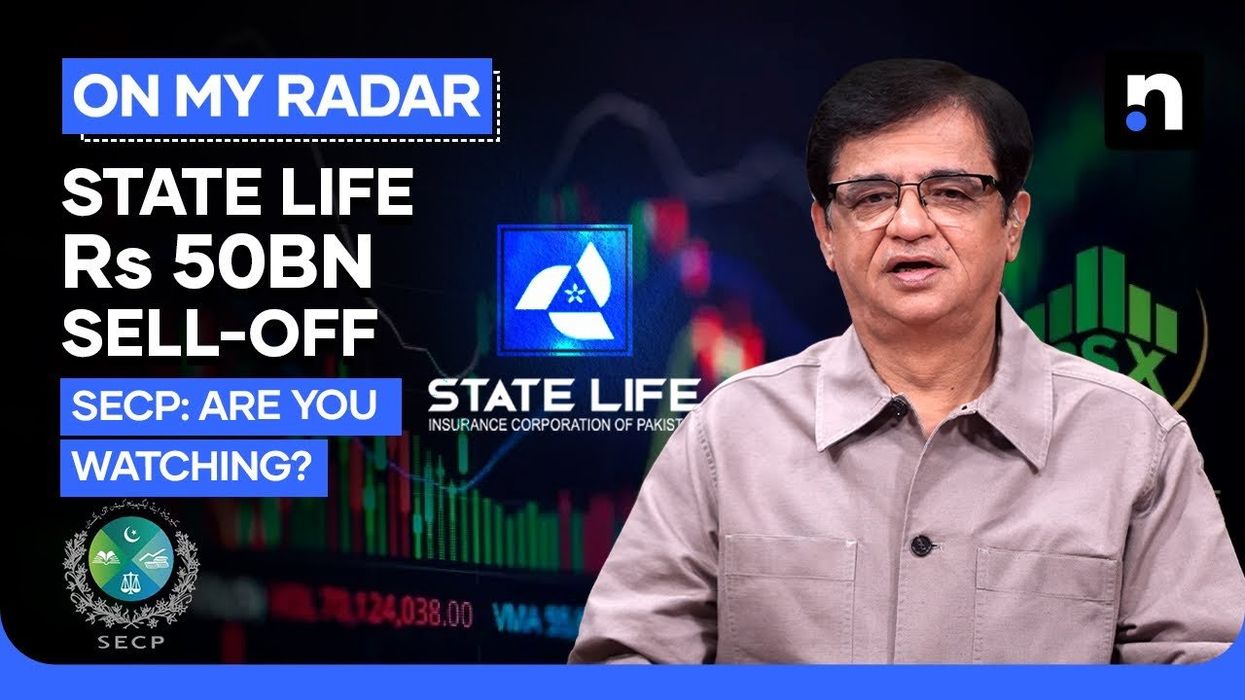
Pakistan’s stock market is witnessing one of the strongest rallies in its history, with the benchmark index at record highs and investor confidence running high across retail, institutional and foreign segments.
Yet amid this bullish momentum, the investment behavior of the state-owned State Life Insurance Corporation of Pakistan has emerged as a point of concern, puzzling market participants and triggering debate over transparency, timing and strategy.
In the latest episode of On My Radar, Kamran Khan said that while the broader market surged, State Life adopted a sharply contrasting approach by aggressively offloading equities - particularly shares of government-listed companies - at a time when most institutional investors were increasing exposure to stocks.
Over the past two years, the Pakistan Stock Exchange (PSX) index has climbed nearly 200 percent, with dozens of stocks posting multi-fold gains. Retail participation has expanded, high-net-worth individuals remain upbeat, banks are confident, mutual funds are active, and financial institutions continue to raise their equity allocations. Private-sector insurance companies have also been adding to their stock market portfolios.
Against this backdrop, State Life’s large-scale selling stood out. Market participants observed that while the index was moving higher, the state-owned insurer was steadily exiting positions, particularly in large-cap government-listed companies such as OGDC, PPL, PSO, MARI and NBP.
For many investors, this behavior was difficult to reconcile with State Life’s traditional investment profile. Some initially described the move as routine profit-taking. However, questions began to mount over the timing and scale of the sell-off, especially as insurance companies are typically viewed as long-term, stabilizing investors rather than active sellers during bullish phases.
Kamran Khan noted that concerns deepened when reports emerged that information about State Life’s impending sales had reached certain large investors in advance. Soon after, billions of rupees’ worth of shares in key government-listed firms entered the market, prompting speculation over whether the move could genuinely be explained as standard risk management or portfolio adjustment.
Data from the Central Depository Company (CDC) shows that over the past two months, State Life sold approximately PKR35 billion worth of equities and redeemed nearly PKR20 billion from mutual funds. This resulted in a total divestment of around PKR55 billion from the equity market.
While this amount represents roughly five percent of State Life’s total assets of about PKR2.1 trillion, analysts argue that such a withdrawal is significant enough to influence sentiment and trigger volatility in a relatively small market like the PSX. Market experts suggest that repeated bouts of heavy selling disrupted the bullish trend, preventing the index from sustaining momentum toward higher milestones.
Globally, insurance companies are known to provide stability to equity markets due to their long-term liabilities and steady cash flows. In Pakistan, private life insurers - including Adamjee, Jubilee and EFU - have collectively invested around PKR31 billion into equities over the past nine months. In contrast, State Life withdrew nearly PKR55 billion in just two months, a divergence that has raised eyebrows within the financial community.
Although portfolio restructuring is not, in itself, inappropriate, analysts say the scale, speed and timing of State Life’s actions make it difficult to dismiss the move as simple profit-taking. The situation gained further attention as the sell-off coincided with a leadership change at the insurer.
During this period, State Life’s former chairman, Sulaiman Mehdi—a well-known investor prior to his appointment—was removed, and PML-N leader Saleem Zia was appointed as his replacement. Whether this leadership transition had any direct link to the insurer’s market-moving sell-off remains unclear, but the overlap has added to speculation.
Another point of concern is disclosure. State Life has not published an updated investment portfolio report since December 2024, leaving the current composition of its equity holdings unknown. This stands in contrast to international practices and benchmarks.
Under global insurance standards, including those set by the International Association of Insurance Supervisors (IAIS) and the International Organization of Securities Commissions (IOSCO), state-mandated insurers are expected to align investment decisions with their liability profiles and maintain a high degree of transparency. By comparison, India’s Life Insurance Corporation (LIC) allocates roughly 25 to 27 percent of its total investments to equities, according to data available up to September 2025.
Kamran Khan emphasized that these questions matter because State Life is a government-owned insurer whose investments are funded by public savings and policyholder premiums. As a custodian of public money, its investment decisions cannot be treated as purely internal matters.
He said that clarity is needed on whether State Life’s buying and selling of government-listed shares met global transparency standards, adding that accountability and disclosure are essential to maintain trust in public financial institutions.



Comments
See what people are discussing