

Moiz Ur-Rehman
A multidisciplinary economist, legal thinker, and broadcast journalist with over five years of experience at the intersection of finance, policy, and media. I have academic grounding; in law, economics, and hospitality management, to accessible, high-impact storytelling for business audiences across Pakistan and beyond.
Year after year, independent auditors signed off on Unity's financial statements
Nukta
This is not simply the story of one man's ambition curdling into greed but it is the story of a system that failed, at every level, to protect the retail investor and not just that but another example of foreign investors being defrauded of their capital. On paper, the case looks open and shut. Whether retail investors and victims actually see justice this time remains to be seen.
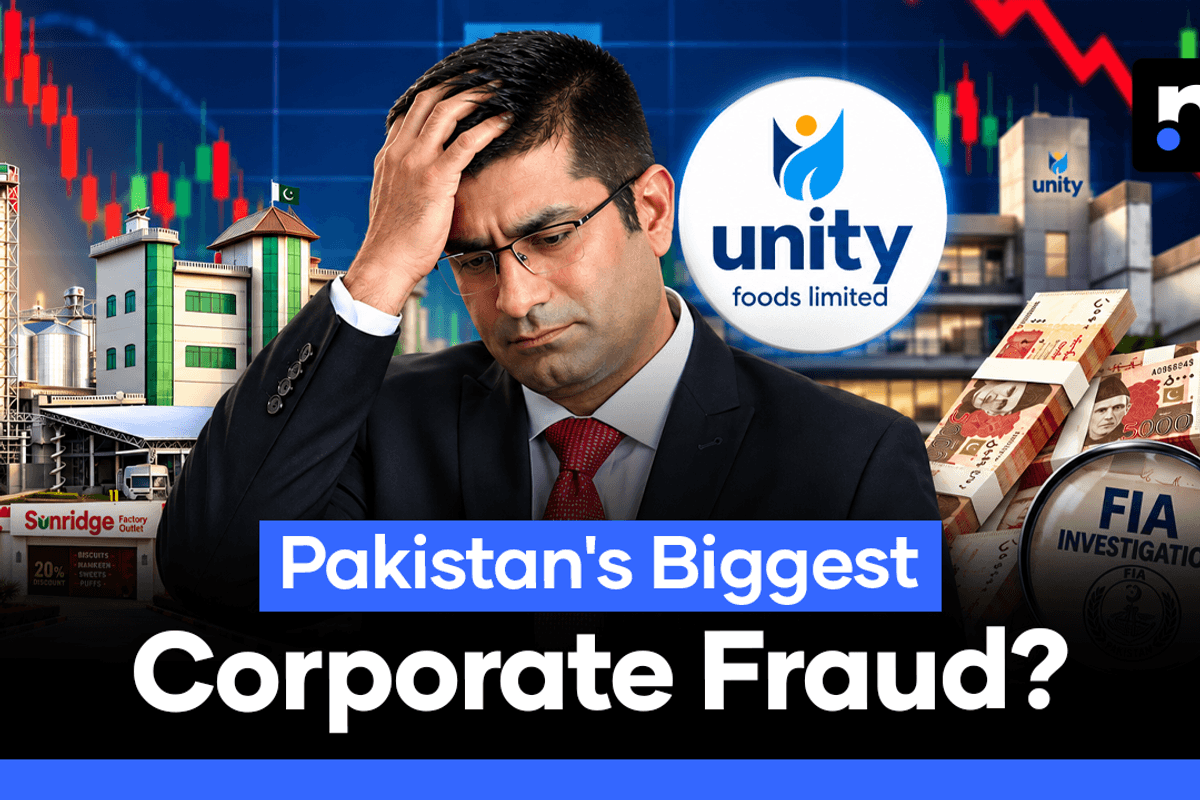
Pakistan's corporate history has seen many players come and go, but few names captured the imagination of entire corporate world quite like Unity Foods Limited did between 2017 and 2023. From the outside, it looked like a modern corporate miracle; a company that seemed to work its way into every Pakistani kitchen almost overnight. Sunridge flour, cooking oil, basmati rice; Unity's presence was everywhere.
The hero of this story was Farrukh Amin Godil, a businessman who sold investors a single, seductive dream: Pakistan's food security, secured under one corporate roof.
Then, in what felt like a single moment, the entire structure folded like a house of cards. The gap between audited balance sheets and reality proved enormous, bank accounts turned up empty, and a scandal worth more than PKR 44 billion came crashing into public view.
This is the story of Farrukh Godil, the rise and overnight collapse of Unity Foods, and the role played by regulators and auditors who, through years of silence, left thousands of retail investors standing on the street with nothing.
When Godil took charge of Unity Foods, his approach was aggressive from day one. To carve out space in the FMCG market, he launched the "Sunridge" brand and that brand was part of television commercials, hard charging marketing, and shelf placement in virtually every retail outlet in the country. Unity became a giant almost overnight.
To fund this aggressive expansion, Godil turned repeatedly to the public markets, raising billions of rupees along the way. In 2019, the company launched a Rights Issue worth PKR 3.75 billion, justified to shareholders as capital for oil storage terminals and other strategic assets. The public, largely, invested with its eyes closed.
But the single biggest turning point in this story came when one of the largest agribusiness companies in the world Wilmar International, took an equity stake in Unity Foods.
The moment Wilmar's name entered the picture, the Pakistan Stock Exchange was electrified. From ordinary retail investors to major financial institutions, the logic seemed simple: if a global giant like Wilmar was willing to buy into Unity Foods, then Farrukh Godil's business model had to be bulletproof. Wilmar's arrival didn't just bring in capital but it opened the door to global supply chains.
More than anything else, the Wilmar partnership handed Godil a shield of international credibility, one that seemed to make questions about his accounts and operations almost unthinkable. With Wilmar's backing behind it, Sunridge and Unity's edible oil portfolio expanded at a pace competitors could only watch. Unity was no longer just a local company but it had become the local face of a multinational giant.
But Godil's appetite did not stop there. Having conquered FMCG, his attention turned to the meat sector and he put his eyes on Al-Shaheer Corporation; a company in the meat sector with a troubled past.
Through Sunridge Foods, Unity acquired a 15.22% stake in Al-Shaheer. The story didn't end there. He later attempted to take full control of Al-Shaheer through a Letter of Understanding.
Allegedly, Unity's group funds and Godil's own relatives were used to engineer this move. Allegedly, more than PKR 1.1 billion is said to have flowed out of Unity's balance sheet to Al-Shaheer, money that was never recovered or reflected back in Unity's accounts. Unity's own cash reserves, it appears, were being squeezed to keep another company afloat.
When the Securities and Exchange Commission of Pakistan (SECP) caught the scent of something wrong, it ordered a forensic audit. The matter was then referred to the FIA's Corporate Crime Circle. When investigators cross-checked Unity's physical SAP records against its published annual reports, the true scale of the fraud began to emerge.
The discrepancy in the records came to nearly PKR 44.7 billion.
One by one, the layers of the story peeled back, and a set of allegations emerged:
The first allegation is inventory fraud. Physical verification found that PKR 5.2 billion worth of stock existed only on paper whereas the warehouses themselves were empty.
The second allegation involves more than PKR 5.3 billion allegedly withdrawn from the company in the form of "loans" made out to Farrukh Godil's mother, Fehmida Amin and that too without the board approval and no banking protocol followed.
The third allegation concerns the PKR 3.75 billion raised from the public through the 2019 Rights Issue. Of that amount, PKR 2.87 billion appears to have no corresponding asset at all meaning no physical infrastructure was ever built.
The fourth and most serious allegation is that PKR 12.45 billion worth of Unity's bank deposits were secretly pledged as collateral, allegedly to cover personal loans taken out by Godil's privately held companies, including Unity Technologies and Unity Plantations.
In the span of what felt like a single night, a corporate giant had turned into a full blown crime scene.
But the biggest question hanging over the entire affair is this: how did this continue for years without anyone noticing? Where were the auditors? Where was the regulator?
Year after year, independent auditors signed off on Unity's financial statements without apparent hesitation. Every annual report told the same story — the company was profitable — even as its operating cash flow was screaming the opposite: that there was no actual cash in the business.
Auditors tucked their concerns into small "Key Audit Matters" footnotes, absolving themselves on paper, but never once raised the fraud as a red flag while it was actively eating away at ordinary retail investors' money. With a name like Wilmar sitting on the board, it seems the auditors, too, found it easier to look the other way.
And the SECP? The regulator stayed largely quiet until Unity simply stopped submitting its half-yearly reports altogether. Only once the situation had become impossible to ignore was the case finally referred to the FIA. We reached out to the SECP to seek their view on this matter however they refused to comment.
By then, it was far too late. FIRs were eventually registered against Farrukh Godil, CFO Jalees Edhi, and their alleged accomplices but by that point, the value of Unity's shares had already been reduced to dust.
Today, the Unity Foods saga stands as one of the darkest chapters in Pakistan's corporate history. This is not simply the story of one man's ambition curdling into greed but it is the story of a system that failed, at every level, to protect the retail investor and not just that but another example of foreign investors being defrauded of their capital.
Sunridge's flour packets may still sit on supermarket shelves today, but the foundation on which the entire enterprise was built never really existed.
Once again, ordinary investors have learned a hard lesson: behind the glossy awards, the polished PR, the international partnerships, and the profits on paper, the truth is often far uglier.
On paper, the case looks open and shut. Whether retail investors and victims actually see justice this time remains to be seen.




Comments
See what people are discussing