

Trump defends Nvidia CEO Jensen Huang over affair with suspected Chinese operative
Trump defends Nvidia CEO Jensen Huang, saying he believes Huang was unaware that his alleged romantic partner was a suspected Chinese spy

News Desk
The News Desk provides timely and factual coverage of national and international events, with an emphasis on accuracy and clarity.
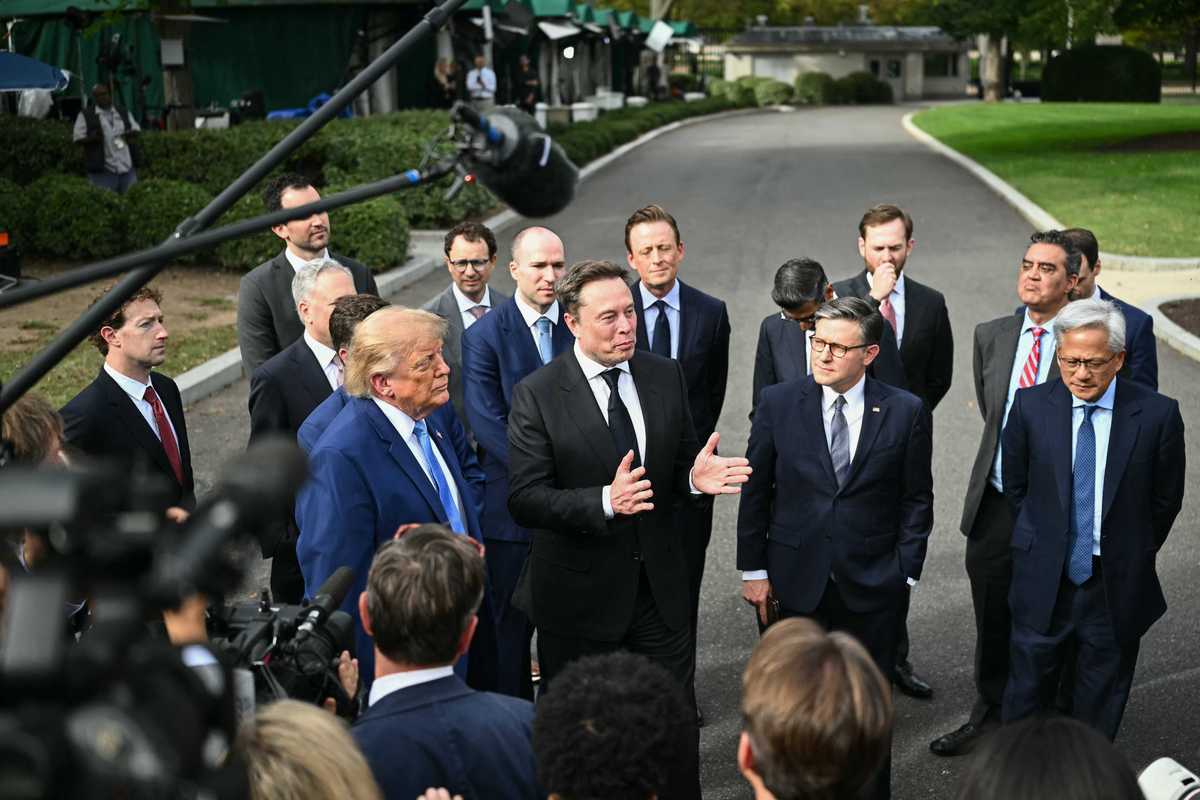
FILE: SpaceX CEO Elon Musk speaks to the press next to US President Donald Trump, House Speaker Mike Johnson and Nvidea CEO Jensen Huang after a meeting of technology executives about artificial intelligence at the White House in Washington, DC, on September 29, 2026.
U.S. President Donald Trump publicly defended Nvidia Chief Executive Jensen Huang on Monday, telling reporters that he directly questioned the tech billionaire regarding his relationship with a suspected Chinese intelligence operative and is convinced Huang was unaware of her espionage ties.
According to the BBC, the presidential defense comes as the Santa Clara-based chipmaker navigates mounting political and regulatory scrutiny over potential counterintelligence vulnerabilities at the core of the global artificial intelligence supply chain.
What did Trump disclose about his conversation with Jensen Huang?
Addressing reporters on the escalating controversy involving the world's most valuable semiconductor company, Trump recounted a direct personal exchange with the Nvidia chief executive.
"I asked him that question, 'Did you have any idea she was a spy?' He said, 'I had no idea she was a spy,' and I really believe him," Trump told the press pool.
The presidential backing reflects a forceful White House intervention, following earlier remarks in which Trump described Huang as an "honorable" and "fine person," CNN reported.
Huang has served as an informal adviser to the administration on semiconductor strategy, often arguing against overly restrictive export controls on commercial computing equipment while seeking managed access to the Chinese enterprise market.
How does Trump’s defense intersect with Nvidia’s board investigation?
The White House endorsement comes as Nvidia’s board of directors proceeds with an independent investigation into whether Huang was the explicit target of a coordinated foreign intelligence operation.
The inquiry was initiated after U.S. intelligence reports indicated that Huang had engaged in an extramarital affair with Alice Huang (also known as Huang Le), a Chinese businesswoman and former executive at Singapore-based data center operator Megaspeed.
U.S. trade authorities had previously placed Megaspeed under scrutiny over suspicions that the firm helped bypass federal export restrictions to divert restricted, high-performance computing hardware to mainland China.
Huang formally acknowledged the relationship in an internal communication to staff, expressing regret for unfaithfulness to his wife and pledging complete cooperation with independent counsel retained by the board.
Nvidia has maintained that internal reviews have yielded no indication that proprietary algorithms, intellectual property, or national security secrets were compromised.
Why do lawmakers remain alarmed by the intelligence breach?
Despite Trump’s public exoneration of Huang's motives, American lawmakers and intelligence officials have expressed acute alarm over the geopolitical implications of the contact.
Nvidia designs the premier graphics processing units (GPUs) and accelerator platforms that underpin leading-edge generative AI models and national security supercomputing clusters.
Since 2022, Washington has treated frontier semiconductor architecture as a core pillar of strategic competition against Beijing, enforcing sweeping export restrictions to deny advanced silicon to the Chinese military-industrial complex.
Congressional leaders across both parties have warned that foreign intelligence approaches targeting executives of systemically critical tech firms pose significant security risks.
Several House and Senate oversight committees are preparing formal inquiries to examine whether corporate security firewalls and export-control compliance programs require tighter federal supervision.





Comments
See what people are discussing