


News Desk
The News Desk provides timely and factual coverage of national and international events, with an emphasis on accuracy and clarity.
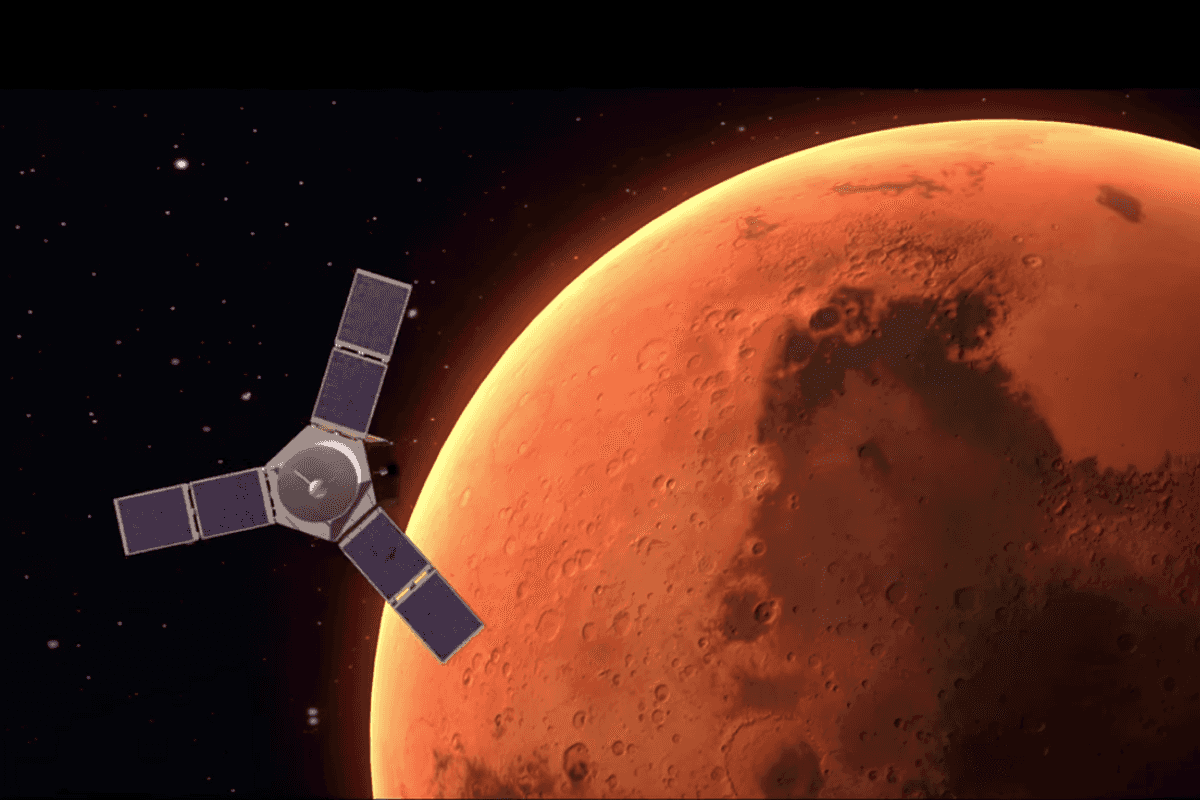
The UAE's EMA mission will send the MBR Explorer on an eight-year journey to study seven asteroids.
Photo via Khaleej Times
The UAE asteroid mission remains on track for launch in the first quarter of 2028, UAE Space Agency official Mohsen Al Awadhi said on Tuesday, according to WAM.
The spacecraft will study seven asteroids to examine water-rich bodies. It will be shipped to Japan for launch.
What is the UAE asteroid mission?
The Emirates Mission to the Asteroid Belt (EMA) is a UAE space program that will send the MBR Explorer spacecraft on an eight-year, roughly five-billion-kilometer journey to study seven asteroids.
It aims to examine the physical and chemical properties, mineral composition and origins of water-rich asteroids, and will include a UAE-built lander.
How far has the UAE asteroid mission progressed?
Al Awadhi, director of the Space Missions Department at the UAE Space Agency, said EMA had made significant progress. This includes the completion of an asteroid lander developed and tested entirely in the UAE in less than two years.
The lander has cleared technical and environmental tests to establish its readiness for flight. It will travel aboard the MBR Explorer before separating near the mission’s final target, asteroid 269 Justitia, where it will approach the surface and capture detailed images.
The Technology Innovation Institute (TII), working with national research bodies and companies, played a central role in developing the lander. It is now being prepared for shipment to the Laboratory for Atmospheric and Space Physics (LASP) at the University of Colorado Boulder, where it will be integrated with the explorer and undergo further testing.
Al Awadhi said the spacecraft had entered its assembly, integration and testing phase after completing its Critical Design Review in 2025 and System Integration Review in September that year. Teams are now combining and testing its subsystems ahead of the lander’s integration.
Further work will involve testing the fully integrated spacecraft under technical and environmental conditions, completing final readiness assessments and transporting it to Japan for launch. The mission is expected to begin its eight-year voyage in early 2028, with its first asteroid encounter, 10253 Westerwald, scheduled for February 2030.
Al Awadhi said the mission team had presented 10 technical papers at the 2026 International Astronautical Congress, detailing engineering progress, development challenges and research.
Why is asteroid 269 Justitia a key target?
EMA aims to deepen scientific understanding of water-rich asteroids, examining their physical and chemical properties, mineral composition and origins. Asteroids preserve material from the early Solar System, offering clues to how planets formed and how water and organic compounds may have reached rocky worlds.
By studying seven asteroids in one mission, researchers will be able to compare their composition, characteristics and evolutionary histories. One of the most significant targets is 269 Justitia, whose spectral features suggest it may have originated in the Kuiper Belt, a distant region beyond Neptune, before moving into the main asteroid belt.
Al Awadhi said studying Justitia could help scientists understand how celestial bodies migrated through the early Solar System and investigate the movement of water and organic materials. The mission will also examine the potential resources available on asteroids and their possible future uses.
What challenges will the MBR Explorer face?
Al Awadhi described EMA as the most complex undertaking in the UAE’s space program to date, pointing to its long travel distance, multiple targets and demanding operating environment. The spacecraft will face substantial temperature changes as it travels near Venus and beyond Mars.
It must also perform precise navigation for gravity-assist maneuvers involving Venus, Earth and Mars, while carrying out high-speed flybys of relatively small asteroids. Greater distances from Earth will create further challenges, including communication delays and reduced solar power.
The explorer has therefore been equipped with advanced thermal-control and power-management systems. The lander is designed to function autonomously, without requiring direct instructions from Earth during its operations.
The launch opportunity will be limited to a three-week window, making detailed engineering, testing and risk management essential, Al Awadhi said. The UAE is working with domestic and international partners to prepare for the launch.
What instruments will the MBR Explorer carry?
The MBR Explorer will carry four main scientific instruments: a high-resolution camera, a thermal infrared camera, a mid-wavelength infrared spectrometer and a thermal infrared spectrometer. Together, they will examine asteroid landscapes, surface features and mineral and chemical composition, while looking for signs of water and organic compounds.
At 269 Justitia, the spacecraft is expected to spend about seven months studying the asteroid from orbit before deploying the lander for a closer approach and detailed imaging. Data gathered during the mission will be shared with the international scientific community.
Which organizations are involved in the UAE asteroid mission?
The program brings together a broad network of UAE institutions and companies, including TII, Sharjah Space and Astronomy Hub, Khalifa University, New York University Abu Dhabi, the Mohammed bin Rashid Space Centre, HEX20 and the National Space Science and Technology Center at United Arab Emirates University.
International partners include LASP at the University of Colorado Boulder, the Italian Space Agency, the Japan Aerospace Exploration Agency, NASA and Mitsubishi Heavy Industries. Their contributions cover areas such as mission development, launch operations and access to deep-space communications networks.
Around 150 Emirati professionals are working on the project alongside international partners, gaining practical experience in spacecraft design, engineering, assembly, testing and operations, Al Awadhi said. He added that the partnerships were enabling local engineers and scientists to take part directly in the mission rather than simply relying on expertise and services from abroad.
How will the UAE asteroid mission support the space economy?
The mission forms part of the UAE’s National Space Strategy 2031, which seeks to build a sustainable and internationally competitive space sector and increase its contribution to the national economy. The project is also expected to develop local expertise and create opportunities for private-sector companies.
About half of the mission’s work has been allocated to private-sector companies, creating opportunities to develop advanced technologies, expand technical capabilities and compete in international markets. The program is also expected to support specialized careers for Emiratis in spacecraft engineering, interplanetary navigation, autonomous landing systems, space operations and scientific data analysis.
Al Awadhi said EMA builds on capabilities developed through earlier national projects, particularly the Hope Probe, while taking the country’s scientific and engineering ambitions further. He said the mission’s success would be judged not only by its scientific findings but also by the expertise it develops, the technologies and companies it helps establish, and its contribution to the UAE’s space economy and readiness for future exploration.




Comments
See what people are discussing