

UN report rejects Taliban denial of militant presence in Afghanistan
The report says TTP attacks from Afghan territory are rising, straining Pakistan-Afghanistan ties and regional stability

News Desk
The News Desk provides timely and factual coverage of national and international events, with an emphasis on accuracy and clarity.
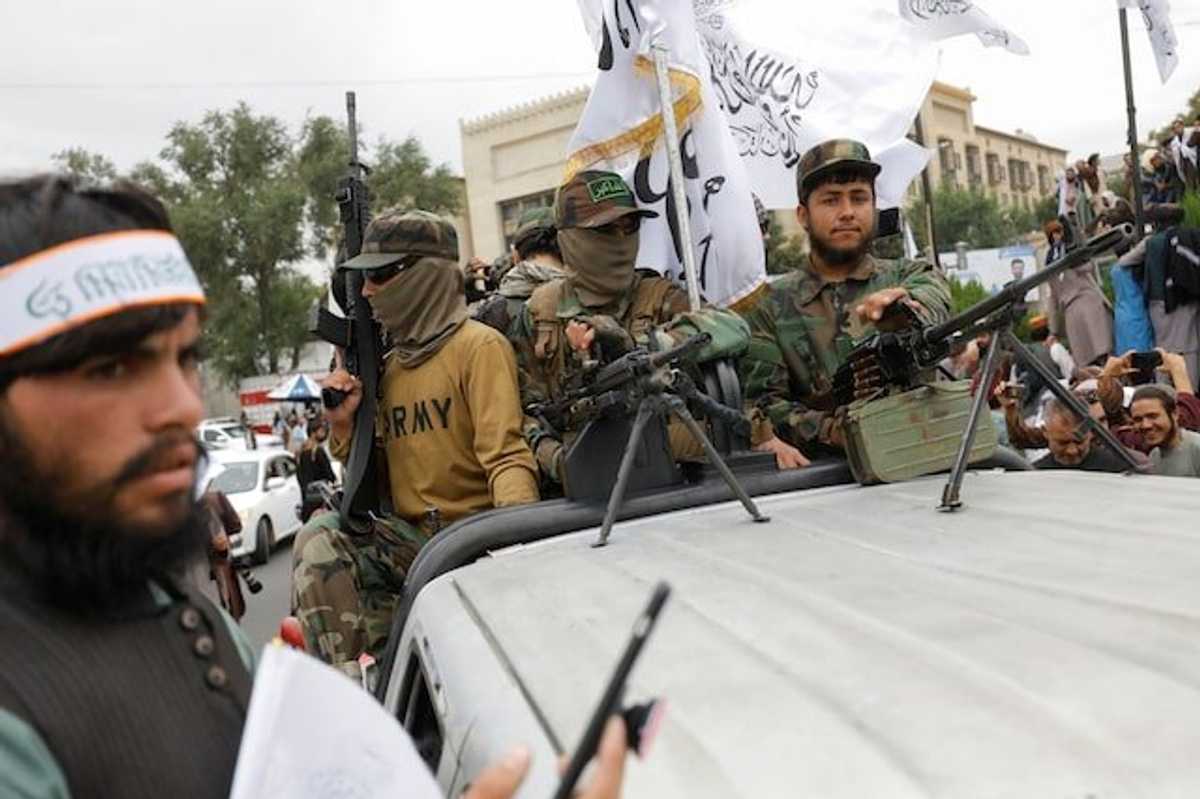
Taliban fighters rejoice on the first anniversary of the fall of Kabul on a street in Kabul, Afghanistan, August 15, 2022.
Reuters
A United Nations Security Council report has dismissed Taliban claims that militant groups are not operating from Afghan territory, calling the assertion “not credible” and warning that neighboring countries increasingly see Afghanistan as a source of regional insecurity.
Pakistan’s leading English-language daily Dawn reported on the findings, which appear in the sixteenth report of the Analytical Support and Sanctions Monitoring Team submitted to the Security Council.
The assessment comes as international concern persists over Afghanistan’s security situation more than four years after the Taliban returned to power in August 2021.
“The de facto authorities continue to deny that any terrorist groups have a footprint in or operate from its territory. That claim is not credible,” the report said.
Doha pledges and militant realities
Under the 2020 Doha Agreement, the Taliban pledged to prevent Afghan soil from being used to threaten other countries. Since regaining power, they have taken forceful action against Islamic State-Khorasan Province, or ISIL-K, but UN assessments say their approach toward other militant groups has differed.
The report said member states “consistently report” the presence in Afghanistan of ISIL-K, Tehreek-e-Taliban Pakistan (TTP), Al Qaeda, the Eastern Turkistan Islamic Movement, also known as the Turkistan Islamic Party, Jamaat Ansarullah and Ittihadul Mujahideen Pakistan.
It added that some of these groups “have used or are continuing to use Afghanistan to plan and prepare external attacks.”
Al Qaeda, the report said, maintains close links with the Taliban and retains a sustained presence in several Afghan provinces. While the group keeps its activities low-profile, UN monitors said it benefits from an environment that allows training and reorganization.
ISIL-K, by contrast, is described as the Taliban’s main adversary. Taliban operations have weakened the group’s territorial control, but the report said ISIL-K has remained resilient and continues to carry out attacks inside Afghanistan and abroad.
TTP seen as gravest threat
The most serious risk to regional stability, however, was identified as the TTP. The UN assessment said the group enjoys strong backing from elements within the Taliban and operates from sanctuaries inside Afghanistan.
“Taliban authorities continue to deny and deflect responsibility for failing to restrain TTP,” the report said, adding that within the Taliban there are “varying degrees of sympathy for and allegiance with TTP.”
The report noted divisions within the Taliban over the group. Some senior figures increasingly see TTP as a liability that damages relations with Pakistan, while others remain supportive.
Assessing the likelihood of the Taliban cutting ties with TTP under pressure from Islamabad, the monitoring team said the Taliban were unlikely to act against the group due to longstanding links. “Even should they wish to, they may lack the ability to do so,” the report said.
According to the assessment, TTP has carried out “numerous high-profile attacks in Pakistan from Afghan soil,” making it the most immediate challenge in relations between Kabul and Islamabad.
“The number of TTP attacks in Pakistan has been increasing throughout 2025,” the report said, citing estimates of more than 600 attacks in Pakistan so far this year.
It added that many of the attacks were complex, involving coordinated teams and tactics such as vehicle-borne improvised explosive devices combined with suicide attackers on foot. A majority of suicide bombers in Pakistan were reported to be Afghans.
Pakistan has long accused the Taliban of sheltering TTP militants. The UN report estimated the group’s strength at about 6,000 fighters, based mainly in the Afghan provinces of Khost, Kunar, Nangarhar, Paktika and Paktia.
The report said TTP chief Noor Wali Mehsud is believed to be living in Kabul. An unnamed member state reported that Mehsud’s family received a monthly payment of three million afghanis, or about $43,000, from the Taliban.
Rising attacks strain Pakistan ties
Disagreements over the TTP presence have badly strained relations between Pakistan and Afghanistan, despite the Taliban once being viewed as close allies of Islamabad.
“These attacks have led to cross-border military confrontation, causing a number of casualties, as well as disruptions to bilateral trade,” the report said. It added that border closures with Pakistan were costing the Afghan economy an estimated $1 million per day.
The monitoring team also said TTP has broadened its targeting. In January, the group issued a directive expanding attacks to include military-owned businesses, escalating its focus on the economic interests of Pakistan’s military and Chinese enterprises in the country.
The report also cited cooperation between TTP and other militant groups.
Despite the wider militant landscape, the UN noted some counterterrorism gains by Pakistan. These included several high-profile arrests, such as the detention of ISIL-K spokesperson Sultan Aziz Azam on May 16, 2025.
“Overall, the capability of ISIL-K has been degraded” by counterterrorism operations by the Taliban authorities and Pakistan, the report said. It added that the mid-2025 arrest by Turkish and Pakistani authorities of Ozgur Altun, also known as Abu Yasir al-Turki, may have contributed to the suspension of ISIL-K’s media outlet, “Voice of Khorasan.”
On Al Qaeda, the report said Osama Mahmoud was formally named emir of Al Qaeda in the Indian Subcontinent in March 2025. He hails from Bajaur district in Pakistan’s Khyber Pakhtunkhwa province.
Pakistan backs UN assessment
Meanwhile, Pakistan said the UN findings support its long-standing position on militant sanctuaries in Afghanistan.
“The UNSC report corroborates what Pakistan has been saying to the Afghan Taliban regime,” Foreign Office spokesperson Tahir Hussain Andrabi said during a briefing on Thursday.
He said the presence of such elements in Afghanistan poses a major threat to regional peace and stability and reaffirmed Pakistan’s assertions on the issue.
—With additional input from Aamir Abbasi.




Comments
See what people are discussing