


News Desk
The News Desk provides timely and factual coverage of national and international events, with an emphasis on accuracy and clarity.
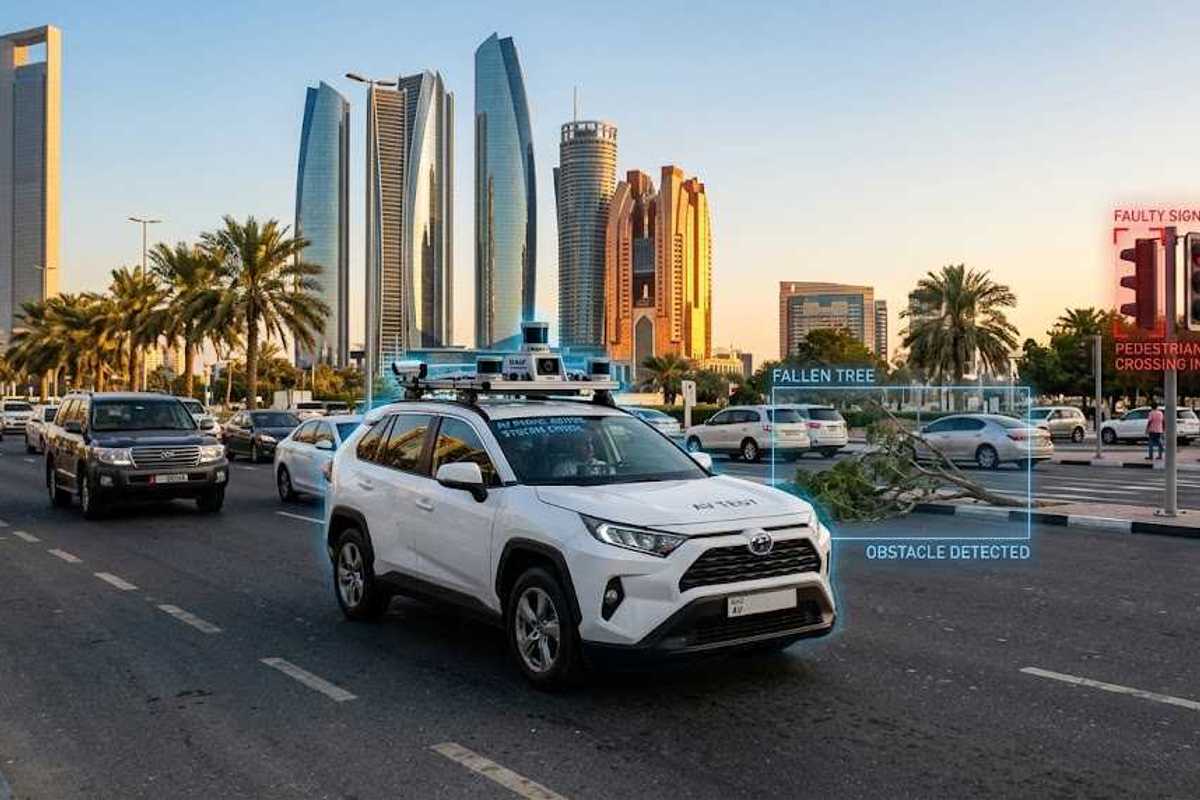
Abu Dhabi’s AI-equipped ‘V City’ vehicle travels across the emirate to detect road accidents, fallen trees and faulty traffic signals.
AI generated
Abu Dhabi is deploying an artificial intelligence-powered vehicle to detect road accidents, fallen trees, faulty traffic signals and other hazards across the emirate, Gulf News reported.
Developed by the UAE AI Alliance for government entities under the V City project, the vehicle identifies and locates potential road hazards and alerts the relevant authorities, helping them respond more quickly.
What does Abu Dhabi’s AI vehicle do?
The vehicle travels across different parts of Abu Dhabi, scanning roads for incidents and obstacles that could disrupt traffic or compromise safety. Once it detects a problem, it sends location-specific information to the relevant authorities so they can assess the situation and respond.
Mohamed Al Amiri, an AI engineer at the UAE AI Alliance, said the vehicle can identify fallen trees blocking roads, unreported accidents, malfunctioning traffic signals and other obstacles. He spoke on the sidelines of AI Everything Abu Dhabi 2026.
How is AI road monitoring different from reports and patrols?
Road hazards are commonly identified through reports from drivers, patrols and surveillance cameras. The AI vehicle adds another layer of monitoring by actively scanning roads as it moves through the city.
This can help authorities identify problems that might otherwise go unnoticed, including fallen trees, non-functioning traffic lights, objects obstructing lanes and accidents that have not been reported.
On busy roads, even a short delay in clearing an obstruction can disrupt traffic, force drivers to change lanes suddenly and increase the risk of secondary accidents.
Why does Abu Dhabi need AI road safety systems?
Road safety remains a significant economic and public safety concern in Abu Dhabi. The Integrated Transport Centre estimates that road accidents cost the economy about Dh5.26 billion in 2025.
The fatality rate fell to 3.11 deaths per 100,000 people in 2025, from 3.41 in 2024. Road safety indicators for 2021 to 2025 also show a 33% decline in fatalities and an 18% reduction in serious injuries.
Abu Dhabi aims to cut road deaths by 50% by 2030, with the longer-term goal of eliminating road fatalities by 2040.
Faster detection of hazards could support these targets by helping authorities identify dangerous conditions and respond before they lead to further incidents.
How does the AI vehicle fit into Abu Dhabi’s traffic network?
The vehicle complements Abu Dhabi’s wider traffic-management infrastructure. At the Abu Dhabi Infrastructure Summit 2026, the Integrated Transport Centre unveiled its Central Traffic Management Platform, which uses AI to monitor accidents, congestion and other road events in real time.
The platform is connected to more than 1,500 surveillance cameras, 253 vehicle sensors and 922 traffic signals. It analyses data from more than 30 sources to help trigger response plans automatically, while 122 electronic message boards provide updates to road users.
Unlike fixed cameras, which monitor specific locations, a mobile AI vehicle can travel between areas and potentially identify hazards outside the immediate view of stationary surveillance systems.
How could AI road data prevent future hazards?
Repeated monitoring could help authorities build a clearer picture of where and when road hazards occur and which types of incidents are most common.
By analysing patterns across thousands of journeys, officials could identify recurring problems and address their underlying causes rather than responding to each incident in isolation.
For example, repeated obstructions in a particular location could indicate a need for improved road design, better maintenance or other permanent safety measures. Identifying patterns in when hazards occur could also help authorities target inspections and resources more effectively.
How will the success of the AI vehicle be measured?
The project’s effectiveness could be assessed through several indicators, including:
- Time taken to detect an incident and notify authorities
- Time between notification and resolution
- Number of incidents identified before members of the public report them
- Reduction in the time road obstructions remain in place
- Number of secondary accidents linked to obstructions or undetected incidents
- Accuracy of the AI system in identifying and classifying incidents
- Reduction in repeated field interventions
- Improvements in traffic flow after incidents are resolved
These measures would help determine whether the vehicle improves response times, reduces exposure to road hazards and delivers measurable safety benefits.
What is Abu Dhabi’s wider push on AI in government?
The AI vehicle is part of Abu Dhabi’s broader effort to integrate artificial intelligence into public services and government operations.
The Abu Dhabi Digital Government Strategy 2025-2027 includes an investment of Dh13 billion in digital transformation and targets the deployment of more than 200 AI solutions across government services. The emirate aims to become the first government to embed AI across its operations by 2027.
In September 2025, the Department of Government Enablement said Abu Dhabi had deployed more than 100 AI use cases across more than 40 government entities.
Abu Dhabi Police also signed a memorandum of understanding with Space42 in January 2026 covering AI and autonomous mobility applications for security systems, mobility vehicles and road safety.
Meanwhile, the Integrated Transport Centre is developing AI systems to analyse risks and forecast traffic challenges, extending the use of predictive technology beyond incident detection to wider transport planning and management.





Comments
See what people are discussing