

CDWP approves seven projects worth PKR 19.3 billion, refers four to ECNEC
Punjab's PKR 104.4 billion agriculture plan and a PKR 47.6 billion youth skills program await ECNEC clearance, while two Iran-border terminals get approval.

Business Desk
The Business Desk tracks economic trends, market movements, and business developments, offering analysis of both local and global financial news.
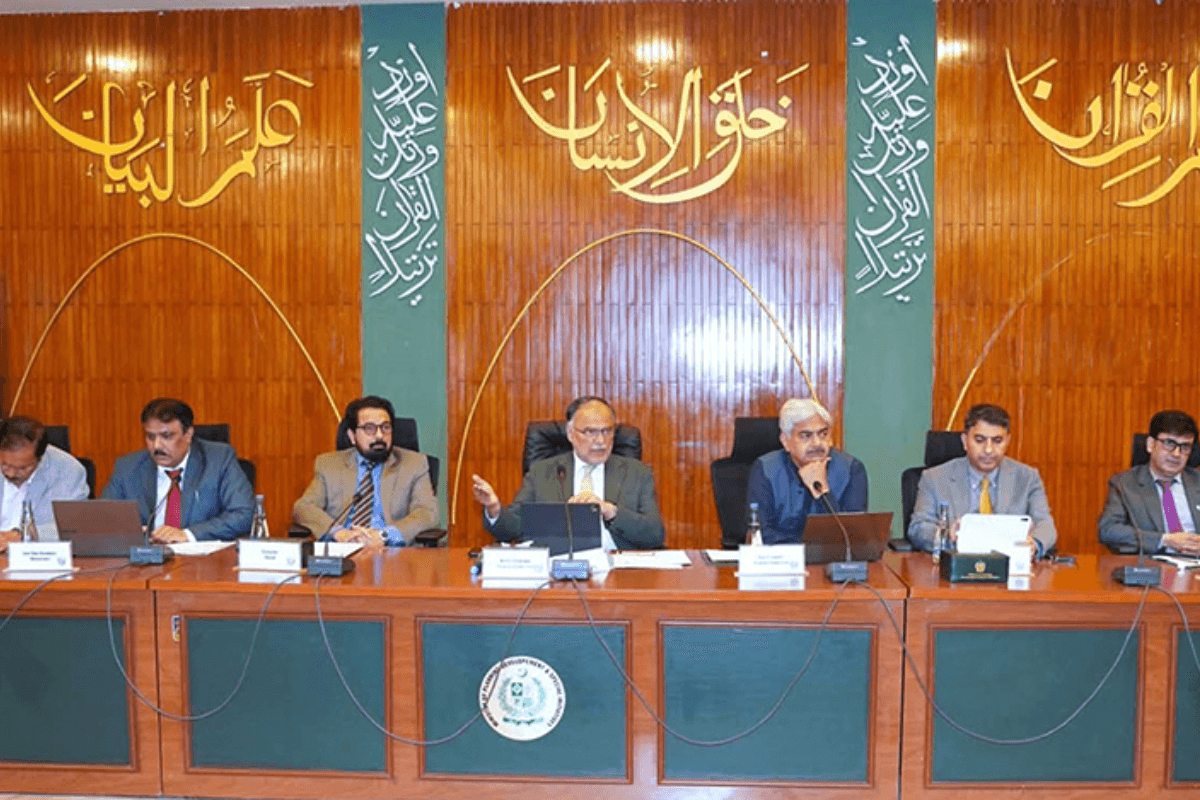
Planning Minister Ahsan Iqbal chairs a Central Development Working Party meeting in Islamabad on November 20, 2026, where seven development projects worth PKR 19.3 billion were approved and four were referred to ECNEC.
APP
Pakistan's Central Development Working Party (CDWP) reviewed 11 development projects worth PKR 191.8 billion on Friday, approving seven worth PKR 19.3 billion and referring four totaling PKR 172.4 billion to the Executive Committee of the National Economic Council (ECNEC), the government said.
Which CDWP projects were approved or referred to ECNEC?
The seven CDWP-approved projects include two Iran-border terminals, a medical college in Muzaffarabad, expanded cellular coverage in Azad Jammu and Kashmir and Gilgit-Baltistan, and a Sindh youth employment program. Larger proposals for Punjab agriculture, national youth skills and two road schemes were forwarded to ECNEC, where final approval remains pending.
The meeting was chaired by Federal Minister for Planning, Development and Special Initiatives Ahsan Iqbal, who also serves as deputy chairman of the Planning Commission.
Which major projects were referred to ECNEC?
The largest proposal was Punjab's Resilient and Inclusive Agriculture Transformation (PRIAT) project, costing PKR 104.4 billion.
The proposed financing includes PKR 91.120 billion from the World Bank and PKR 13.313 billion from the Punjab government.
The project aims to improve farmers' incomes and agricultural water access through upgraded watercourses, irrigation systems, solar-powered irrigation, water storage ponds, certified plants and seeds, and crop diversification. It also includes value addition and measures to improve farmers' access to markets through Farmers Entrepreneur Groups.
The CDWP also gave in-principle approval to the third revised Prime Minister's Youth Skill Development Program (2023–28), costing PKR 47.6 billion, and recommended it to ECNEC.
The project is proposed to be financed through the Public Sector Development Programme (PSDP) and implemented by the National Vocational and Technical Training Commission (NAVTTC).
Iqbal directed officials to rationalize the project's cost and avoid duplication of work.
Two road projects were also referred to ECNEC: the revised Sibi–Talli and Kohlu–Rakhni road construction and widening project, costing PKR 11.1 billion, and the Sui–Kashmore black-topped road project, costing PKR 9.3 billion.
The first covers 23.52 kilometers between Sibi and Talli and 85.16 kilometers between Kohlu and Rakhni.
Which projects received CDWP approval?
Among the seven approved schemes were two border terminals along the Pakistan-Iran border, costing approximately PKR 9.15 billion combined.
The Taftan terminal in Balochistan was approved at PKR 4.8 billion, while the Gabd terminal will cost approximately PKR 4.35 billion.
The projects are intended to regulate cross-border trade, create employment opportunities and help curb smuggling.
The forum also approved a PKR 4.4 billion project to expand cellular services in Azad Jammu and Kashmir and Gilgit-Baltistan.
In the health sector, CDWP approved the revised establishment of Mirwaiz Molvi Muhammad Farooq Shaheed Medical College in Muzaffarabad at a cost of approximately PKR 3.4 billion.
The Pakistan Atomic Energy Commission's PKR 1.4 billion project to explore radioactive minerals in the Marwat Range was also approved, with the objective of reducing reliance on imported fuel for nuclear power generation.
Another approved initiative was the PKR 600 million Youth Education, Employment and Empowerment Project Sindh (YEEEP-Sindh).
Supported by UNDP funding under a 50:50 cost-sharing arrangement, the project will operate in 16 districts and target 15,000 young people, approximately half of them women.
It will provide skills training, entrepreneurship support, internships and employment linkages in sectors including garments, construction, agriculture, energy, services, tourism and information technology.
The CDWP also approved the revised Strengthening Institutions for Refugees' Administration (SIRA) project, costing PKR 255.8 million, with financing through technical assistance under a World Bank IDA loan.


Comments
See what people are discussing