


News Desk
The News Desk provides timely and factual coverage of national and international events, with an emphasis on accuracy and clarity.
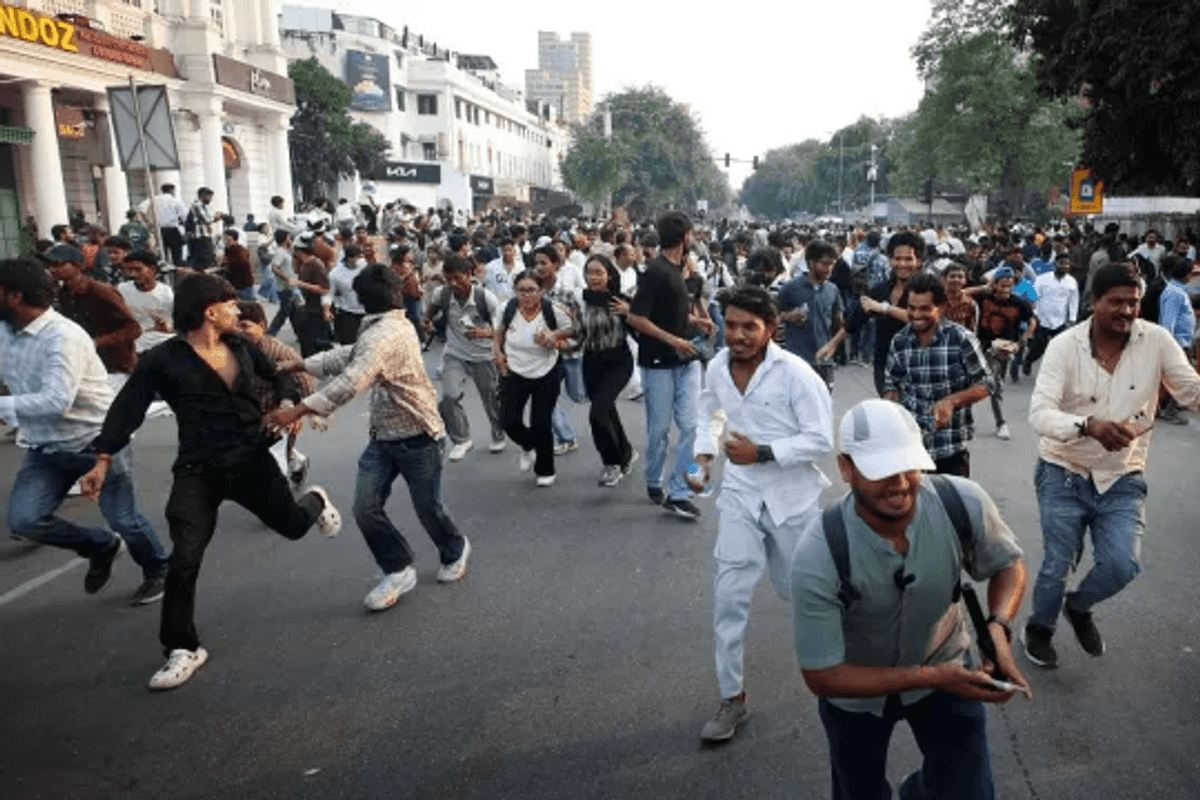
The protest demands the resignation of Election Commission of India chief over a voter-roll revision critics.
Photo via X
Indian police detained Cockroach Janta Party (CJP) founder Abhijeet Dipke and thousands of protesters trying to join a major demonstration in New Delhi on Saturday, the group said.
The protest demands the resignation of Election Commission of India chief Gyanesh Kumar over a voter-roll revision critics say could disenfranchise millions.
What is the Cockroach Janta Party protest in Delhi?
The CJP, a satirical online movement, called the demonstration at the Jantar Mantar protest site in New Delhi. It follows weeks of opposition mobilization over allegations of misconduct in a nationwide voter-roll revision by the Election Commission of India (ECI). Protesters also want the revision halted.
The demonstrations are widely seen as a reprise of the “cockroach” movement’s mass mobilization in July, which led to the education minister stepping down over an examination scandal. This time, protesters want Kumar to resign.
Who has been detained at the Delhi protest?
Dipke and two other leaders were detained before disembarking from a flight in the capital, according to a statement from the group. “They’re being denied access to their lawyers and cut off from all contact with others,” it said, adding the trio had been taken to “an undisclosed location”.
The CJP also said that thousands more protesters were detained in New Delhi as they attempted to march to the main Jantar Mantar protest site, defying a massive security clampdown. “More than 15,000 protesters have been detained,” Ajinkya Shinde, a CJP leader, said at a news conference in Delhi. Police did not immediately respond to AFP’s request for comment on detentions.
The Hindu newspaper reported more than 5,000 protesters had been detained, although it was not immediately possible to verify that number. Media outlets, including the Scroll and Newslaundry, said their journalists had also been detained briefly.
Dozens of protesters shouted anti-government slogans as they were taken away in police vehicles, AFP reporters witnessed. “We will be back, let them fill up all the jails,” Shinde said.
How did authorities and critics react to the protest?
Ahead of the protest, authorities in the capital deployed thousands of police, closed dozens of metro stations, cancelled more than 200 trains and temporarily shut down mobile internet around the protest site.
Demonstrators expressed anger on Saturday, telling AFP their right to protest peacefully was being hampered. Saransh, a university graduate, walked several miles after navigating security barricades to get close to the Jantar Mantar protest site. “I am here to protect the constitution,” said the 24-year-old, who gave only one name. “Why do I need permission to peacefully express my opinion?”
Amnesty International denounced the “lockdown-like restrictions”, and Rahul Gandhi, leader of the opposition Congress party, called on young people to continue with the rallies. “Youth of India, I am proud of you. Keep protesting. We are standing with you,” he said. The United Nations’ human rights office urged India to release those “arbitrarily detained” in the protests and expressed concern at reports of mass detentions.
BJP spokesman Sambit Patra said on Saturday the CJP had failed in its attempt to spread “anarchy”. “What is happening at Jantar Mantar, what you can see on TV and a few social media handles, is not India’s story,” he told reporters.
Why are protesters targeting the Election Commission of India?
Calls for the ECI chief Gyanesh Kumar to step down have intensified in recent weeks as opposition parties and critics said his commission’s voter-roll revision could disenfranchise millions of constituents and benefit Prime Minister Narendra Modi’s ruling Hindu nationalist Bharatiya Janata Party. The ECI has rejected allegations of impropriety, saying the revision was intended to remove duplicate and ineligible voters.
The issue flared up last month when the Indian Express newspaper reported that key decisions linked to the revision were likely taken without the approval of two of the three election commissioners. The ECI, a constitutional body, says all its decisions were unanimous and legally valid.
The voter list overhaul, which began in 2025, has led to more than 133 million names being excluded from draft rolls, according to Indian media reports citing ECI data. The ECI has said the revision identifies fraudulently registered voters and aims to prevent “foreign illegal immigrants” from voting.
Critics say the drive has disproportionately affected marginalised and minority communities. Members of Modi’s party have long alleged that large numbers of undocumented Muslim migrants from neighbouring Bangladesh have fraudulently entered India’s electoral rolls.
What does the protest mean for Modi?
The accusations are a fresh challenge for 76-year-old Modi during his third term in office. Opposition parties have long alleged that legitimate voters are being struck off lists in India, the world’s largest democracy with 1.4 billion people.
Political analyst Nilanjan Mukhopadhyay told AFP the protest comes at a time when Modi appears to be “at his weakest politically and individually”. Though India’s next general elections are not slated until 2029, the country’s most populous state of Uttar Pradesh will go to the polls next year. “I see this becoming a bigger challenge in the coming months,” Mukhopadhyay said.




Comments
See what people are discussing