

From brinkmanship to partnership: Pakistan-Iran ties deepen after 2024 crisis
Trade targets, border security and regional politics now define Pakistan-Iran ties, according to Kamran Khan

News Desk
The News Desk provides timely and factual coverage of national and international events, with an emphasis on accuracy and clarity.
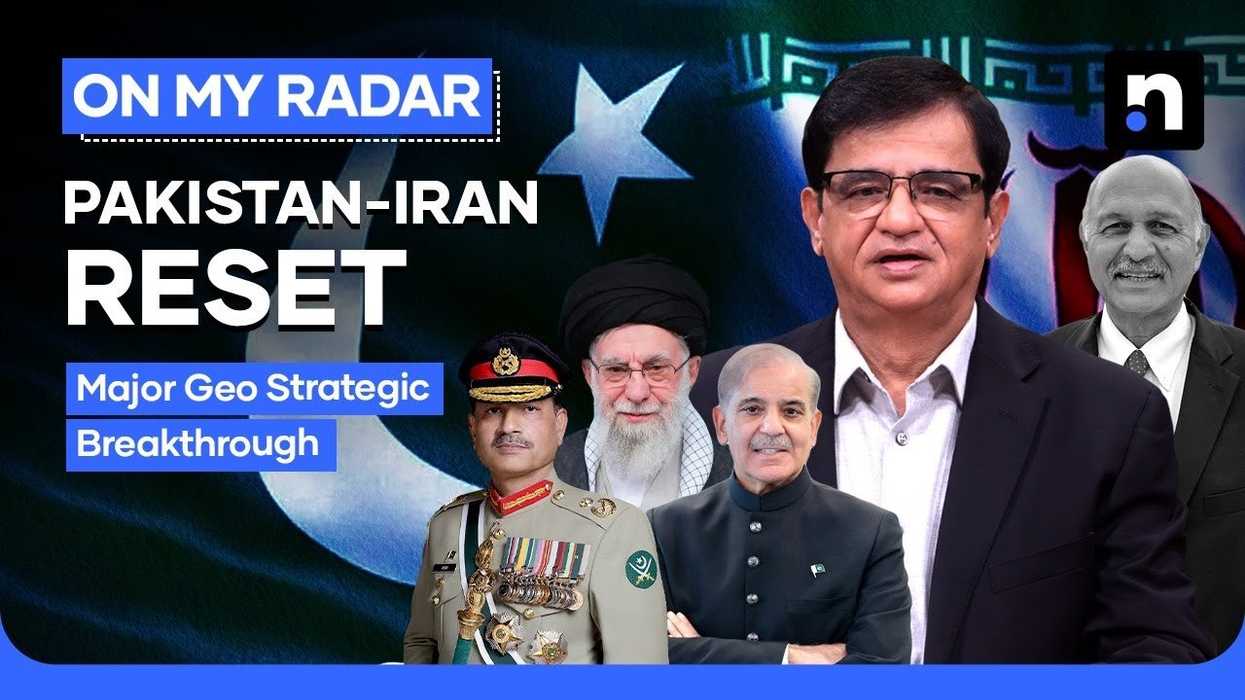
Pakistan and Iran are entering a new phase of diplomatic, economic and security cooperation, Kamran Khan said during a recent episode of his program “On My Radar.”
Khan said the latest developments mark a sharp contrast to early 2024, when the two neighboring countries exchanged missile strikes and briefly appeared to be heading toward open conflict.
He recalled that in January 2024, Iranian missile attacks on Pakistani territory prompted a strong retaliatory response from Pakistan, creating what he described as a “near-war” situation. The crisis, he said, was ultimately brought under control through diplomatic engagement on both sides.
According to Khan, relations gained new regional importance after the Iran-Israel war broke out in May 2025. He said it remains unclear whether Pakistan provided Iran with any strategic-level assistance during the conflict.
However, Khan said Pakistan offered strong diplomatic backing to Iran, issued forceful condemnations of Israeli actions and took positions that were publicly welcomed in Tehran.
He noted that at one point, Iran’s parliament echoed with chants of “Thank you, Pakistan,” reflecting Tehran’s appreciation of Islamabad’s diplomatic support during the war.
In recent months, sustained high-level engagement has underscored what Khan described as a mutual desire in Islamabad and Tehran to strengthen historical ties at every level.
Iranian President Masoud Pezeshkian paid his first official visit to Pakistan in August 2025, following the Iran-Israel conflict. Earlier, Prime Minister Shehbaz Sharif visited Iran in May 2025 after regional tensions linked to India.
Khan said that in just six months, Field Marshal Syed Asim Munir and President Pezeshkian have held three meetings in Islamabad, Tehran and the Chinese city of Tianjin.
In November 2025, Iran’s Supreme National Security Council Secretary Ali Larijani visited Islamabad and held meetings with Pakistan’s civilian and military leadership.
During talks with Pakistan’s National Security Adviser Lt. Gen. Asim Malik, Larijani stressed the need for intelligence sharing to deal with the region’s changing security situation, Khan said.
He said both countries now appear to be planning a future in which security challenges are treated as a shared responsibility rather than a bilateral dispute.
On the economic front, Khan said Pakistan and Iran have set what he called a “revolutionary” target of boosting annual bilateral trade and economic partnership to $10 billion from the current level of about $3.1 billion.
To achieve this, the two sides are working on a possible free trade agreement and the activation of six new markets along the Pakistan-Iran border. Khan said three of those border markets are already operational.
He added that Iran has shown interest in joining the China-Pakistan Economic Corridor, which Islamabad sees as a central pillar of its regional connectivity strategy.
Energy cooperation, Khan said, remains a major opportunity but also a serious challenge. He noted that while Iran has vast oil and gas reserves and Pakistan is a large consumer market, U.S. sanctions on Tehran continue to constrain large-scale energy projects.
Khan identified a major security shift in Iran’s acknowledgment that cross-border terrorism in Pakistan’s Balochistan province is a shared threat.
He said both countries’ civil and military leaderships are now working to translate political intent into concrete security cooperation.
Pakistan and Iran share a roughly 900-kilometer border. Khan said both sides are intensifying joint measures to curb terrorism and smuggling along the frontier.
Joint operations have already targeted militant groups including the Balochistan Liberation Army and Jaish al-Adl, he said.
Iran’s navy also participated in Pakistan Navy’s multinational exercise “Aman 2025,” which Khan described as a significant signal of growing military coordination.
He said Iran has expressed interest in a broader defense arrangement with Pakistan, potentially covering intelligence sharing, joint defense cooperation and long-term strategic partnership.
Khan also pointed to what he described as a visible change in Iran’s regional and international posture.
In the past, Iran faced allegations of backing proxy groups across the Middle East. Questions were also raised about Indian influence and the presence of hostile militant actors on Iranian soil.
Khan said Iran’s policies now appear to be shifting under changing regional dynamics. He cited the China-brokered easing of tensions between Iran and Saudi Arabia as a key example.
He added that Indian influence in Iran is declining and that New Delhi’s footprint at the Chabahar port is shrinking.
Khan said Iran has also offered to mediate between Pakistan and the Afghan Taliban, while Islamabad and Tehran now show rare diplomatic alignment on several geopolitical issues, including the Palestinian question.
Together, Khan said, the recent diplomatic, economic and security developments suggest that Pakistan-Iran relations are undergoing a strategic transformation.
A relationship once shaped by distrust, border tensions and suspicion is now being reoriented around mutual confidence, cooperation and a shared vision of regional stability, he said.


Comments
See what people are discussing