

Glacier collapse may have triggered deadly Nepal flash flood, experts say
A glacier collapse may have triggered Nepal's deadly flash flood, experts say, citing satellite imagery showing a large ice-rock avalanche

News Desk
The News Desk provides timely and factual coverage of national and international events, with an emphasis on accuracy and clarity.
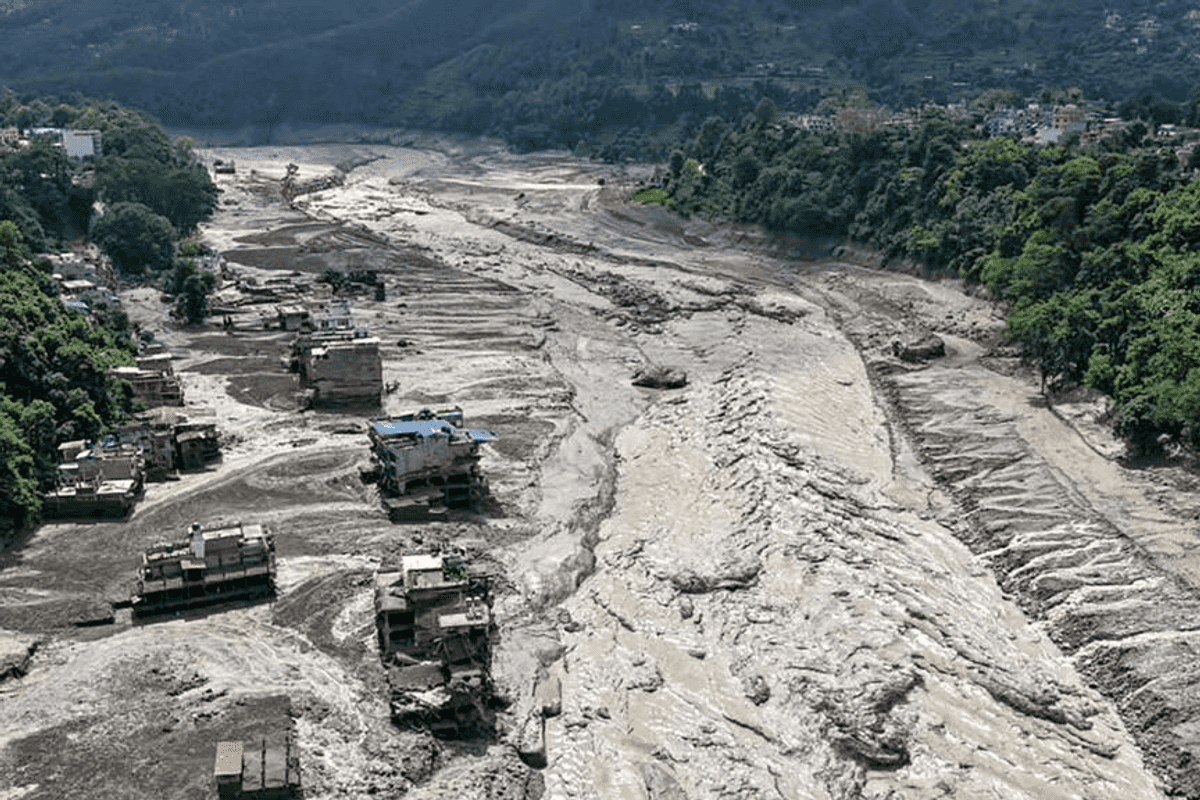
Experts say the lower section of a glacier collapsed and crashed onto the valley floor below, likely pulling rock and sediment with it.
AFP
A deadly flash flood near Nepal's border with Tibet on Wednesday may have been triggered when the lower part of a glacier broke off and crashed onto the valley floor hundreds of metres below, experts said, citing satellite imagery from Planet Labs.
What triggered the deadly Nepal flash flood?
Experts say the lower section of a glacier collapsed and crashed onto the valley floor below, likely pulling rock and sediment with it. Satellite imagery reviewed by Reuters showed the region's lush green mountainside now buried under brown debris. Nepali officials had initially pointed to an earthquake, but the U.S. Geological Survey later said the tremor was in fact seismic energy generated by the glacial collapse and debris flow.
Authorities on both sides fear the total casualty count will be far higher than the nearly 170 bodies recovered so far. Nearly 1,500 people, including at least 700 foreigners, remain missing.
What do satellite images show about the glacier collapse?
"It's confirmed that a substantial portion of that glacier snout collapsed to initiate the event, probably including or entraining a fair amount of rock and sediment," said Vikram Gupta, who specialises in engineering geology and teaches at India's Sikkim University. Earth scientist Dan Shugar, an associate professor at the University of Calgary, said the imagery seemed to show that a large amount of snow had melted in the 24 hours before the disaster.
"Some of the glaciers in the valley were covered in snow yesterday and today they are mostly bare ice. So in other words, and I haven't seen any weather station data yet, it was probably warm," he said. Shugar said the lower part of a glacier broke off at about 5,200 metres and crashed onto the valley floor about 1,200 metres below, based on this morning's Planet Labs imagery.
Is climate change linked to Nepal's glacier collapse?
Nepal's snow-capped mountains have lost close to one-third of their ice in just over 30 years due to global warming, the United Nations said in 2023. The agency added that glaciers in Nepal, wedged between two major carbon emitters, India and China, melted 65% faster in the last decade than in the previous one. Shugar said construction could be a factor too, and "whether climate change played a role is something we will no doubt be looking into in the near future."
Andrew Zolli, Planet's chief impact officer, said his organisation would be releasing fuller imagery soon under an open licence to aid frontline response. "Dan's analysis suggests this may have been the result of a glacier collapse, due to rapid melting," Zolli wrote on LinkedIn. "Whether that, in turn, had a climate component is something that I'm sure will get scrutiny in the days to come."
Where exactly did the ice-rock avalanche occur?
Several hydropower projects are located in the worst-affected areas of Rasuwa, a mountainous district with a population of about 50,000. Nepal's National Disaster Risk Reduction and Management Authority said the "glacier-inclusive flood" occurred in the Lhende River due to a landslide about 20 km (12 miles) northeast of a Nepal-China border crossing.
"The flash floods were caused by an ice-rock avalanche on the Nepali side," said Prakash Pokharel, a geologist at the authority who reviewed the Planet Labs images. Floods, landslides, avalanches and droughts are increasing in frequency and ferocity across the Hindu Kush Himalayas, and accelerating changes to water, land and air across the region pose a major threat to people, the International Centre for Integrated Mountain Development says.
The group said on Wednesday the flash flood sent a powerful surge of water, sediment and boulders through the Bhote Koshi and Trishuli river systems. Water levels on the river at the Galchhi area downstream reportedly rose by as much as nine metres (30 feet) within 30 minutes.





Comments
See what people are discussing