

Hesson, Farhan reflect on Pakistan’s defeat in final Sri Lanka T20I
While Pakistan secured the series, the final defeat served as a reminder that squad depth, middle-order stability and tactical adaptability will remain crucial as they prepare for tougher international challenges

Zaid Hassan
Producer
Zaid Hassan, a seasoned sports journalist, led Cricket Pakistan as editor for four years, shaping its coverage with insightful analysis. Now a producer at Nukta, he expands into broader storytelling while remaining a key voice in Pakistan’s sports media.
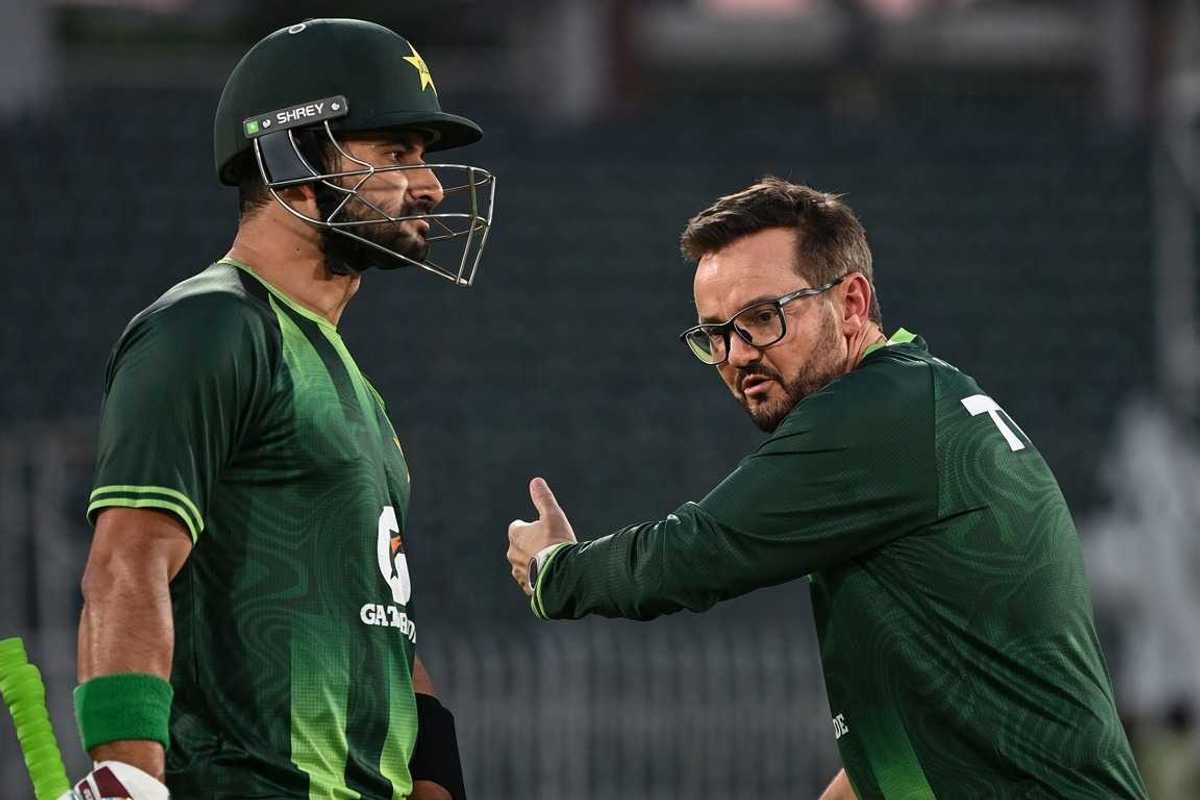
Pakistan's white-ball head coach Mike Hesson (right) in conversation with Sahibzada Farhan (left) during a training session ahead of the first ODI against Australia at Rawalpindi Cricket Stadium on May 29, 2026, in Rawalpindi, Pakistan.
AFP
Pakistan head coach Mike Hesson and captain Sahibzada Farhan acknowledged the team’s shortcomings after Sri Lanka secured a consolation victory in the third T20I at the Rawalpindi Cricket Stadium on Tuesday, ending the hosts’ hopes of completing a series whitewash.
Despite the defeat, Pakistan clinched the three-match series 2-1 after winning the first two games. However, their performance in the final fixture exposed weaknesses in the middle order and highlighted areas that need improvement ahead of the upcoming ODI tri-series involving Sri Lanka and England.
Hesson defended the decision to experiment with the squad, while Farhan reflected on the batting collapse, praised Arafat Minhas’ contribution and stressed the importance of maintaining consistency.
What went wrong for Pakistan in the third T20I?
Pakistan struggled to replicate the batting performances that had helped them dominate the opening two matches, finishing with 168/8 in their allotted 20 overs.
Although Farhan scored another half-century, the middle-order collapse threatened to leave the hosts with a considerably smaller total. A late counterattack from emerging all-rounder Arafat Minhas helped Pakistan approach the 170-run mark.
Speaking at the post-match press conference, Hesson admitted that his side had fallen short of expectations.
“Today, we certainly weren’t at our best. We made few changes. We lost our way a little in the middle order, which probably left us 20 or 30 runs short. The ball also started skidding nicely in the second innings and we weren’t able to execute what we wanted,” Hesson said.
Sri Lanka capitalised on Pakistan’s struggles, chasing down the 169-run target with eight wickets remaining and 17 balls to spare. Captain Kusal Mendis led the response with an unbeaten half-century.
Why did Hesson defend Pakistan’s decision to experiment?
Hesson explained that Pakistan’s strong record in T20I series over the preceding 18 months had provided the team with an opportunity to give younger players valuable international exposure.
The coach maintained that the decision to make changes for the final fixture was justified, even though the experiment ended in defeat.
He added that Pakistan had won every series during the period, giving them the confidence to explore their squad options.
“We have 100 percent ratio from a series point of view. We have won every single series, so we have earned the right to expose our squad to some opportunities in third T20I, which was good,” he said.
The defeat therefore offered Pakistan an opportunity to assess their depth while identifying areas that require attention before more challenging assignments.
How did Farhan assess Pakistan’s batting collapse?
Farhan acknowledged that Pakistan had entered the match with the same intention of posting a substantial total but admitted that cricket does not always follow the planned script.
“The way we set a superb target in the first two matches, today also we had the same plan, but it's cricket, anything can happen,” said Farhan at the post-match presentation.
The captain also explained that the middle-order setbacks had forced him to focus on batting deep into the innings.
“Maaz was unlucky today, so the responsibility was on me, so I wanted to bat long. Can't decide someone's performance based on one match,” Farhan shared.
He revealed that Pakistan had briefly feared they would finish with only 140 runs before Minhas’ aggressive batting changed the situation.
“At one point we felt we'll only get 140. But the way Arafat batted helped us get 170,” he added.
Farhan finished the series with three consecutive half-centuries and a record tally of 238 runs, earning the Player of the Series award despite Pakistan’s final-match defeat.
What did Hesson say about Farhan’s captaincy?
Hesson believes Farhan is gradually becoming more comfortable in his leadership role, trusting his instincts and improving his ability to read the game.
However, the coach pointed out that captaincy becomes more challenging when experienced players are unavailable to provide guidance on the field.
“Captaincy is also about having people around you that can assist you on the park and having some more experienced heads. Today, didn’t have quite that experienced heads out there, but I think his captaincy will develop. In T20s, the game move fast, and you got to stay ahead of the game,” Hesson said.
Farhan, meanwhile, emphasised that consistency remained his main objective, acknowledging that performances inevitably fluctuate in cricket.
“The effort is to stay consistent. When I perform well, I'm even more focused to do well in the next match. It's cricket, you're not always in form. So I'm looking to make the most of it,” Farhan stated.
What lies ahead for Pakistan?
Pakistan will now turn their attention to the ODI tri-series featuring Sri Lanka and England, starting from Sunday, with Hesson expecting a significant challenge against the English side, currently ranked number one in ODIs.
The coach believes Pakistan have improved in the 50-over format in recent times but stressed that the upcoming matches will provide a meaningful test of their progress.





Comments
See what people are discussing