

Houthis claim strikes on Riyadh airport and refinery as Pakistan and Turkey pledge rapid troop deployment
Yemen's Houthi movement launched missile and drone attacks targeting King Khalid International Airport and an Aramco refinery, prompting Saudi Arabia, Pakistan, and Turkey to activate a mutual defense pact for the rapid deployment of military forces to protect the Kingdom

News Desk
The News Desk provides timely and factual coverage of national and international events, with an emphasis on accuracy and clarity.
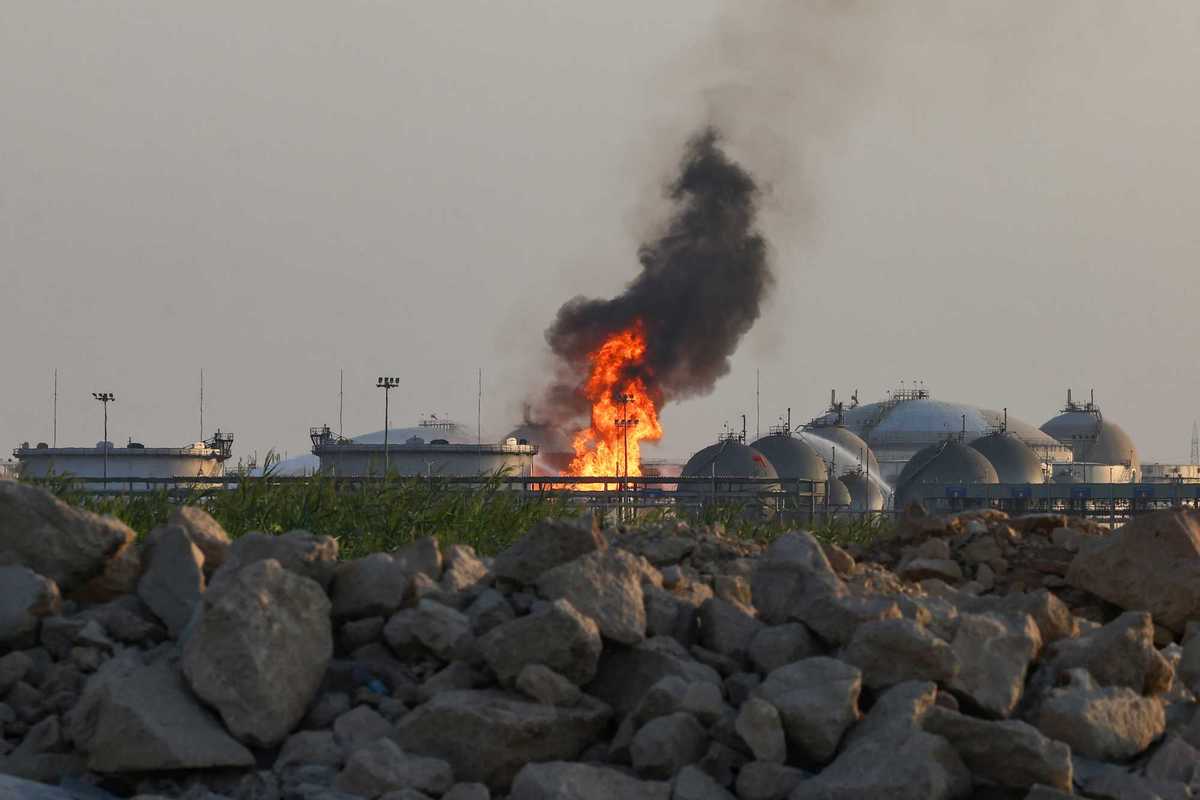
FILE: Flames burn at a facility belonging to Saudi oil giant Aramco south of Riyadh on October 3, 2026.
AFP
Loud explosions shook the Saudi capital as Yemen's Iran-backed Houthi militia launched a series of coordinated missile and drone strikes targeting King Khalid International Airport, an Aramco refinery in Rabigh, and military sites across southern Saudi Arabia.
What occurred during the Houthi attacks on Riyadh and Saudi oil infrastructure?
According to statements issued by Houthi military spokesman Yahya Saree, the group conducted three qualitative military operations utilizing ballistic missiles, cruise missiles, and autonomous drones. Saree claimed the strikes directly hit King Khalid International Airport in Riyadh, disrupting air traffic, and ignited a fire at the Aramco refinery in Rabigh along the Red Sea coast. Additional strikes targeted Abha Airport, Khamis Mushait Air Base, and military encampments in Asir, Najran, and Jizan.
The attacks follow earlier strikes that disabled pumping along Saudi Arabia's East-West pipeline, a critical bypass route for crude exports since Iran's blockade of the Strait of Hormuz. Speaking at the Energy Intelligence Forum in London, Saudi Aramco CEO Amin Nasser warned that global crude inventories are "scarily thin" and the global supply system is under severe strain because of escalating regional warfare.
How are Saudi Arabia, Pakistan, and Turkey responding to the escalation?
The sudden spike in cross-border strikes triggered immediate diplomatic and military countermeasures across the region.
Senior officials from Saudi Arabia, Pakistan, and Turkey convened an emergency meeting of the Makkah Joint Defence Alliance in Riyadh. Following the meeting, Islamabad and Ankara agreed to activate collective deterrence commitments and oversee the rapid deployment of military forces and capabilities to Saudi Arabia.
The Saudi-led military coalition launched major counterstrikes along Yemen’s Red Sea coast, including naval strikes around Hodeida targeting Houthi weapons depots, booby-trapped vessels, and naval mines. At the same time, Yemeni government forces launched a 1,000-strike offensive aimed at retaking the Houthi-held capital, Sanaa, supported by around 100 coalition aircraft sorties.
UN Secretary-General António Guterres condemned the Houthi cross-border attacks and expressed deep concern over the sharp escalation. More than 184,000 people have reportedly been displaced across Yemen in recent weeks.
Trilateral military committees are coordinating the logistics and force structure of incoming Pakistani and Turkish contingents. The forces are reportedly being positioned to help secure critical energy and defense infrastructure across Saudi Arabia.





Comments
See what people are discussing