

UN court finds Myanmar responsible for genocide against Rohingya in landmark ruling
The ICJ has found Myanmar responsible for genocide against the Rohingya, citing mass killings and widespread sexual violence in a 2017 crackdown

News Desk
The News Desk provides timely and factual coverage of national and international events, with an emphasis on accuracy and clarity.
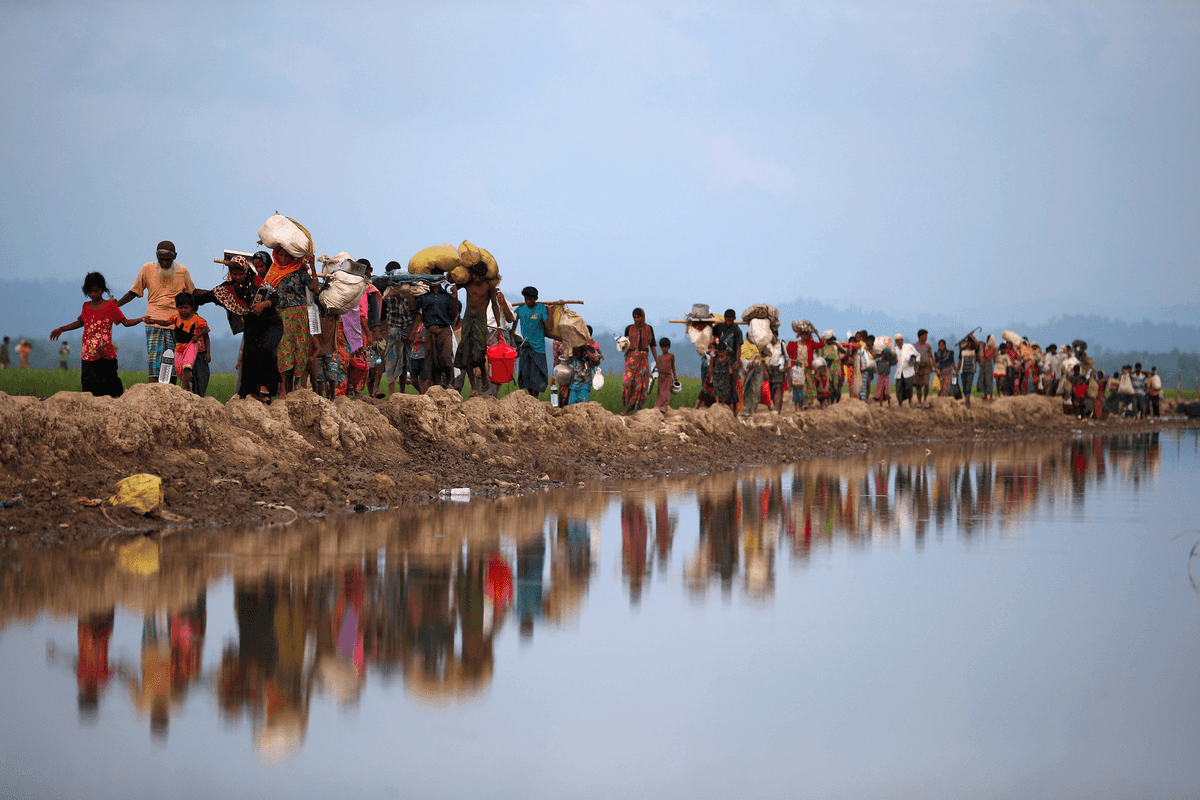
Rohingya refugees continue their way after crossing from Myanmar into Palang Khali, near Cox's Bazar, Bangladesh November 2, 2017.
Reuters/File
The International Court of Justice (ICJ) ruled on Thursday that Myanmar is responsible for genocide against its Rohingya Muslim minority, citing mass killings, widespread sexual violence and other atrocities during a 2017 military crackdown.
The crackdown drove hundreds of thousands of people into neighboring Bangladesh.
What did the ICJ rule in the Myanmar genocide case?
President Yuji Iwasawa, delivering the judgment at the Hague-based court, said Myanmar’s security forces had killed thousands of Rohingya civilians, committed widespread sexual violence, subjected children to extreme brutality and attacked people fleeing the military offensive. It is the first time the ICJ has held a state responsible for committing the crime.
The landmark ruling is a significant step in international efforts to hold governments accountable for genocide. It is only the fourth time since the Nazi Holocaust that an international court has determined that the legal threshold for genocide has been met.
Why did The Gambia take Myanmar to the ICJ?
The proceedings began in 2019 after The Gambia, a Muslim-majority West African nation, brought a case against Myanmar, accusing it of violating the 1948 Genocide Convention. The Gambia asked the court to order Myanmar to end actions targeting the Rohingya, prevent further violations and ensure that those responsible face justice. It also sought reparations for the community, including full citizenship rights and the ability to return to their homeland.
The case centres on the military’s August 2017 offensive in northern Rakhine state, launched after an insurgent attack on security forces. The operation triggered allegations of mass killings, systematic rape and the burning of thousands of homes, forcing hundreds of thousands of Rohingya to cross into Bangladesh.
Myanmar has rejected the genocide allegations. It maintains that its 2017 operation was a legitimate response to attacks by a Rohingya insurgent group and a counterterrorism campaign, rather than an attempt to destroy the minority population.
The Genocide Convention requires proof of an intention to destroy a national, ethnic, racial or religious group, either entirely or partially, for an act to qualify as genocide.
Could the Myanmar genocide ruling affect other cases?
The ruling could carry implications beyond Myanmar, as the ICJ is considering separate genocide-related proceedings arising from conflicts in Gaza and Ukraine. Melanie O’Brien, a professor of international law at the University of Western Australia, said the judgment could influence other proceedings because genocides often involve similar patterns of conduct.
South Africa has accused Israel of violating the Genocide Convention through its military campaign in Gaza, allegations that Israel strongly denies. That case remains ongoing and is expected to take years to conclude. Ukraine has also brought proceedings against Russia, arguing that Moscow used fabricated allegations of genocide in eastern Ukraine to justify its full-scale invasion in February 2022.
The ICJ had previously examined genocide-related allegations involving Serbia over the 1995 Srebrenica massacre, in which Bosnian Serb forces killed around 8,000 predominantly Muslim men and boys. In its 2007 judgment, the court found that Serbia had failed to fulfil its obligation to prevent genocide.
What does the ruling mean for Rohingya refugees?
For the Rohingya, Thursday’s decision represents a long-awaited recognition of the violence and persecution endured by their community. Around 1.2 million Rohingya refugees now live in Bangladesh, most of them in overcrowded camps in the Cox’s Bazar district. Their lives remain affected by inadequate sanitation, infectious diseases, fire outbreaks, monsoon-related landslides and restrictions on employment.
Yasmin Ullah, a Rohingya human rights activist who fled Myanmar with her mother as a young child in the 1990s, said the case was about securing recognition and dignity for a population that had spent years without stability or a secure future. She said Rohingya refugees had remained in extremely precarious conditions across the Asia-Pacific region for nearly a decade.
Can the ICJ enforce its ruling on Myanmar?
The ICJ’s judgments are final and legally binding, but the court has no direct enforcement mechanism. If Myanmar fails to comply, the matter can be referred to the United Nations Security Council, where members can consider further action.



Comments
See what people are discussing