

IMF urges faster fiscal action as debt and borrowing costs rise
Fund warns delaying adjustment will increase interest burdens, deepen fiscal vulnerabilities and leave governments with fewer policy options

Business Desk
The Business Desk tracks economic trends, market movements, and business developments, offering analysis of both local and global financial news.
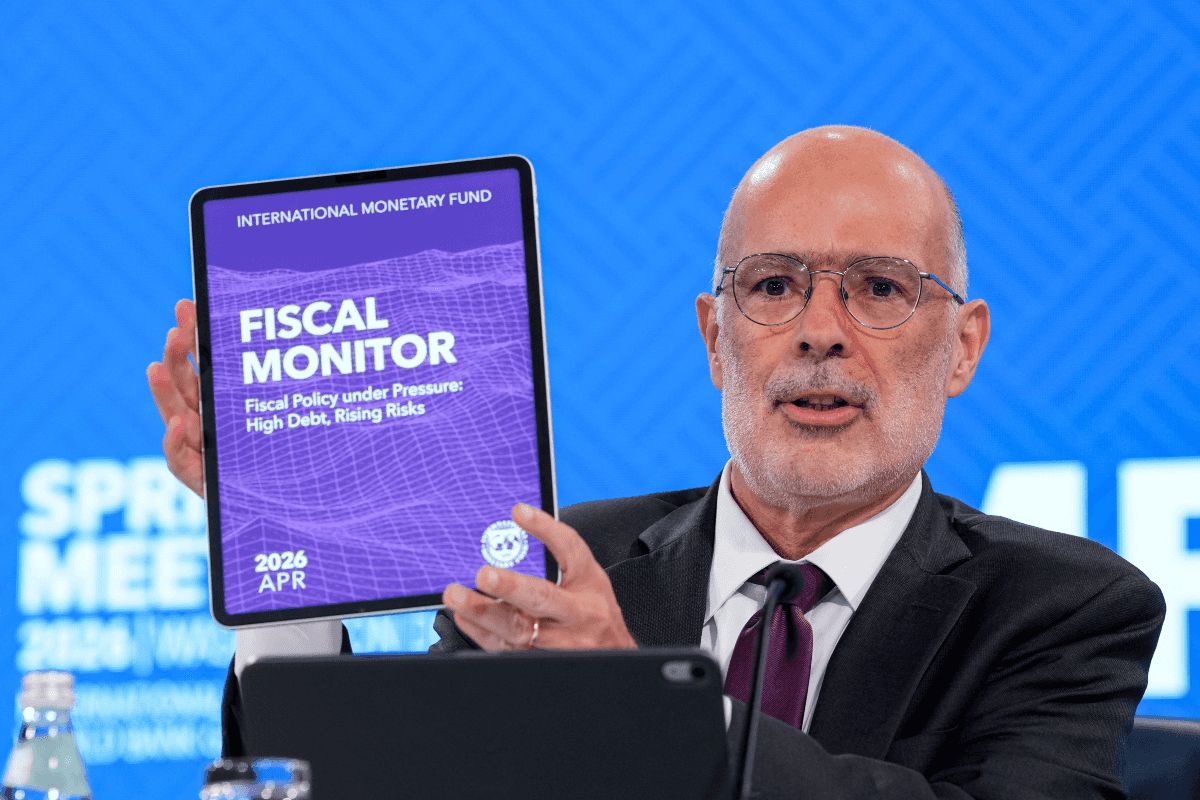
Director of the Fiscal Affairs Department Rodrigo Valdes attends the International Monetary Fund (IMF)/World Bank Spring Meetings in Washington, DC, US, April 15, 2026.
Reuters
The International Monetary Fund has stepped up calls for governments facing high fiscal risks to act as rising sovereign bond yields add to pressure from elevated debt and persistent spending demands.
Rodrigo Valdes, director of the IMF’s Fiscal Affairs Department, said at the IMF and World Bank annual meetings in Bangkok that fiscal risks were rising as higher interest rates and mounting spending pressures left countries with less room for delay.
Global gross government debt rose to nearly 94% of GDP in 2025 and is projected to reach 100% by 2029, a level previously reached only in the aftermath of World War II, according to the IMF.
Why does the IMF say fiscal action is urgent?
The Fund says high debt, elevated borrowing costs and persistent spending pressures are reducing governments’ room to maneuver. Delaying adjustment could increase interest burdens and fiscal vulnerabilities, leaving countries with fewer options and potentially forcing a more painful correction later if financial markets demand one.
Valdes told Reuters that fiscal outcomes this year were worse than the IMF had expected six months ago and a year earlier, while a majority of countries were looking to increase spending rather than tighten fiscal policy.
For major advanced economies with high debt levels, he said that the challenge was to build political support for concrete medium-term plans that could contain borrowing costs and limit spillovers to the rest of the world.
The IMF said financing conditions for many emerging market and developing economies had remained favorable but might not last, urging them to reduce fiscal vulnerabilities and strengthen debt management.
Low-income countries, where external financing was already tighter, need stronger tax systems and more efficient government spending, according to the Fund.
Higher bond yields are increasing financing costs
High oil prices, persistent inflation, stronger investment demand and higher-than-expected artificial intelligence growth have contributed to sharp increases in long-term sovereign bond yields in recent months, Reuters reported, citing the IMF.
The average 10-year government bond yield across the Group of Seven economies rose by more than 110 basis points between February and September, reaching its highest level in nearly two decades, according to the IMF data.
The IMF projected the effective average cost of government financing would rise to 3.7% by 2031 from 2.3% in 2021.
In the US, interest payments are expected to reach 5.3% of GDP, up from 2.8% before the COVID-19 pandemic and roughly equal to projected spending on Social Security, according to the same reporting.
Interest costs are also placing significant pressure on low-income countries, where payments currently consume more than 15% of tax revenues, compared with an average of around 9% between 2011 and 2019.
Advanced economies are also refinancing more debt at shorter maturities, allowing higher interest rates to feed through to government borrowing costs more quickly. For the G7 and Spain, the share of debt maturing within one year is approaching 30%.
High rates could leave less room to respond to shocks
Above-target inflation and higher energy prices could require central banks to keep interest rates elevated for longer, limiting governments’ ability to respond to economic downturns as demands for spending on defense, energy security and aging populations increase.
The IMF said interest rates on government debt already exceeded expected nominal economic growth in several countries, making it more difficult to stabilize debt burdens.
Valdes said that more countries were allowing higher energy prices to pass through, while many continued to rely on costly, broad-based measures to shield households and businesses.
He estimated the combined fiscal cost of those measures at about 0.5% of global GDP and said maintaining them could contribute to higher prices globally.
The IMF said support should instead be limited, targeted, temporary and transparent, with assistance directed toward those most in need.





Comments
See what people are discussing