

OGDCL targets 8%–10% production growth in FY27 despite field declines
Pakistan's largest oil and gas producer plans new drilling and exploration projects as pipeline bottlenecks constrain output from key fields

Business Desk
The Business Desk tracks economic trends, market movements, and business developments, offering analysis of both local and global financial news.
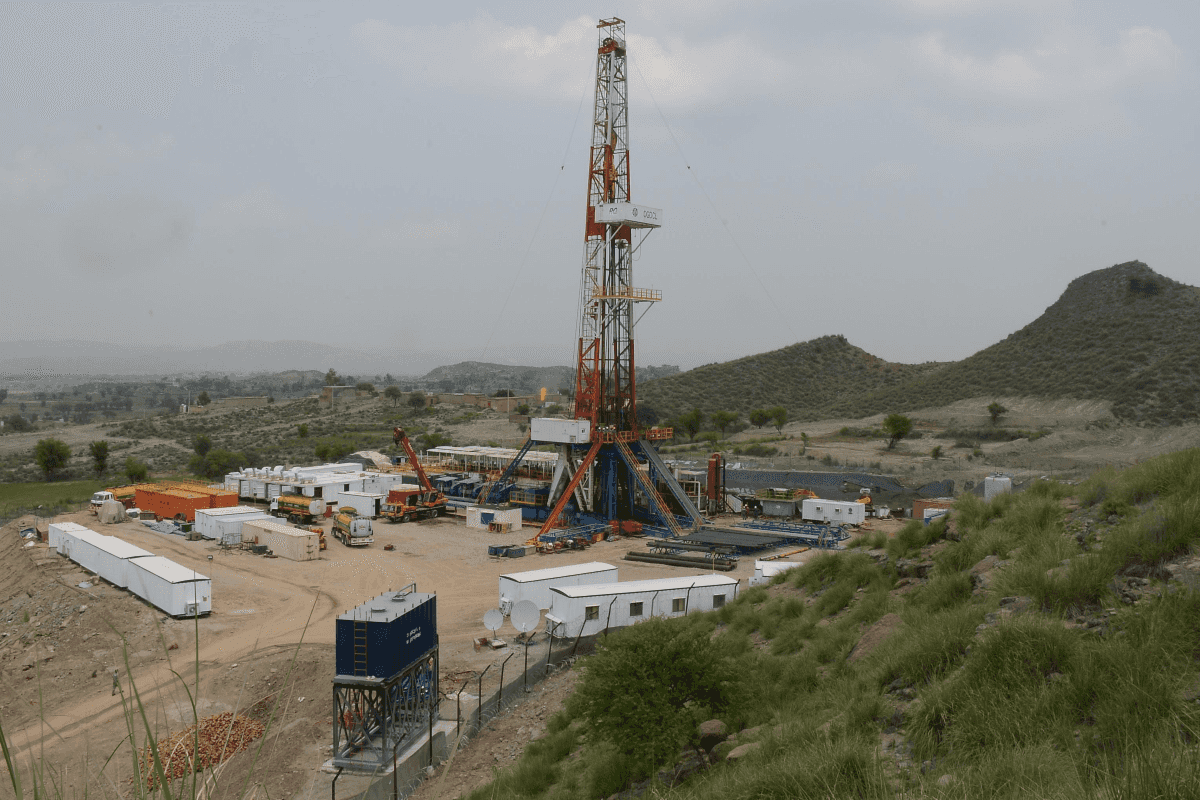
An OGDCL drilling rig at an exploration site in Pakistan. The company is targeting higher oil and gas production in FY27.
OGDCL
Pakistan's Oil and Gas Development Company Limited (OGDCL) is targeting 8%–10% growth in oil and gas production during fiscal year 2027 through new wells, workovers and expanded exploration activities, despite natural field depletion, operational challenges and pipeline disruptions, according to management's latest corporate briefing.
During the first quarter of FY27, OGDCL's average daily net crude oil production increased 13.3% year over year to 35,494 barrels, while natural gas output rose 14.2% to 732 million cubic feet per day. Liquefied petroleum gas (LPG) production also increased 10.5% to 696 metric tons per day.
What will drive OGDCL's production growth?
The company expects new wells, production optimization and ongoing development projects to support higher output during FY27. Management said natural declines of approximately 16% at existing fields remained a major challenge, while operational constraints and limited pipeline capacity continued to restrict production from some assets.
The improvement in first-quarter production was supported by four wells connected to the production system, although curtailments resulted in estimated daily losses of 1,254 barrels of crude oil, 94 million cubic feet of natural gas and five metric tons of LPG.
The production curtailments resulted in an estimated revenue loss of PKR 9.72 billion during the quarter, according to the company's financial report.
Production at some fields, particularly Bettani, has been restricted by limited capacity in the Sui Northern Gas Pipelines Limited (SNGPL) network.
During FY26, OGDCL produced an average of 32,861 barrels of crude oil per day, compared with 30,919 barrels in the previous year. Average daily natural gas production increased to 667 million cubic feet from 652 million cubic feet.
The company accounted for approximately 51% of Pakistan's domestic crude oil production and 28% of natural gas output during FY26, maintaining its position as the country's largest indigenous hydrocarbon producer.
What is the production potential of Baragzai and Rajian?
The Baragzai field remains among OGDCL's key production growth opportunities, with output of approximately 6,000 barrels per day reported in the company's FY26 annual report.
Management plans to bring production from an additional geological formation online while continuing to test other zones.
The field has longer-term production potential of approximately 25,000 barrels per day over the next two to five years, subject to further drilling and the availability of processing and transportation infrastructure.
However, management said constraints at the Lashari facilities would need to be addressed before the field's full production potential could be realized.
The Rajian field also has estimated production potential of 8,000 to 10,000 barrels per day. Its heavy crude oil, with an American Petroleum Institute (API) gravity of 11 to 12 degrees, requires arrangements with suppliers and refineries before production can be increased.
OGDCL is also advancing development projects at Uch, KPD-TAY, Bettani and Sinjhoro. The Uch compression project is intended to sustain gas supplies, while the other projects are expected to support additional production as infrastructure constraints are addressed.
How is OGDCL expanding exploration and drilling?
OGDCL plans to accelerate exploration and development activities to sustain production and replenish hydrocarbon reserves.
The company drilled 23 wells during FY26, including eight exploratory wells, 11 development wells, three tight-gas wells and one geothermal well.
During the first quarter of FY27, it commenced drilling two wells, including Nahiyoon-1, Pakistan's first pilot horizontal shale gas well.
OGDCL made nine oil, gas and gas-condensate discoveries during FY26 through five exploration wells, with Baragzai X-1 accounting for five discoveries across multiple geological formations.
The company is also planning additional offshore seismic surveys with its joint venture partners, including Pakistan Petroleum Limited and Turkish Petroleum, ahead of potential exploratory drilling.
Turkish Petroleum has joined the offshore venture, with seismic activities expected to begin within weeks following an earlier postponement due to regional developments.
Onshore, management reported a large-scale three-dimensional (3D) seismic survey covering approximately 1,600 square kilometers in an area considered to have strong exploration potential following nearby exploration success. A subsequent drilling program will be finalized after the survey results are analyzed.
During the first quarter of FY27, the company acquired 31 kilometers of two-dimensional (2D) seismic data and 213 square kilometers of 3D seismic data, accounting for 80% and 98% of Pakistan's total acquisition in the respective categories during the period.
OGDCL plans to drill 33 wells during FY27, comprising 12 exploratory and appraisal wells, 16 development wells and five shale, tight-gas or re-entry wells.
The company's annual report estimates net capital expenditure of PKR 156.13 billion for FY27, including PKR 80.17 billion for drilling and PKR 75.96 billion for development projects and other capital investments.
Management expects annual capital spending to remain above PKR 100 billion over the next two years, although actual expenditure could vary depending on tender outcomes and equipment costs.
How much progress has OGDCL made in replenishing reserves?
OGDCL achieved a gross reserve replacement ratio of 236% during FY26, reflecting additions to its recoverable hydrocarbon resources through exploration and reserve revisions.
Management also said the company's estimated reserve life had increased from 12 years to more than 20 years.
Its FY26 investor presentation reported net recoverable reserves of 728 million barrels of oil equivalent on a proved (1P) basis and 1,026 million barrels of oil equivalent on a proved-plus-probable (2P) basis.
The company held approximately 53% of Pakistan's oil reserves and 31% of its natural gas reserves, underscoring its importance to domestic energy supplies.
Management said continued exploration, additional production from existing discoveries and infrastructure development would remain central to sustaining output and offsetting declines at mature fields.



Comments
See what people are discussing