

Pakistan austerity drive targets public spending as fuel costs soar
Kamran Khan says government must cut structural spending, not just ask public to sacrifice

News Desk
The News Desk provides timely and factual coverage of national and international events, with an emphasis on accuracy and clarity.
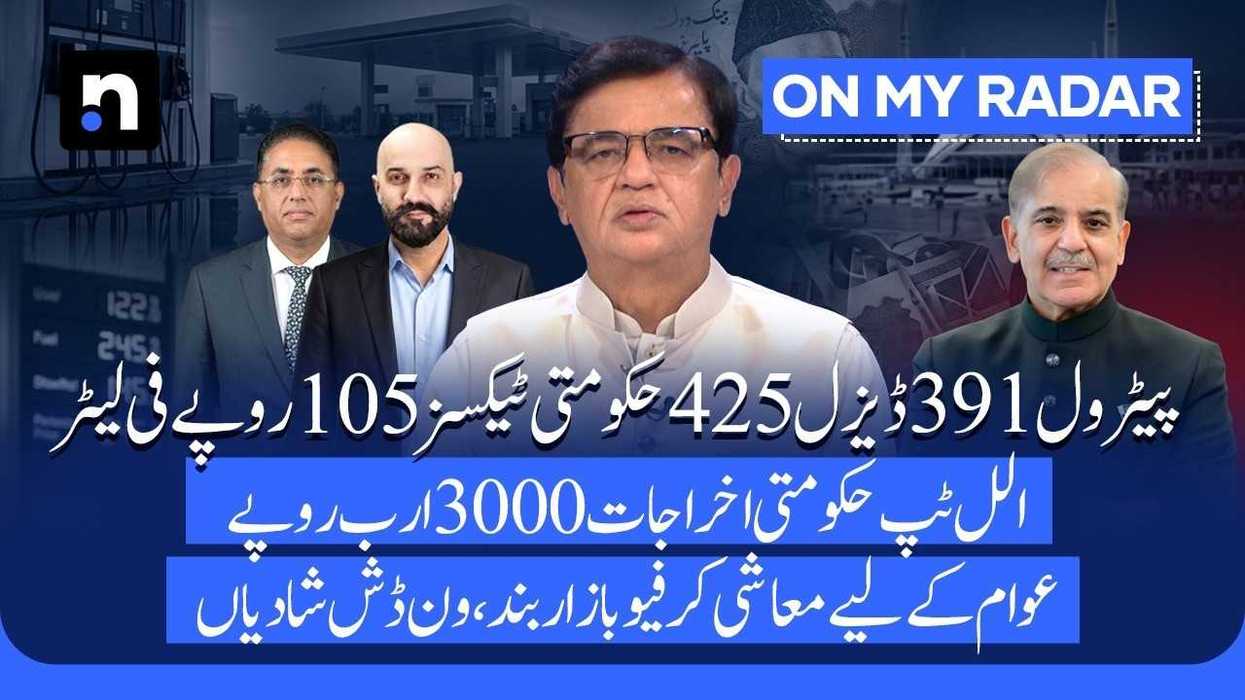
Pakistan’s new austerity measures should extend beyond earlier closing times, restrictions on weddings and cuts in official fuel allocations to the government’s larger and recurring expenses, Kamran Khan said in his latest “On My Radar” episode.
The federal government has introduced a fresh fuel conservation and austerity package as petrol and high-speed diesel prices remain at record levels. Petrol is now Rs390.79 per liter and high-speed diesel Rs424.92 per liter.
Under the measures, shops, markets and shopping malls must close by 9 p.m., marriage halls and other venues hosting festive events by 10 p.m., and restaurants and cafes by 11 p.m. A single dish has also been mandated at marriage-related functions.
Khan said the public was once again being asked to save money, use less fuel, close markets early and limit wedding meals while making sacrifices during a difficult economic period.
He questioned whether these steps address the underlying causes of Pakistan’s fiscal problems.
“The economic crisis of Pakistan did not arise from government dinners, one or two foreign trips or the fuel used by a few vehicles,” Khan said. “The real crisis is in the government’s own large and continuously wasteful expenditures.”
Government cuts fuel and other spending
The federal government has cut fuel allocations for official vehicles by 50% for three months. It has also banned the purchase of new government vehicles and most durable goods, except IT-related equipment, while foreign travel has been suspended for three months. Ministers and officials making unavoidable foreign trips must travel in economy class.
Official dinners, government-funded seminars, training programs and conferences have also been restricted, while government meetings have been directed to use video and teleconferencing where possible. The government has ordered a 5% reduction in the non-employee-related expenditure budget for fiscal year 2026-27.
Khan said these measures were necessary but argued that they represented only a small part of the savings Pakistan needs.
He pointed to the federal budget for 2026-27, which allocates about Rs1.071 trillion for running the civil government, Rs1.091 trillion for subsidies and Rs2.68 trillion for grants and transfers.
Khan also questioned the cost of the federal government’s cabinet, describing it as a “56-member jumbo-sized cabinet,” and argued that the size and cost of the government itself should be examined as part of the austerity drive.
State-owned companies remain a major drain
Khan said the most serious problem was the continuing losses of state-owned enterprises.
According to the Finance Ministry’s annual report, 25 loss-making state-owned enterprises recorded combined losses of Rs832.8 billion in fiscal year 2025. The National Highway Authority recorded the largest loss at Rs294.9 billion, followed by Quetta Electric Supply Co. at Rs112.7 billion, Peshawar Electric Supply Co. at Rs92.7 billion and Pakistan Railways at Rs60.3 billion.
The government also provided state-owned enterprises with Rs2.078 trillion in financial support during fiscal year 2024-25 through loans, subsidies, grants and equity, according to the Finance Ministry.
“This is the real place where austerity should be applied,” Khan said.
He called for chronically loss-making institutions to be restructured, decisions on privatization to be taken where possible, duplicate departments to be eliminated and unnecessary positions removed.
He also called for a genuine audit of government vehicles, residences, protocol, official events and administrative spending, saying provincial governments should face the same scrutiny.
“On My Radar” has previously questioned the size and spending of the Sindh government, including its cabinet, ministers, advisers and broader administrative structure, Khan said.
“If the federal government announces austerity but the provinces do not significantly reduce their spending, the entire campaign will have no national impact,” he said.
Khan calls for petroleum levy review
Khan also questioned the government’s petroleum levy, saying that the government collects a substantial levy on every liter of fuel sold to consumers and therefore has room to reduce it.
He argued that the government should cut unnecessary spending and return part of those savings to consumers through a reduction in the petroleum levy.
“If the government can create a permanent 10% saving in the more than Rs2 trillion in support given to state-owned enterprises, about Rs200 billion could be generated,” Khan said.
He said this should be one of the measures used to assess the austerity campaign.
“Closing markets early is easy. Enforcing a single dish is easy. But eliminating waste from your own system is difficult,” he said.
“The real test is of the government, which is asking the common man to sacrifice but is not showing the same firmness in cutting its permanent and major expenditures.”
Punjab aircraft purchase raises austerity questions
Khan also pointed to spending by the Punjab government as an example of what he described as a contradiction in the austerity campaign.
A Gulfstream GVII-G500 aircraft acquired by the Punjab government has been reported to cost about Rs11 billion. Transparency International Pakistan questioned the procurement in February, alleging that competitive procurement procedures had not been followed.
Khan said the reported purchase raises questions about when austerity principles will be applied to those in government.
“On one hand, the public is being told to save every single liter of petrol, while on the other hand, the government must first explain to the public the justification for such expenditures worth billions of rupees,” he said.
The federal government has said the latest austerity campaign is aimed at conserving fuel and reducing unnecessary expenditure amid higher international petroleum prices and tensions in the Middle East. Prime Minister Shehbaz Sharif has also said that sacrifices should first be made by the government and the elite.



Comments
See what people are discussing