

Pakistan's biggest test is no longer diplomacy - it's solving problems at home
Kamran Khan says Pakistan's unresolved domestic challenges deserve far greater national attention

News Desk
The News Desk provides timely and factual coverage of national and international events, with an emphasis on accuracy and clarity.
Pakistan's recent diplomatic successes have given the country renewed confidence on the global stage. The U.S.-Iran conflict, which erupted on February 28, and Islamabad's increasingly positive international image have dominated headlines, projecting the image of a country regaining strategic relevance.
Yet behind these foreign policy gains lies a far more pressing reality: Pakistan continues to grapple with deep-rooted domestic challenges that remain largely unresolved.
In fact, many of these problems have become even more complicated over the past six months. They extend far beyond the economy, encompassing governance, internal security, institutional reform, and the everyday struggles of ordinary Pakistanis.
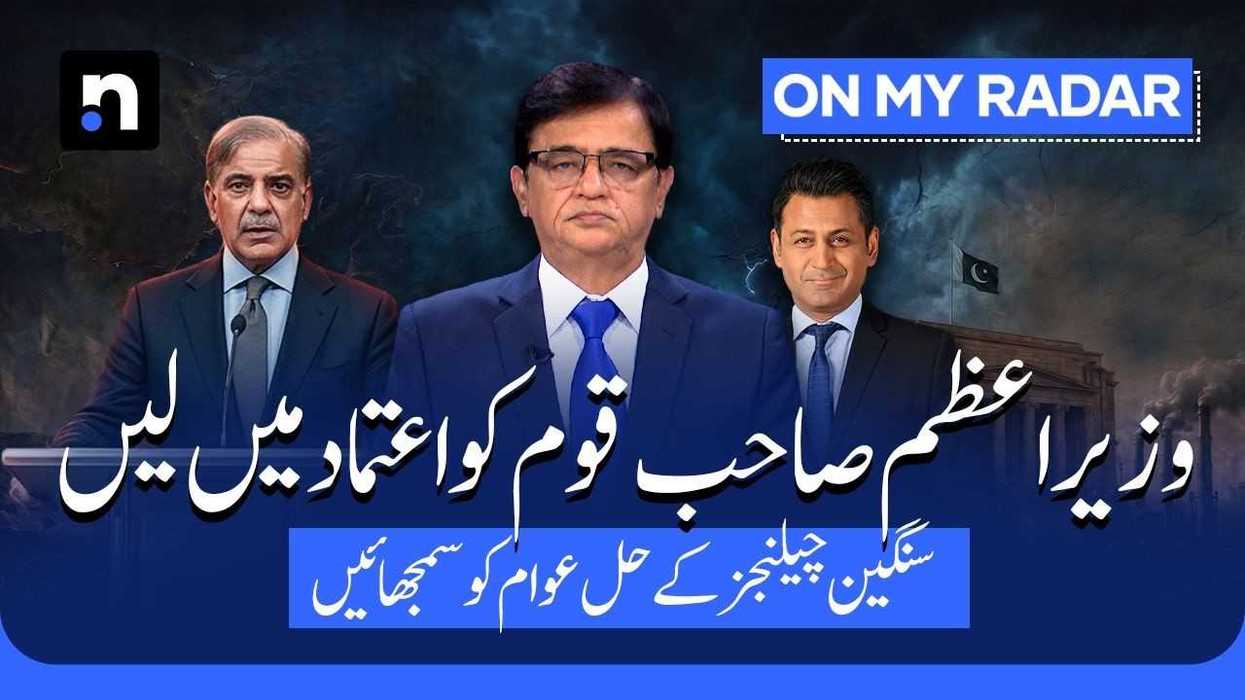
In the latest episode of On My Radar, Kamran Khan argued that these unresolved internal challenges deserve far greater national attention than they currently receive. He stressed that while Pakistan's diplomatic standing has improved significantly, the country's long-term stability and prosperity will ultimately depend on how effectively it addresses its domestic crises.
It is therefore the foremost responsibility of Prime Minister Shehbaz Sharif's government to present these challenges honestly before Pakistan's 250 million citizens and explain how it intends to overcome them. The public deserves a clear assessment of the country's most pressing problems, along with a credible roadmap outlining the government's strategy to address them.
Among the most urgent concerns is the deteriorating security situation in Balochistan. The threat of terrorism emanating from Afghanistan continues to intensify with each passing day. Meanwhile, Pakistan's debt burden has reached increasingly unsustainable levels, while there has been little visible progress on resolving the National Finance Commission (NFC) Award—one of the country's most significant constitutional and fiscal issues.
Similarly, the government has made limited progress in reducing public expenditures or restructuring the oversized federal bureaucracy into a leaner and more efficient system. Efforts to expand the tax base by bringing the retail, real estate, and agriculture sectors into the tax net have either moved at a sluggish pace or stalled altogether. Reforms and privatization of loss-making state-owned enterprises have also fallen short of expectations.
The energy crisis remains another major concern. Millions of Pakistanis continue to bear the burden of expensive electricity, while broader structural issues—including a long-term strategy to reduce public debt and the establishment of a genuinely empowered local government system—remain unresolved.
These are not questions being asked only by economists or political analysts. Ordinary Pakistanis are asking them as well. Citizens do not expect every problem to disappear overnight, but they do expect clarity about where the country is headed, what the government's priorities are, and what roadmap it has prepared for the years ahead.
What makes this debate particularly significant is the political environment in which the current government has operated. Prime Minister Shehbaz Sharif has enjoyed an unusually favourable governing landscape—one that many political observers describe as among the strongest hybrid arrangements in Pakistan's history due to the establishment's backing.
Unlike many previous governments, it has not had to contend with frequent judicial intervention or recurring suo motu proceedings. Nor has it faced sustained anti-government sit-ins or large-scale protest movements seeking its removal. In Parliament, too, the government has encountered relatively limited resistance. At the same time, Pakistan's international standing has improved considerably, while relations with international financial institutions and friendly countries have remained stable.
In other words, from the very beginning, the government has enjoyed considerable political and administrative space to formulate and implement policy - advantages that many previous administrations could only wish for. Ironically, these are the very conditions that Shehbaz Sharif himself once argued were necessary for meaningful governance. While criticizing Imran Khan's government, he repeatedly maintained that even if he received just 20 percent of the establishment's support, he could dramatically transform Pakistan's fortunes.
Today, after years of governing with the support he once sought, expectations are naturally much higher. Pakistanis are not demanding miracles, nor do they expect decades-old crises to disappear overnight. What they do expect is a comprehensive strategy, a clear sense of direction, measurable priorities, and realistic timelines that inspire confidence the state is not merely managing day-to-day affairs but preparing the country for a more stable future.




Comments
See what people are discussing