

Pakistan’s economic journey from crisis to relative stability
Kamran Khan says the State Bank plays a key role in steering Pakistan through its economic crisis

News Desk
The News Desk provides timely and factual coverage of national and international events, with an emphasis on accuracy and clarity.
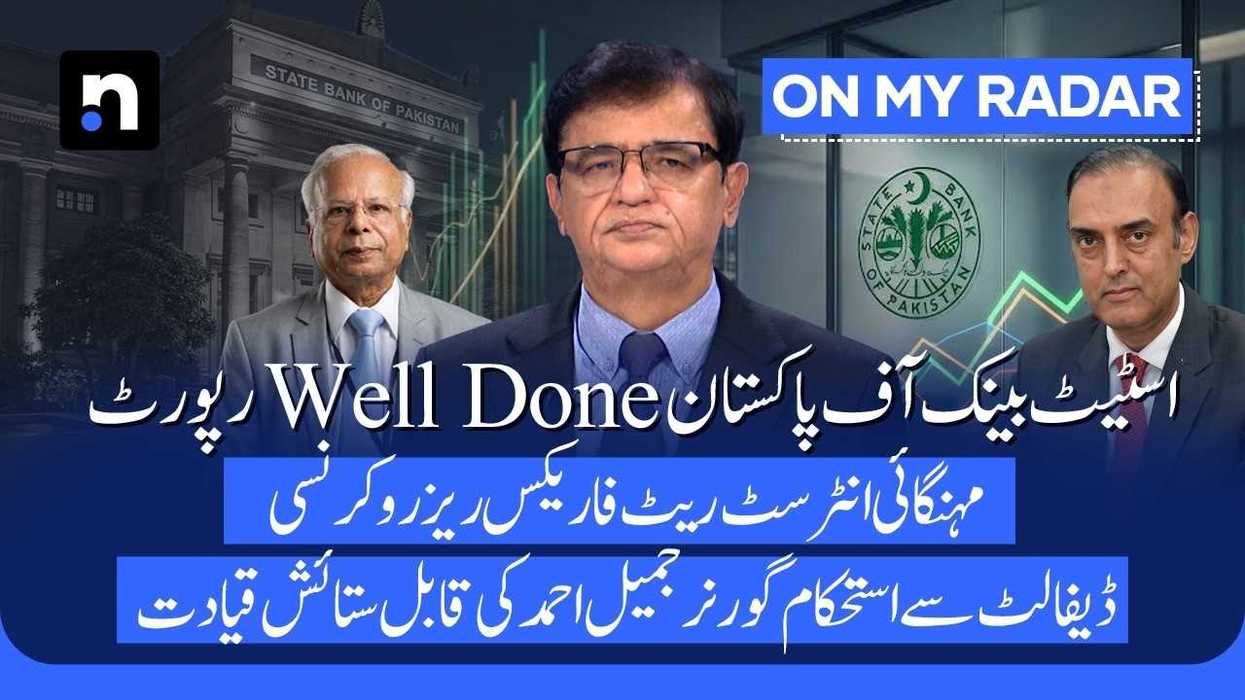
Pakistan has travelled a difficult economic road over the past four years, moving from the brink of a balance-of-payments crisis to a period of relative currency and reserve stability. Foreign exchange reserves have recovered sharply, the rupee has remained broadly stable for nearly two years, inflation has fallen substantially from its peak and the State Bank of Pakistan has begun easing monetary policy after one of the country’s most aggressive tightening cycles.
Kamran Khan, speaking in the latest episode of On My Radar, said the State Bank of Pakistan deserves significant credit for helping steer the country through one of the most dangerous economic periods in its recent history.
He noted that Governor Jameel Ahmad has led the central bank for the past four years, a period that began with Pakistan facing rapidly depleting reserves, a weakening rupee, soaring inflation and a severe balance-of-payments crisis.
When Jameel Ahmad took charge in August 2022, the State Bank’s own foreign exchange reserves stood at around $7.7 billion. At the worst point of the crisis, those reserves fell to approximately $3 billion.
Today, Pakistan’s total foreign exchange reserves stand at around $23.7 billion. Of this, the State Bank holds approximately $18.3 billion, while commercial banks hold around $5.4 billion.
That represents a significant recovery.
However, the improvement cannot be attributed to the State Bank alone. The IMF program, external financing, inflows from friendly countries and record remittances from overseas Pakistanis have all played important roles.
The State Bank, however, had its own critical role to play. Converting incoming dollars into reserves, managing the currency market, narrowing the gap between interbank and open-market exchange rates, and buying dollars from the market when conditions allowed to build reserves were all part of its policy strategy.
This is where Jameel Ahmad and his team deserve clear credit.
The trajectory of the rupee is also significant.
When Jameel Ahmad took charge, the dollar was trading at around 221 rupees. The exchange rate later crossed 300 rupees, but for roughly the past two years, the rupee has remained relatively stable within a narrow range of around 277 to 280 to the dollar.
The State Bank, in other words, appears to have prioritized rebuilding reserves and maintaining stability in the currency market rather than spending scarce dollars to defend an artificially strong exchange rate.
Pakistan had repeatedly used its foreign exchange reserves in the past to support the rupee. That approach changed significantly during Jameel Ahmad’s tenure.
The toughest test, however, came in monetary policy.
When Jameel Ahmad took charge, the policy rate stood at 15%. As inflation surged and the rupee came under severe pressure, the rate was eventually raised to 22%. Businesses, industry, construction and private investment paid a heavy price for that tightening.
But when inflation reaches between 30% and 38%, a central bank has very few options beyond taking tough measures to contain price pressures.
The State Bank did not begin cutting rates until inflation had started to come down.
The policy rate now stands at 11.5%. On September 14, the State Bank decided to keep it unchanged at that level, even as inflation rose again to 11.1% in August.
That now presents the next major test for monetary policy.
Pakistan’s current account has also moved from a record deficit of $17.5 billion in FY2022 to roughly balance. But here too, record remittances from overseas Pakistanis have played a major role.
The overall picture, nevertheless, points to substantial progress on stabilization.
Jameel Ahmad’s first year at the State Bank coincided with a further deepening of the crisis. But the period that followed saw reserves rebuild, the currency market stabilize, inflation decline and interest-rate decisions increasingly driven by caution and policy discipline rather than panic.
Against that backdrop, the past four years can be viewed as a significant period of crisis management and economic stabilization in Pakistan’s recent history.
But stabilization is not the same as a complete economic recovery.
Inflation is putting renewed pressure on the economy, while high interest rates have constrained businesses and private investment. The heavy burden of domestic and external debt, debt repayments, weak exports and growing reliance on remittances remain major risks.
Jameel Ahmad’s tenure has therefore been marked by a strong focus on crisis management, rebuilding foreign exchange reserves and maintaining monetary discipline. The bigger test now is whether the stability achieved so far can translate into sustained economic growth, lower inflation, greater employment and reduced dependence on debt and external inflows.




Comments
See what people are discussing