


News Desk
The News Desk provides timely and factual coverage of national and international events, with an emphasis on accuracy and clarity.
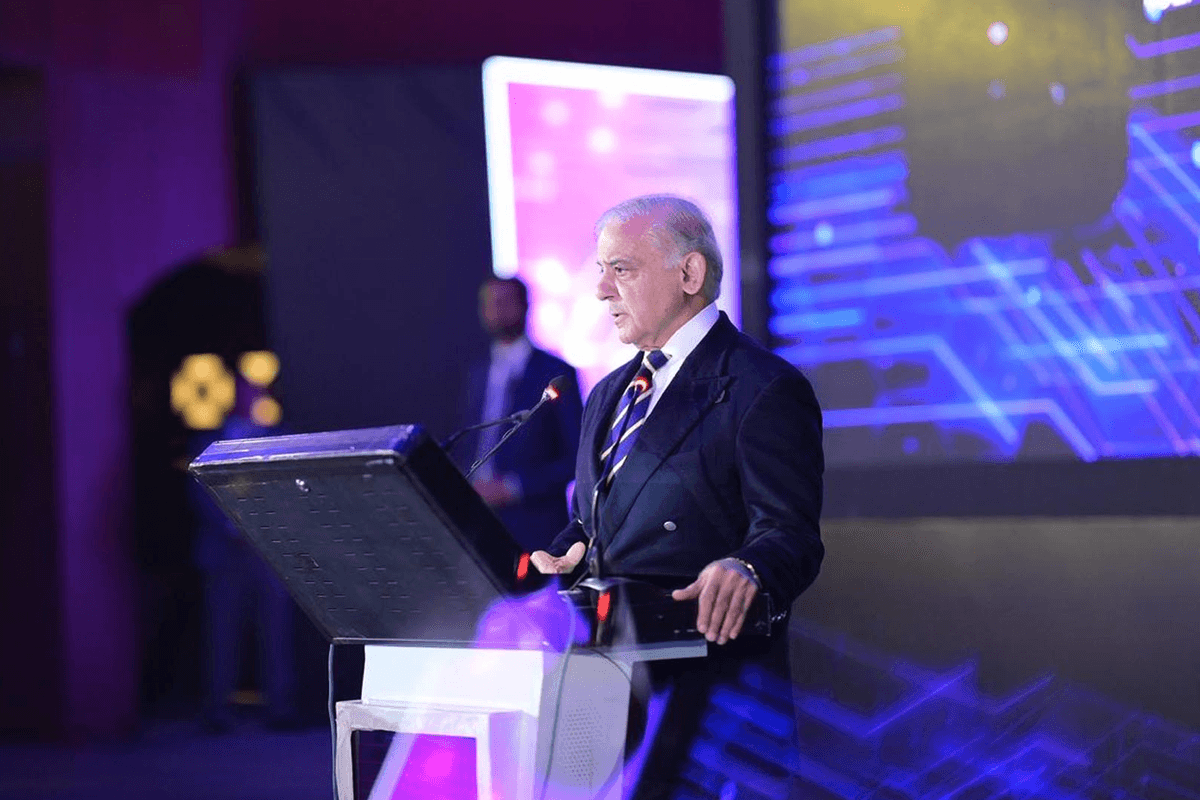
Prime Minister Shehbaz Sharif addresses Indus AI Week 2026 in Islamabad on Monday.
PID
Pakistan’s government said on Monday it will commit up to $1 billion by 2030 to develop the country’s artificial intelligence (AI) capabilities, a key part of its strategy to modernize the economy and create new opportunities for its young population.
Prime Minister Shehbaz Sharif outlined the initiative at the opening of Indus AI Week 2026, a week‑long event aimed at bringing together policymakers, industry leaders and academics to shape the nation’s AI agenda, the state-run wire service APP reported.
The funding will support the creation of a national AI ecosystem, including the introduction of AI education in all federally run schools and the award of 1,000 fully funded PhD scholarships in AI disciplines to students nationwide by the end of the decade.
A separate program will train one million non‑IT professionals in AI‑related skills to bolster productivity and employability across sectors, the prime minister’s office said.
“Pakistan is ready to meet the AI challenge and pursue partnership with global collaborators with determination,” Sharif said in brief remarks to delegates at the event, which runs through Feb. 15.”
The premier signaled that priority areas for AI deployment will include agriculture, mining, commerce, trade and youth empowerment, reflecting government efforts to harness technology for broad‑based economic impact.
With a population of approximately 240 million, of whom nearly 60 percent are under 30, Sharif said equipping the young workforce with modern technical skills was imperative.
Addressing concerns from the country’s IT community about rapid technological shifts, he said government‑backed training initiatives would help transition traditional IT professionals into AI‑capable experts, unlocking potential gains in agricultural output, industrial growth and enhanced opportunities for women.
Sharif also cited recent digital transformation efforts as evidence of Pakistan’s readiness for broader AI adoption, including the digital overhaul of the Federal Board of Revenue, greater use of data systems for revenue collection, and new scanning and detection technologies at ports aimed at curbing smuggling.
He noted that the current push builds on earlier reforms, including digital initiatives under former prime minister Muhammad Nawaz Sharif, such as laptop distribution schemes for top students, setting up e‑libraries in remote areas, e‑stamp paper systems, and the digitization of land records in partnership with the World Bank.
Pakistan’s first Safe City project and its first IT university, both established in Lahore, were also cited as foundations for the country’s tech evolution.
Shaza Fatima Khawaja, Minister for IT, said Indus AI Week aims to deepen cooperation among universities, government institutions and international firms, and that the Pakistan Digital Authority is developing a comprehensive national digital master plan to guide future efforts.
Planning Minister Ahsan Iqbal described AI as a transformative force with greater disruptive potential than electricity or the internet, stressing that global competition has shifted toward ideas, talent, data and technology rather than traditional commodities.
“Pakistan began engaging with digital technologies more than two decades ago,” he said, citing early IT policies and the development of institutions such as the National Database and Registration Authority (NADRA).



Comments
See what people are discussing