

Pakistan parliamentarians advise balanced approach on Afghanistan
PM chairs security meeting as opposition amid rising regional tensions

Ali Hamza
Correspondent
Ali; a journalist with 3 years of experience, working in Newspaper. Worked in Field, covered Big Legal Constitutional and Political Events in Pakistan since 2022. Graduate of DePaul University, Chicago.
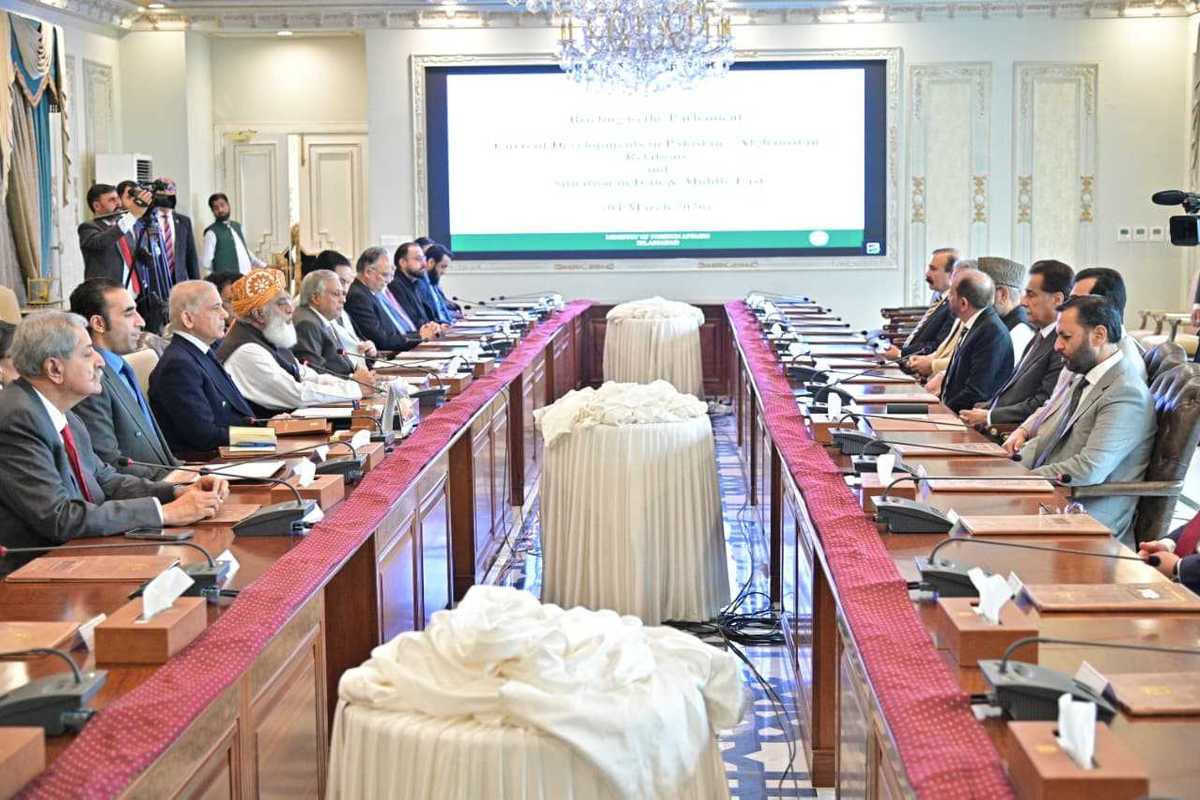
Prime Minister Muhammad Shehbaz Sharif chairs a meeting of Parliamentary Leaders and Representatives of Political Parties.
Picture courtesy: Government of Pakistan
Parliamentary leaders at Pakistan’s national security meeting advised against prolonging the conflict in Afghanistan on Wednesday and cautioned that simultaneous confrontation on Pakistan’s eastern and western borders would not serve the country’s interests.
Pakistan’s Prime Minister Shehbaz Sharif chaired a parliamentary leaders’ meeting to discuss rising regional tensions, as the ex-PM Imran Khan-led opposition party boycotted the session.
The Pakistan Tehreek-e-Insaf (PTI) called for a national security briefing to be held on the floor of the parliament instead.
Law Minister Azam Nazeer Tarar told Nukta that leaders of major political parties, including government ally Bilawal Bhutto Zardari and opposition ally Maulana Fazlur Rehman, attended the in-camera meeting and shared their views on developments in Afghanistan, Iran, and the wider Gulf region.
Officials from the Ministry of Foreign Affairs delivered a detailed briefing on Pakistan’s diplomatic outreach and the evolving regional security environment, he said.
Tarar said Fazlur Rehman noted during the meeting that the PTI and other opposition parties should have been present. The government responded that all opposition parties, including the PTI, had been formally invited.
Emphasis on negotiations between Islamabad and Kabul
Another federal minister, speaking to Nukta on condition of anonymity, said Fazlur Rehman also offered his assessment of the situation in Afghanistan, Iran and Gulf Cooperation Council countries. He emphasized the need for negotiations between Islamabad and Kabul to resolve outstanding issues.
Some parliamentary leaders observed that Afghanistan had historically been viewed as Pakistan’s “strategic depth”, underscoring the importance of stable ties. They stressed that parliament should be taken into confidence through a joint briefing.
Bilawal said Pakistan’s foreign policy must remain balanced among international stakeholders and safeguard long-term national interests. He also appreciated the country’s economic trajectory under Sharif’s leadership, according to the minister.
In a statement, the Prime Minister’s Office said Sharif had convened parliamentary leaders and party representatives for an in-camera briefing on Pakistan-Afghanistan relations, tensions involving Iran, and developments in the Middle East and Gulf region.
The statement said participants expressed their views openly and emphasized the need for national unity.
They appreciated Pakistan’s diplomatic efforts for regional peace, called for intensifying such initiatives, and reaffirmed their resolve to eliminate terrorism from the country. Attendees also welcomed the prime minister’s move to consult the broader political leadership in the national interest.
The government plans to convene a joint in-camera session of parliament comprising both treasury and opposition lawmakers to provide a comprehensive briefing on the international situation and Pakistan’s role, the senior minister said.
However, PTI declined to attend the meeting.
Opposition boycotts meeting
Speaking to Nukta at the parliament, PTI Chairman Barrister Gohar Ali Khan said his party had sought a comprehensive national security briefing on the floor of the National Assembly or during a joint session of parliament.
“Our stance is principled. We will support the government, but we cannot attend meetings just for photo sessions,” he said, adding that the PTI, which he said secured 30 million votes and holds hundreds of lawmakers across national and provincial legislatures, should not be sidelined.
Gohar questioned the value of closed-door meetings if, in his view, the opposition’s “voice and existence” were not respected. He also criticized authorities over restrictions on access to jailed former prime minister Imran Khan, alleging that family members, party leaders, and lawyers were being denied meetings with him.
He reiterated that the PTI supported Pakistan’s security institutions and had condemned militant groups such as the Tehreek-e-Taliban Pakistan.
He added that the PTI backed Afghanistan but expected Kabul not to allow its territory to be used against Pakistan. He added that the party had condemned attacks on Iran’s sovereignty and had previously supported the government’s position on Hamas.
Responding to the boycott, Tarar said the government had invited the opposition “in good faith” and criticized it for prioritizing political concerns over national security.
“The prime minister invited them with sincerity. It would have been better if the opposition had attended today’s session,” he told journalists, adding that political differences should be set aside on security matters so that Pakistan could “speak with one voice.”
Minister for Parliamentary Affairs Tariq Fazal Chaudhry said the prime minister had invited parliamentary leaders and top party leadership from across the political spectrum to discuss developments concerning Afghanistan and Iran.
He said the Foreign Office officials had delivered a detailed briefing, followed by remarks from the foreign minister, and described the decision to consult all parties as appropriate.
“We need to collectively find solutions to the challenges facing the country,” he said.


Comments
See what people are discussing