

How quadcopter drones are reshaping militancy in northwest Pakistan
Police data shows 246 militant drone attacks in KP this year, with Bannu reporting the highest number

Kamran Ali
Correspondent Nukta
Kamran Ali, a seasoned journalist from Khyber Pakhtunkhwa, Pakistan, has a decade of experience covering terrorism, human rights, politics, economy, climate change, culture, and sports. With an MS in Media Studies, he has worked across print, radio, TV, and digital media, producing investigative reports and co-hosting shows that highlight critical issues.
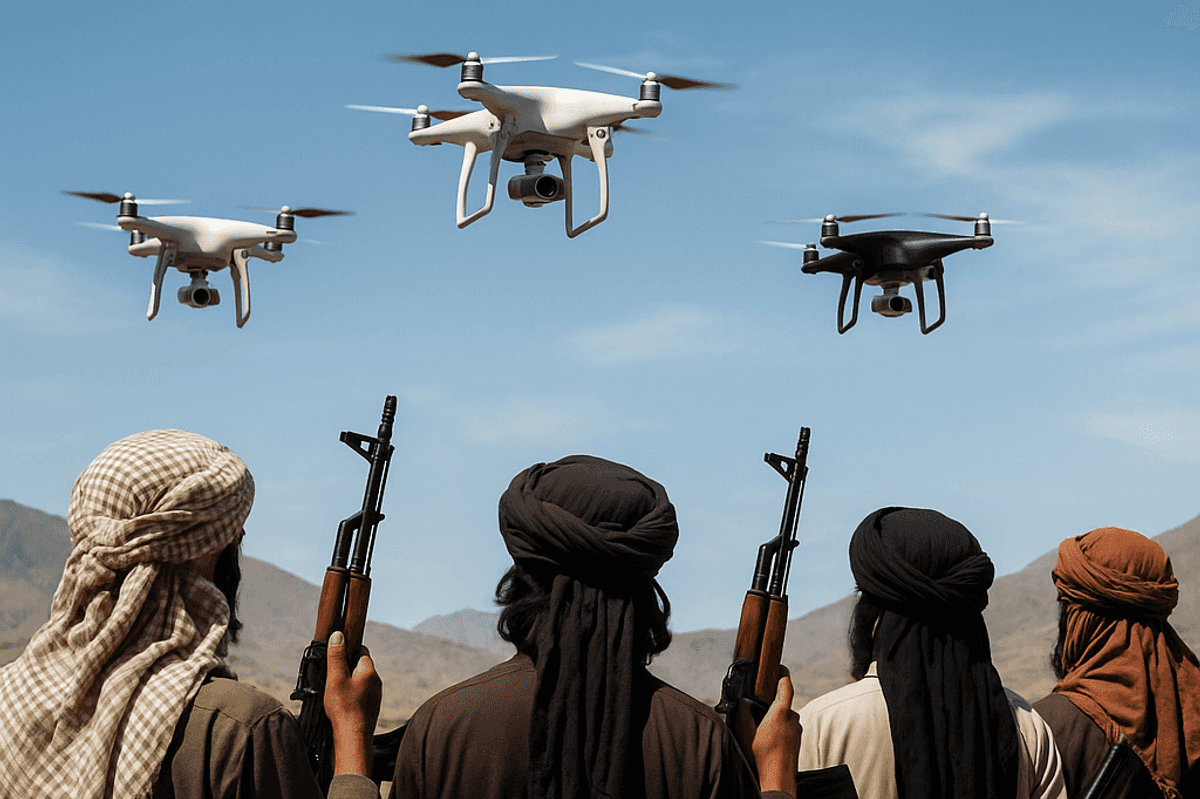
A new security threat is emerging in Pakistan’s northwestern Khyber Pakhtunkhwa province, where militant groups are increasingly using commercially available quadcopter drones to carry out attacks, signaling a shift from conventional battlefield tactics to a new phase of drone-led warfare.
How many drone attacks have militants carried out in KP this year?
According to data obtained from provincial police, militants have carried out 246 drone attacks across Khyber Pakhtunkhwa so far this year.
The highest number, 215 attacks, was reported in the Bannu region. The southern Dera Ismail Khan region recorded 15 attacks, followed by Malakand with seven and Peshawar with four, while Mardan and Kohat reported two each and Hazara one.
A separate report said at least 50 alleged quadcopter drone strikes targeted civilians, raising concerns over the growing use of aerial attacks in the province.
Zulfiqar Hameed, the provincial police chief, said rapid technological advances around the world had also affected Pakistan’s security landscape.
“Last year, drone attacks were limited to a few dozen, but this year the number has risen into the hundreds,” he said.
When did drone strikes start in KP?
Rifatullah Orakzai, a senior journalist covering militancy in the region, told Nukta that the first known U.S. drone strike in Pakistan was reported in 2004, marking the beginning of drone warfare against militant groups.
“Later, Pakistan also started using drones against militants, which helped security forces curb militancy,” he said.
Orakzai added that militants would often scan the skies before emerging from their hideouts because of fears of aerial surveillance or strikes.
He said such aerial operations inflicted heavy losses on militant groups, eventually compelling them to acquire and adopt similar technology for their own operations.
How did militants acquire drones?
Rahim Nasari, a PhD scholar specializing in regional security, said militant groups are increasingly moving away from conventional attacks toward the tactical use of quadcopter drones.
“This enables them to bypass traditional security checkpoints and carry out direct strikes,” he said.
Nasari noted that despite restrictions on drone imports, quadcopters priced between $200 and $1,000 remain widely available in Pakistani markets, with most sourced from Chinese manufacturers.
Orakzai said drones had also become easier for militant groups to obtain through black markets following the U.S. withdrawal from Afghanistan in 2021.
He added that, since Afghanistan also claims to manufacture local drones, sourcing them from there could not be ruled out.
“Militant groups have also claimed to be developing their own drones and are recruiting technicians to modify them to carry explosives or fire projectiles,” he said.
The banned Tehreek-e-Taliban Pakistan announced in December 2025 the creation of a unit called the “Air Force,” raising concerns over the increasing use of drones and quadcopters in attacks.
How do drones give advantages to militants?
Nasari said the use of quadcopter drones modified to drop explosives, including improvised explosive devices, mortar shells and grenades, gives militant groups asymmetric advantages.
“Their drone strategies reduce operational risks and increase casualties among security forces, allowing operations to be monitored from a distance while avoiding direct confrontation,” he said.
Orakzai said militant groups also gain propaganda benefits by claiming successful quadcopter drone strikes while denying responsibility for attacks that cause civilian casualties.
“They blame security forces for such incidents to erode public trust in the state,” he said, warning that the quadcopter threat could pose greater risks in future warfare if left unaddressed.
What is the response from the police?
Zulfiqar Hameed, inspector general of police in Khyber Pakhtunkhwa, said police remain on high alert amid ongoing threats, with surveillance and countermeasures in place to prevent future incidents.
He said anti-drone units had been deployed in most districts after completing training on the technology.
“Most of the attacks were successfully neutralized using advanced anti-drone technology, highlighting improved security capabilities in the region,” he said.
Hameed added that authorities had disrupted some training centers and arrested several trainers.
“The accused are under investigation, with hopes of tracing how and where they acquired this technology and dismantling the network,” he said.





Comments
See what people are discussing