

Pakistan's foreign investment falls 34% despite SIFC
Kamran Khan examines how high costs, weak policies and trade barriers are driving investors away

News Desk
The News Desk provides timely and factual coverage of national and international events, with an emphasis on accuracy and clarity.
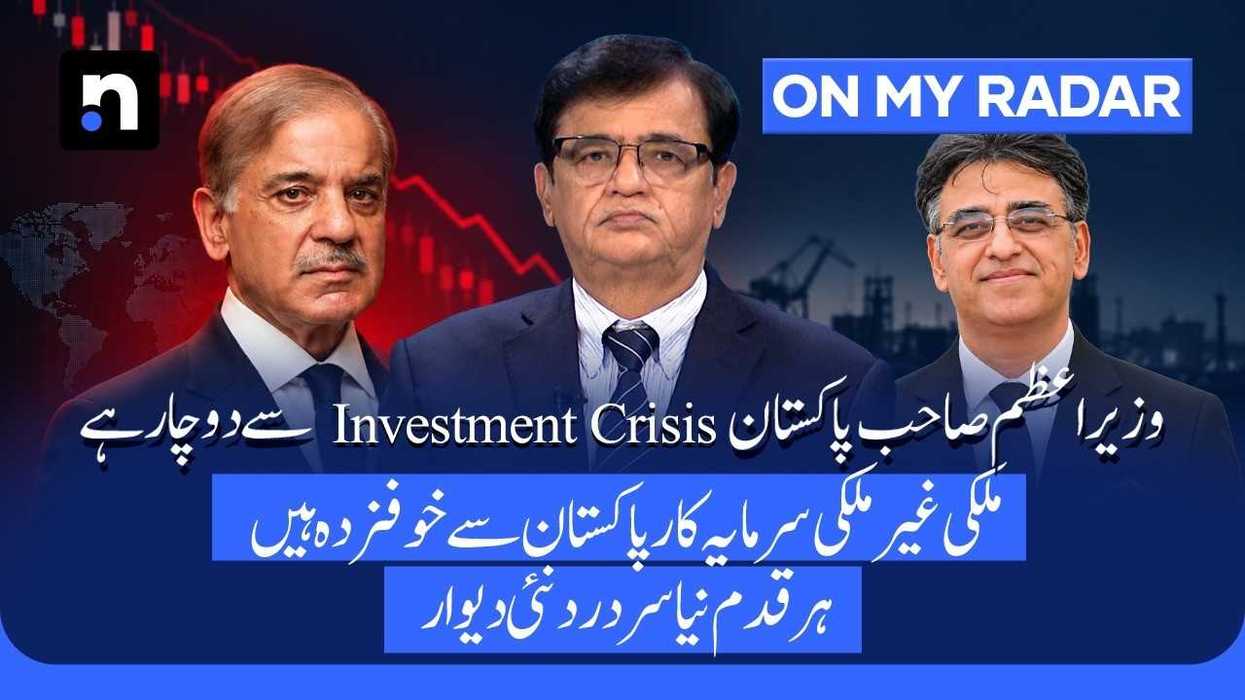
Pakistan's efforts to attract foreign investment have failed to reverse a deteriorating business climate, with foreign investment declining 34% despite the establishment of the Special Investment Facilitation Council (SIFC), Kamran Khan said in his latest episode of On My Radar.
The program examined why foreign and domestic investors are increasingly reluctant to invest in Pakistan, citing high energy costs, heavy taxation, limited access to bank financing, regulatory obstacles and strained trade relations with neighboring countries.
According to State Bank of Pakistan figures cited in the program, foreign investment stood at just $1.64 billion in fiscal year 2025-26. The decline comes as several international companies, including Shell, Telenor, Yamaha, Pfizer, Sanofi, Procter & Gamble and Microsoft, have scaled back or ended their operations in Pakistan.
The World Bank's Business Ready report highlights significant weaknesses in Pakistan's business environment. While the country scored 87 in business registration, its scores were considerably lower in resolving commercial disputes (40), international trade (43), taxation (50) and market competition (49).
Other international indicators also reflect the challenges. Pakistan ranked 152nd on the Economic Freedom Index and 130th out of 143 countries on the Rule of Law Index, compared with India's 86th position. It ranked 136th out of 182 countries on the Corruption Perceptions Index. The program also cited the 2026 Global Terrorism Index, which ranked Pakistan as the country most affected by terrorism.
Pakistan falls behind regional competitors
The investment gap with regional competitors is particularly stark. According to World Bank figures discussed in the program, India attracted $39 billion in foreign investment in 2025, Vietnam received $22 billion, while Pakistan secured just $1.85 billion.
Google's parent company, meanwhile, announced a $14.5 billion investment in a single data center in India, roughly eight times Pakistan's total annual foreign investment.
Pakistan's export performance has also deteriorated. In fiscal year 2005, the country exported approximately $14.4 billion worth of goods, compared with Bangladesh's $8.6 billion. Pakistan's exports were then 66% higher than Bangladesh's.
Today, Bangladesh exports approximately $48 billion worth of goods, compared with Pakistan's $30 billion. Vietnam's exports reached $475 billion in 2025, about 15 times Pakistan's level, according to the program.
The cost of doing business is a major factor. Industrial electricity costs approximately 13.5 cents per unit in Pakistan, compared with 6.3 cents in India and 7.7 cents in China.
Pakistan's basic corporate tax rate is 29%, rising to as much as 46% when super tax and other levies are included. This compares with approximately 25% in India and 27.5% in Bangladesh.
Former Federal Board of Revenue chairman Shabbar Zaidi highlighted the burden of more than 50 taxes on businesses, arguing that the existing tax structure leaves little room for foreign direct investment.
Access to financing is another obstacle. Private-sector bank lending in Pakistan amounts to just 11% of gross domestic product, compared with 35% in Bangladesh and approximately 42% in India.
The program cited figures showing that more than 60% of Pakistani banks' assets are directed toward government loans and securities. During the first 11 months of fiscal year 2025-26, the federal government borrowed 3.5 trillion rupees from banks, while private-sector borrowing stood at 986 billion rupees. Interest rates have also risen to 12%.
This leaves businesses struggling to secure financing for expansion, new machinery and higher production, while banks find government lending safer and more profitable.
Trade restrictions compound investment problems
Pakistan's business challenges extend beyond domestic policies, with strained relations and border closures restricting access to important regional markets.
Before formal trade with India was suspended in August 2019, bilateral trade stood at approximately $1.76 billion in fiscal year 2018-19. Formal trade has largely remained suspended since then.
Trade with Afghanistan also declined sharply after border tensions led to the closure of trade routes in October 2025. Bilateral trade fell from approximately $1.3 billion in fiscal year 2024-25 to $358 million in fiscal year 2025-26.
Afghanistan had been an important market for Pakistani cement, medicines, rice, fruit and other products.
Trade with Iran reached approximately $3.13 billion in fiscal year 2024-25, with both countries setting a target of increasing it to $10 billion. However, the conflict involving the United States and Iran disrupted commercial activity.
The program also highlighted the impact of illegal trade and smuggling, which it said costs Pakistan's economy approximately 3.4 trillion rupees annually. Around 1 trillion rupees of that loss is attributed to Afghan transit trade, while an estimated 56% of the cigarette market operates outside the tax net.
The consequences are visible in the industrial sector. More than 120 spinning mills and 800 ginning factories had closed by April 2025, according to figures cited in the program.
SIFC fails to reverse investment decline
The government established the SIFC in June 2023 through cooperation between civilian and military leadership to remove bureaucratic obstacles, ensure policy continuity and attract approximately $60 billion in investment across various sectors.
However, foreign investment declined by 34% over the following three years instead of increasing.
The Finance Ministry has acknowledged that a lack of transparency in SIFC operations could weaken investor confidence. The council's highest-level committee had not met even once since January 2025, according to the program.
Retired Lt. Gen. Sarfraz Ahmed discussed why Pakistan was struggling to attract investment, while pharmaceutical industry representative Khalid Mahmood highlighted the departure of international pharmaceutical companies. Former finance minister Asad Umar also featured in the program.
The central problem, Kamran Khan argued, is that the SIFC offers investors a special channel for selected projects but does not fix the wider business environment. It cannot independently speed up court proceedings, reduce electricity prices or ensure stable tax laws.
Reforms needed to restore investor confidence
The program argued that Pakistan needs fundamental reforms rather than new investment councils, conferences and promises.
These include opening business bank accounts within days, providing electricity, gas and water connections within fixed deadlines, preventing sudden changes in tax laws, ensuring timely tax refunds for exporters and speeding up commercial court decisions.
Banks must also direct more financing toward industry and the private sector, while authorities need to curb smuggling and protect businesses that pay taxes.
The central message was that Pakistan cannot attract investors while making it difficult for companies to operate profitably. Unless the government addresses the underlying problems, domestic businesses will continue to close or move their investments abroad, while foreign investors will look toward competing markets such as Bangladesh, Vietnam and India.




Comments
See what people are discussing