

Pakistan's startups raise USD 74.7 million in Q3 2026, led by Fasset's unicorn round
Excluding Fasset, early-stage funding remains scarce at just USD 6.7 million as PSX emerges as a new exit route

Business Desk
The Business Desk tracks economic trends, market movements, and business developments, offering analysis of both local and global financial news.
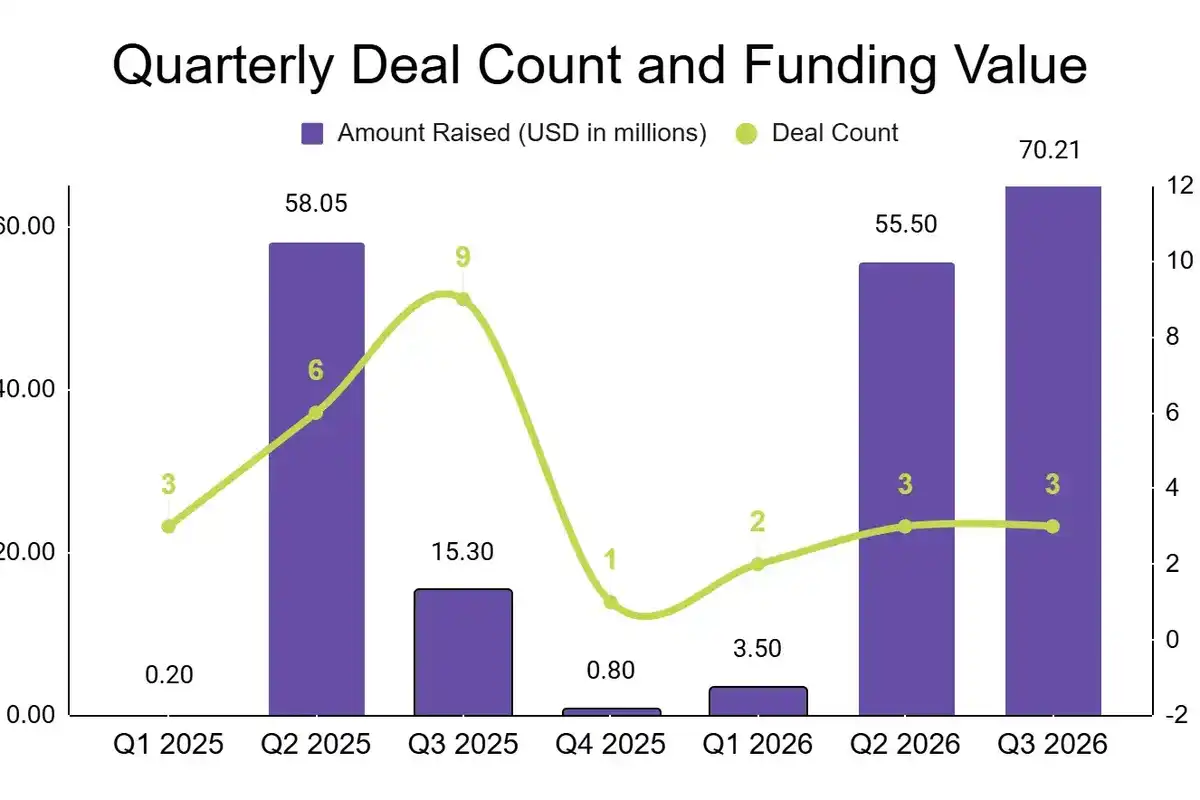
A table by i2i ventures for its report focused on quarterly startup financing
Pakistan's startup ecosystem raised USD 74.7 million across five deals in the third quarter of 2026, nearly five times the funding secured a year earlier, although the figures mask continued scarcity of early-stage capital, according to a quarterly ecosystem report.
Startups raised USD 15.3 million across nine deals in the third quarter of 2025. Funding in the first nine months of 2026 reached USD 133.7 million across 10 deals, the report said.
The headline increase was largely driven by Fasset, a stablecoin-powered neobank for emerging markets, which accounted for about 91% of the quarter's funding. Although Fasset is headquartered in the United Arab Emirates, it was included in the Pakistan startup data because the country is a key market in its strategy.
Excluding Fasset, Pakistani startups raised about USD 6.7 million in the quarter, underscoring the continued shortage of early-stage capital despite a handful of companies attracting large international rounds.
Fasset achieved unicorn status after raising USD 68 million in a Series C round at a valuation of USD 1 billion, led by Japan's SBI Group. The funding followed the company's USD 51 million Series B round in May.
Other funding activity included Qist Bazaar, a buy-now-pay-later fintech, which raised PKR 500 million, or about USD 1.8 million, through a privately placed, unrated Sukuk. The company described the financing as the first tranche of a planned series intended to create a recurring source of institutional funding and reduce reliance on traditional bank financing. The financing highlights a growing trend among Pakistani fintech companies to use debt to fund working capital and their loan books rather than relying exclusively on equity financing.
Consumer fintech company Oraan raised an undisclosed amount from Epic Angels, described as the world's largest all-female investment collective, alongside existing investors Wavemaker and i2i Ventures. The funding will support Oraan's gold product and expansion into new markets.
Ed-tech startup Edversity raised USD 400,000 from Rapidev Group to support international expansion and scale its artificial-intelligence-powered education platform.
PSX offers potential exit route
The Pakistan Stock Exchange is also emerging as a potential exit route for growth-stage startups, although exits remain one of the biggest gaps in the country's startup ecosystem.
Tasdeeq, Pakistan's first State Bank of Pakistan-licensed private credit bureau, completed an initial public offering on the PSX in August. Its book building was reportedly fully subscribed within two seconds.
Abhi Microfinance Bank has also applied for a main-board listing on the PSX, with its IPO expected soon, the report said. The listings come during one of the PSX's busiest periods for IPO activity in recent years and could provide an alternative exit mechanism for investors in growth-stage companies.
Government moves to strengthen venture capital framework
The government has also taken steps to improve the regulatory and financing environment for startups and investors.
The Securities and Exchange Commission of Pakistan has sent a draft Venture Capital bill to the Board of Investment for consultation. Stakeholder consultations involving startups, fund managers and regulators are also underway before the proposed legislation moves forward.
Much of Pakistan's venture capital activity is currently structured offshore. A domestic venture capital framework could make it easier to establish and manage investment funds within Pakistan, potentially increasing institutional participation in the sector.
The government has separately announced a USD 10 million fund under the second phase of the Pakistan Startup Fund. The government is engaging with the World Bank, International Finance Corp. and Asian Development Bank and plans to use the funding to anchor a larger fund alongside local and international investors.
A professional fund manager is expected to be appointed through a request-for-proposals process, with the resulting fund expected to make USD 25 million to USD 50 million available to startups over the next several years.
While the first phase of the Pakistan Startup Fund provides startups with matching grants of up to 30% of their latest funding round, the second phase is designed to invest at the fund level through a privately managed fund. The approach is intended to create another source of institutional capital at a time when domestic venture funds remain limited.
Virtual asset regulation opens new market
Pakistan has also moved to establish a formal regulatory framework for virtual assets.
The Pakistan Virtual Assets Regulatory Authority notified licensing regulations in August under the Virtual Assets Act 2026, which became law in March. The framework establishes 10 categories of licenses covering exchanges, custody, broker-dealer services, advisory, lending and borrowing, derivatives, asset management, transfer and settlement, issuance and mining.
The move is significant given the size of cryptocurrency activity in Pakistan, which ranked third in Chainalysis' 2025 Global Crypto Adoption Index. For years, regulatory uncertainty and restrictions on banks' dealings with crypto-related businesses had kept much of the sector outside the formal financial system. Licensed virtual asset service providers will now be able to access the formal banking system, removing a major operational barrier for legitimate businesses. A clearer licensing regime could also make crypto-related startups more attractive to institutional investors, who have largely remained cautious because of regulatory uncertainty.
Regulatory sandbox supports fintech innovation
The State Bank of Pakistan has also completed its first Regulatory Sandbox, launched in August 2025, covering inward remittances, open banking and remote onboarding of merchants.
Participants that successfully graduated included Taptap Send UK and United Bank Ltd. for remittances, and Digi Khata, Swich Retail and Neem Exponential Financial Services for open banking. Graduation from the sandbox does not constitute regulatory approval, but progress in open banking could lay the groundwork for data-driven lending and new financial products.
Google office, data centers expand ecosystem
The startup ecosystem is also benefiting from increased involvement by global technology companies and investment in digital infrastructure.
Google opened its first local office in Pakistan, with the office inaugurated by Prime Minister Shehbaz Sharif and Google's Vice President for Global Affairs Wilson L. White. Fasieh Mehta was appointed as the first head of Google's Pakistan mission. The local presence is expected to bring cloud and developer support closer to Pakistani companies while signaling greater interest in the country's technology market.
Pakistan is also expanding its data-center infrastructure. Prime Minister Shehbaz Sharif inaugurated the Sky47 Karakorum-01 data center in Islamabad on July 24. The facility has an 8.5-megawatt Tier III design and is intended to support artificial intelligence workloads.
Separately, Pakistan's sovereign cloud infrastructure based on the Internet Computer Protocol is being developed by the Pakistan Digital Authority in partnership with the DFINITY Foundation. Four data centers currently host ICP cloud engines, keeping data and computing infrastructure within Pakistan. For startups, the expansion of domestic cloud and data-center capacity could reduce dollar-denominated hosting costs and latency while making it easier for companies to meet data-residency requirements.
The developments point to a startup ecosystem that remains constrained by a shortage of early-stage capital but is gaining support from public-market activity, new financing structures, regulatory reforms, global technology companies and expanding digital infrastructure. The concentration of funding in a small number of companies, however, indicates that broad-based access to venture capital remains a major challenge for Pakistani startups.




Comments
See what people are discussing