

Pakistan, World Bank review reforms to boost growth, jobs and investment
Pakistan’s finance minister met the World Bank country director to review economic reforms focused on growth, jobs, revenue, investment and institutional development
Haris Zamir
Business Editor
Experience of almost 33 years where started the journey of financial journalism from Business Recorder in 1992. From 2006 onwards attached with Television Media worked at Sun Tv, Dawn Tv, Geo Tv and Dunya Tv. During the period also worked as a stringer for Bloomberg for seven years and Dow Jones for five years. Also wrote articles for several highly acclaimed periodicals like the Newsline, Pakistan Gulf Economist and Money Matters (The News publications)
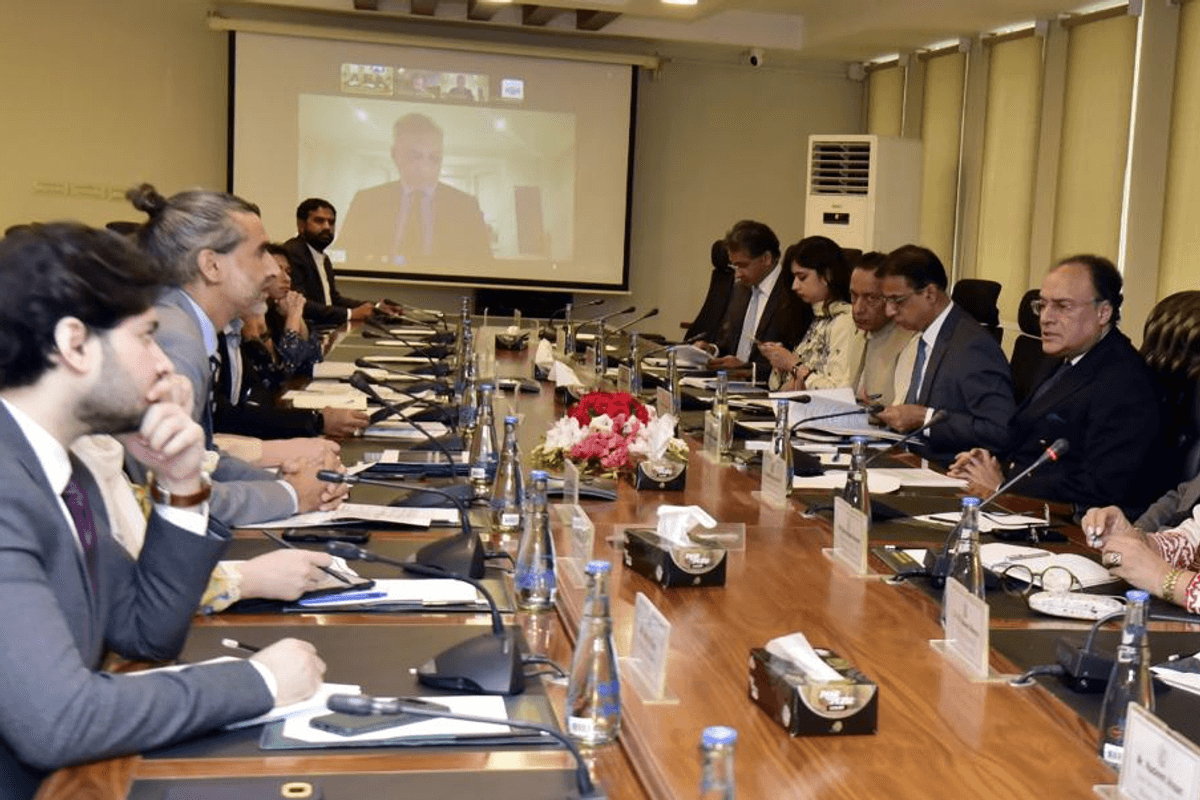
The discussion focused on translating reform priorities into practical measures.
Ministry of Finance
Federal Minister for Finance and Revenue, Senator Muhammad Aurangzeb, met a World Bank delegation led by Country Director Ms. Bolormaa Amgaabazar to review progress under their economic reform partnership and discuss implementation priorities spanning growth, jobs, fiscal management, revenue mobilization, capital markets, trade, investment and institutional reforms.
The discussions focused on translating reform priorities into practical measures and strengthening coordination among federal and provincial governments and implementing agencies.
Aurangzeb stressed the need to move from reform design to effective implementation, with measures that can deliver tangible gains in economic activity, investment, employment and the business environment.
The proposed World Bank growth and jobs operation was a key part of the discussions, with measures aimed at improving the investment climate, easing regulatory and business constraints, expanding SME access to finance and increasing sectoral productivity. The World Bank also outlined proposed export-finance products for the EXIM Bank of Pakistan to support additional trade flows.
The sides also discussed strengthening the Prime Minister’s Access to Finance initiative through a unified insolvency framework, factoring legislation and regulations to facilitate SME financing, alongside measures to expand commercial lending and private-sector participation.
Sectoral reforms included proposed measures for pharmaceuticals, medical products and agriculture. These covered seed registration, deregulation of selected commodities and stronger international accreditations to improve access to global procurement and markets.
Skills development and labor-market reforms were also reviewed, including improvements to the national vocational qualifications framework, greater international recognition of Pakistani skills and formal overseas migration pathways supported by digital platforms.
Trade and fiscal reforms
The Finance Minister and World Bank delegation reviewed implementation of the National Tariff Policy and analytical support for further tariff reforms, including work on the automotive sector. The discussion focused on improving competitiveness, productivity and exports while integrating Pakistan more closely into global value chains.
On taxation, the World Bank is providing technical assistance to strengthen tax-policy capacity, including support for the Medium-Term Revenue Strategy and revenue-policy modelling. The sides also discussed GST harmonization, with emphasis on aligning rules, definitions and classifications for services, improving federal-provincial coordination and strengthening data sharing.
Progress on agricultural income tax reforms was also reviewed, including implementation of amended provincial laws and rules and digital systems for registration, filing and payment. Participants stressed the importance of stronger compliance and federal-provincial information sharing.
The discussion also covered provincial property-tax reforms, including improved and harmonized valuation methods, digital systems and a gradual shift towards more market-based property valuations.
Capital markets and public-sector reform
The World Bank Group is supporting the development of a capital-market reform roadmap through the Capital Markets Development Council. The initiative aims to deepen domestic capital markets, broaden financing options and strengthen the investment and capital-formation ecosystem.
The sides also reviewed support for public-sector efficiency and the government's rightsizing agenda, including technical assistance to improve institutional effectiveness and the use of public resources.
Aurangzeb highlighted the importance of strengthening debt-management capacity and domestic bond markets. Discussions covered financial instruments for managing market risks, domestic bond-market development and improving investor-relations capacity.
The World Bank also briefed the minister on analytical work concerning Pakistan's sovereign credit profile and potential pathways for further rating improvements. Aurangzeb said the government would focus on strengthening the fiscal and debt position, external buffers, sustainable growth, institutional effectiveness and broader structural reforms.
Governance and institutional effectiveness
The delegation also presented analytical work on governance and institutional effectiveness, focusing on practical reforms to improve government performance, regulatory quality, transparency and accountability.
Both sides reaffirmed their commitment to continued cooperation under the economic reform partnership, with an emphasis on implementation, institutional strengthening, private-sector-led growth, more efficient public-resource management, investment and employment opportunities.
The World Bank delegation included Lasse Melgaard, Operations Manager; Simon Andrews, Division Director, IFC; Anna Godfriedovna Okutu Twum, Economist; Irum Touqeer, Senior Public Sector Specialist; Sahar Etezaz, Country Officer, IFC; Shabih Ali Mohib, Practice Manager; Tobias Akhtar Haque, Lead Economist; Rafay Khan, Senior Economist; and Omar Riaz, Operations Analyst.
Secretary Finance and senior officials of the Finance Division also attended the meeting.





Comments
See what people are discussing