

Pakistan’s energy sector burdened by soaring circular debt
Kamran Khan says Pakistan faces an LNG oversupply crisis as circular debt pressures continue mounting

News Desk
The News Desk provides timely and factual coverage of national and international events, with an emphasis on accuracy and clarity.
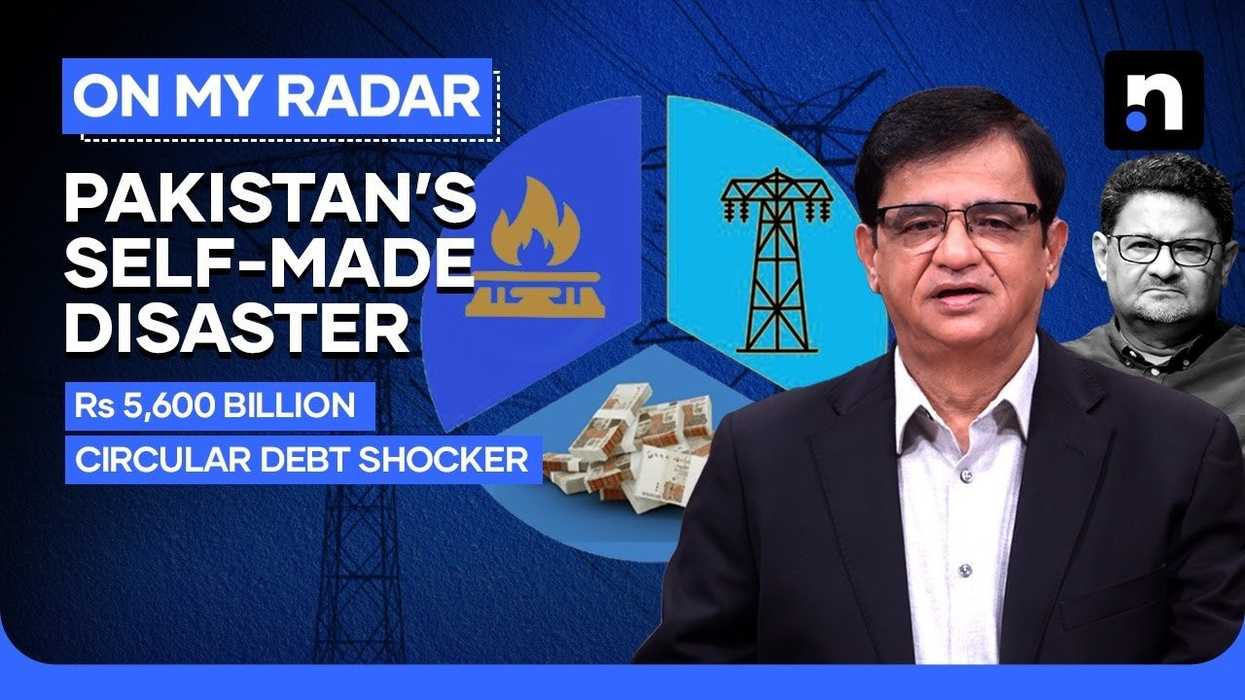
Pakistan’s energy sector remains trapped in a worsening cycle of losses and rising arrears, with total circular debt now standing at PKR 5,600 billion, Kamran Khan said in the latest episode of “On My Radar.”
He said the power sector accounts for PKR 3,000 billion of the total while the gas sector carries PKR 2,600 billion. The circular debt, he explained, is created when electricity and gas are purchased at high prices but sold at lower rates, or when distribution losses and poor bill recovery erode revenues. These gaps accumulate into debt, eventually freezing internal payments across power, gas and fuel companies.
Khan said the government’s attempts to raise tariffs and renegotiate capacity payments with independent power producers have created the impression of improvement. But the debt remains largely unchanged, he added.
In September, the government approved a PKR 1,225 billion bank-financed payment to reduce the recorded circular debt in the power sector. The amount was deducted from the Power Division’s books, but the actual disbursement to the concerned companies has not taken place nearly three months later, Khan said. As a result, the real stock of debt in the power sector remains the same, and any future reduction will come only through additional bank borrowing.
Khan described even deeper complications in the gas sector, where Pakistan has more LNG than it can consume. He said expensive LNG purchases have pushed the sector’s circular debt to PKR 2,600 billion, including PKR 570 billion linked specifically to high-priced LNG imports.
Pakistan had signed two long-term “take or pay” LNG supply agreements with Qatar and a relatively flexible contract with Italian firm ENI between 2016 and 2021. Under these deals, he said, Pakistan committed to buying about 120 LNG cargoes annually for 10 years — nine per month from Qatar and one from ENI.
These quantities were estimated based on power sector demand projections of 800–900 million cubic feet per day through 2023. LNG prices were benchmarked to a three-month average of Brent crude. But planners underestimated future price volatility and largely ignored the rapid spread of solar energy, Khan said.
When global LNG prices surged, electricity produced from re-gasified LNG became prohibitively expensive. Power sector demand for LNG dropped from nearly 900 mmcfd to as low as 200–600 mmcfd, creating an oversupply crisis.
Pakistan now has more LNG shipments, storage and scheduled consignments than it can use — and insufficient capacity to pay for them in dollars. To contain the losses, the Shehbaz Sharif government is trying to divert contracted LNG cargoes to other markets.
According to Khan, Pakistan plans to move 24 to 29 Qatar-supplied cargoes for 2026 to external buyers and cancel 21 ENI cargoes over the next two years. He noted that ENI’s contract terms are more flexible, but the Qatar deals carry a strict take-or-pay clause requiring Pakistan to pay regardless of demand.
Under the current “net proceed differential” mechanism, Qatar keeps profits if diverted cargoes sell at higher prices elsewhere, while Pakistan absorbs the loss if they sell for less, Khan added.





Comments
See what people are discussing