


News Desk
The News Desk provides timely and factual coverage of national and international events, with an emphasis on accuracy and clarity.
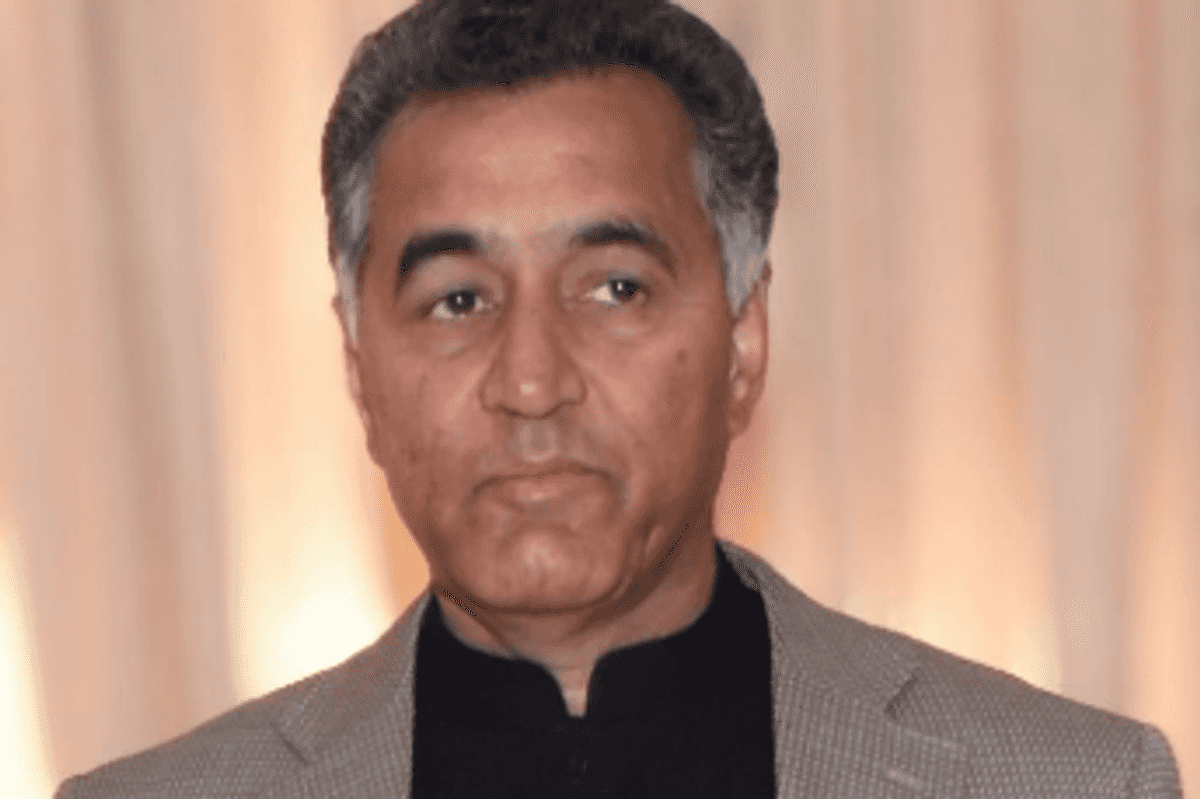
Former Inter-Services Intelligence chief Lt. Gen. Faiz Hameed.
Courtesy: ISPR
Pakistan’s military said Thursday that former Inter-Services Intelligence chief Lt. Gen. Faiz Hameed has been convicted by a Field General Court Martial and sentenced to 14 years of rigorous imprisonment.
The verdict concludes a 15-month trial of one of the country’s most high-profile former intelligence officials.
The Inter-Services Public Relations said the court found Hameed guilty on four charges, including involvement in political activities, violations of the Official Secrets Act that harmed state security, misuse of authority and government resources, and causing wrongful loss to individuals.
ISPR said the court martial proceedings began on August 12, 2024, under the Pakistan Army Act. According to the military’s media wing, the trial involved “lengthy and laborious” legal processes, after which the court convicted him on all counts.
The army said the process complied with all legal requirements and that Hameed was given full rights, including the ability to choose his own defense team. He retains the right to appeal before the appropriate forum under military law.
The military added that Hameed’s alleged role in “fomenting vested political agitation and instability in cohorts with political elements” is being addressed separately, signaling potential additional proceedings.
Hameed, once regarded as one of the most influential figures in Pakistan’s security establishment, previously served as head of the ISI, the country’s powerful intelligence agency.
Verdict to be challenged
Speaking to Nukta, the legal counsel for Hameed, Barrister Mian Ali Ashfaq, said the former intelligence chief has directed him to challenge the 14-year sentence handed down by the military court.
Ashfaq said he will request the certified verdict and full case record from the military authorities as the first step in initiating the appeal. “We will submit an application to the military court seeking a copy of the judgment and the relevant record,” he said.
He noted that the law provides 40 days to file an appeal before the Court of Appeal. “We will file the appeal within this period,” Ashfaq added, confirming that the challenge will be lodged as soon as the documents are received.
Decisive shift
Dr Rasool Bux Rais, a political analyst, told Nukta that the sentencing of a former director general of the ISI is unprecedented in Pakistan’s civil-military history and raises difficult questions about what it signals for internal accountability within the security establishment.
He said the conviction should be viewed within the broader context of Pakistan’s current power structure. “The system is loaded with every conceivable power and may not tolerate opposition from any quarter,” he said, noting that the verdict reflects a decisive shift in how authority is exercised.
Rais described the development as a moment that should “ring alarm bells,” suggesting it offers a clearer view of the country’s evolving political architecture. “From now on, one can clearly see the path of our new power arrangements and the power politics. It is hybrid plus,” he said.
Timeline of the case
Hameed was promoted to lieutenant general in April 2019. He was appointed director general of the ISI on June 16, 2019, during the tenure of then-Prime Minister Imran Khan. His transfer from the intelligence agency in October 2021 was widely viewed as a significant moment in civil-military relations. Khan was removed from office in April 2022 after losing a parliamentary vote of no-confidence.
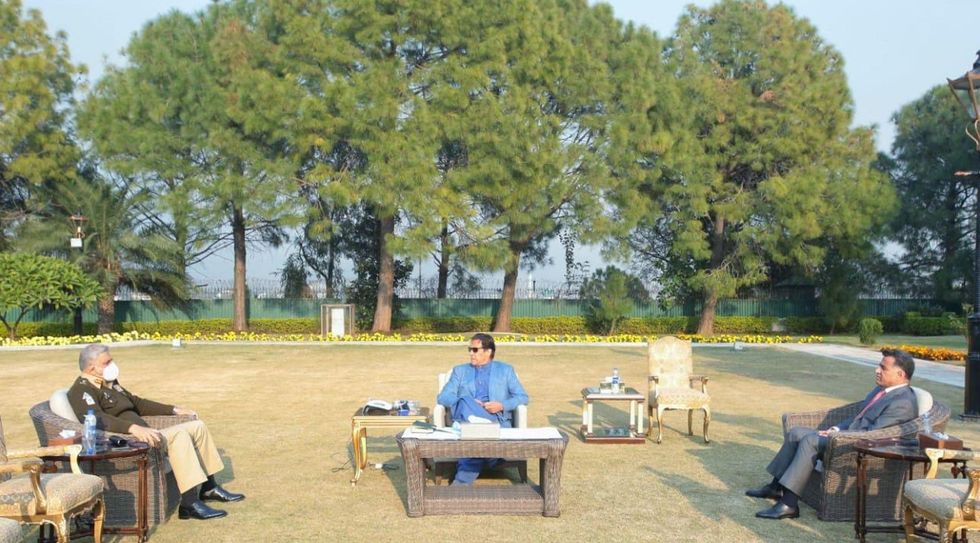 Former Chief of Army Staff General Qamar Javed Bajwa and former DG ISI Lt. General Faiz Hamid call on former\u00a0prime minister Imran Khan in Islamabad, Pakistan, December 24, 2020. Reuters
Hameed retired from the army in December 2022.
He was arrested on August 12, 2024, after the military announced it had taken him into custody to “ascertain the correctness” of complaints in a property-related case. The army said at the time that “multiple instances of violation” of the Army Act had occurred after his retirement and that disciplinary action had been initiated.
ISPR also confirmed then that the Field General Court Martial process had begun and that Hameed had been placed in military custody pending trial.
Charges linked to 2017 raids
Part of the case against Hameed stems from a petition filed on November 8, 2023, in Pakistan’s Supreme Court. The petitioner, Moeez Ahmed Khan, the owner of the real estate project Top City, accused Hameed of misusing his authority when he was serving in the ISI.
According to the petition, ISI officials raided Moeez’s office and home on May 12, 2017, “on the behest of Gen Faiz.” The petitioner said valuables including gold, diamonds, and cash were seized during the raid. He also alleged that Hameed’s brother, Sardar Najaf, later contacted him to discuss resolving the matter.
Those allegations eventually became part of the proceedings examined by the military court, according to official statements issued over the past year.
A history of high-profile court martials in Pakistan
Pakistan has witnessed several rare but high-impact court martials of senior military officers. These cases, often tied to corruption, espionage or breaches of national security, have shaped debates about internal accountability within the armed forces.
In 2009, the Public Accounts Committee launched an inquiry into the National Logistics Cell after the state-run organization reported losses of PKR 1.8 billion incurred between 2004 and 2008. The episode eventually drew scrutiny toward two retired senior officers, Lt. Gen. Khalid Munir Khan and Lt. Gen. M. Afzal Muzaffar.
Espionage charges led to the conviction of Lt. Gen. Javed Iqbal, who was found guilty by a Field General Court Martial on May 30, 2019, for leaking sensitive information to foreign agencies. His original 14-year sentence was cut in half by an appellate authority in May 2021.
One of Pakistan’s most notorious military trials occurred in 1995, when Maj. Gen. Zaheerul Islam Abbasi, Brig. Mustansir Billah, Col. Mohammad Azad Minhas, Col. Inayat Ullah Khan and 38 others were arrested for allegedly plotting to storm a scheduled corps commanders’ meeting at the army’s General Headquarters in Rawalpindi.
A more recent case involved Brig. Ali Khan, who was arrested in 2011 on allegations of links with the banned group Hizb ut-Tahrir. He and four other officers, Maj. Inayat Aziz, Maj. Iftikhar, Maj. Sohail Akbar and Maj. Jawad Baseer, were later convicted.
Some senior officers have also been removed from service without full court martial proceedings. Gen. Ziauddin Butt, appointed army chief by then–Prime Minister Nawaz Sharif in October 1999, was detained for two years after the military takeover that followed.
In 2016, under the command of Gen. Raheel Sharif, six army officers, including two serving generals, Lt. Gen. Obaidullah Khattak and Maj. Gen. Ejaz Shahid, were dismissed in a sweeping corruption-related purge.





Comments
See what people are discussing