

Pakistan’s pace puzzle ahead of T20 World Cup 2026
The fast-bowling resources continue to pose selection headaches for the team management

Sports Desk
The Sports Desk is the editorial team responsible for covering the latest news, updates, and analysis from the world of sports. Our team of experienced writers and journalists bring you in-depth coverage of local and international sports events, player profiles, and expert opinions.
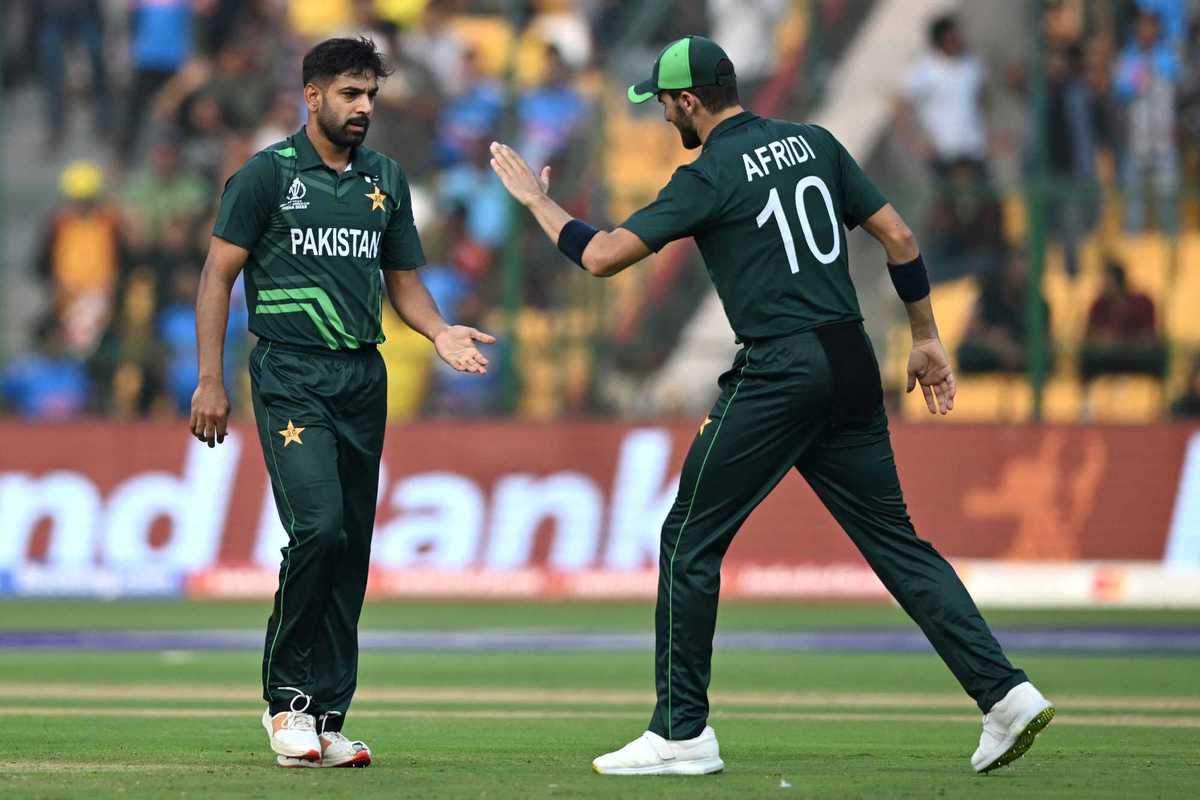
Pakistan's Haris Rauf (L) celebrates with teammate Shaheen Shah Afridi after taking the wicket of Australia's David Warner during the 2023 ICC Men's Cricket World Cup one-day international (ODI) match between Australia and Pakistan at the M. Chinnaswamy Stadium in Bengaluru on October 20, 2023.
AFP
With the ICC T20 World Cup 2026 fast approaching, Pakistan’s pace attack has become a major subject of debate, carrying both promise and uncertainty.
While the spin department looks largely settled, the fast-bowling resources continue to pose selection headaches for the team management, particularly in light of form, fitness, and conditions expected in Sri Lanka.
Pakistan’s spin arsenal appears well-equipped for the spin-friendly surfaces likely to be on offer. Abrar Ahmed’s mystery spin, Usman Tariq’s guile and control, Mohammad Nawaz’s all-round value, and Shadab Khan’s experience provide balance and variety.
As a result, the team may look to lean heavily on spin, making every pace bowling slot even more competitive.
Despite this, Pakistan is expected to field three fast bowlers in their playing XI. Faheem Ashraf’s all-round abilities almost guarantee his place as the third seamer, thanks to his lower-order batting and ability to provide crucial overs.
This leaves only two spots for specialist fast bowlers, intensifying competition among several contenders.
Shaheen Shah Afridi remains the leader of the attack and the most likely first-choice pacer. However, his recent knee injury sustained during BBL 15 has raised concerns.
Although he has resumed training at the National Cricket Academy in Lahore and is expected to recover in time, his form is far from reassuring. Managing just two wickets in four BBL matches, Shaheen will need to rediscover his rhythm quickly to justify his automatic selection.
Naseem Shah has made a strong case for himself with consistent performances. His outing in the recent ILT20 was encouraging, where he claimed 12 wickets in eight matches at an impressive economy of 6.97.
His ability to bowl at pace while maintaining control could be invaluable in pressure situations. Among the emerging options, left-arm pacer Salman Mirza has caught the eye with outstanding numbers, picking up 19 wickets in 12 matches at an average of 14.89.
Mohammad Wasim Jr also remains in contention, offering reliability and the ability to bowl in different phases of the innings.
The most contentious name, however, is Haris. Out of favor since the Asia Cup final, Rauf has not featured in a T20I for Pakistan recently, and reports suggest he could miss out on selection.
Yet, his sensational Big Bash League campaign, where he finished as the leading wicket-taker in the highest-scoring season in BBL history, has reignited the debate.
With spin likely to play a dominant role, Pakistan’s final balance remains uncertain. Whether the selectors opt for experience, form, or conditions-based selections, and whether Haris Rauf makes the cut, will be key questions as Pakistan shape their pace attack for the T20 World Cup.





Comments
See what people are discussing