

PCB takes control of Hyderabad’s historic Niaz Stadium in 20-year deal
Board promises major upgrades, floodlights and return of first-class, PSL and international cricket to a venue that once hosted Javed Miandad’s iconic 280 not out
Usama Manj
Producer, Correspondent
Usama Manj is an experienced multimedia journalist with over 8 years in the industry. He began his career at Express News before moving on to Indus News as news producer and then worked for Aik News as a sports producer and anchor.
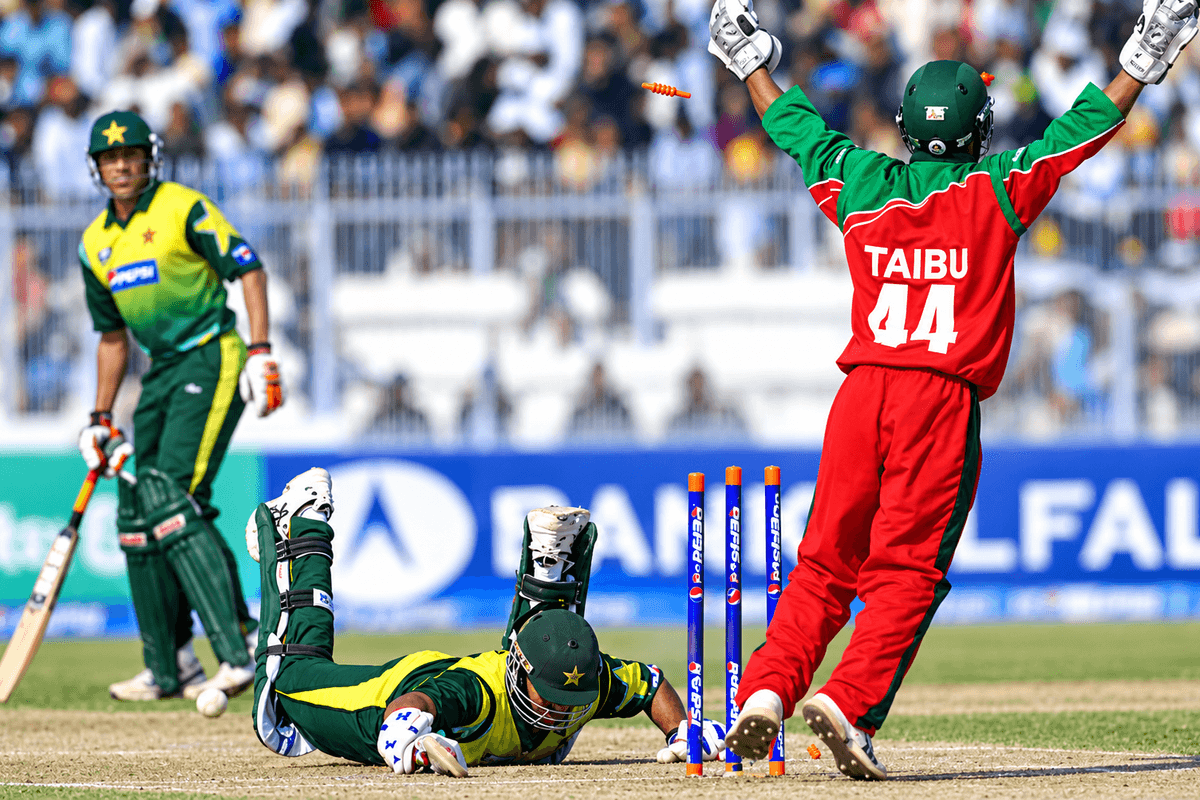
Niaz Stadium last hosted an international match in January 2008, when Pakistan faced Zimbabwe in an ODI.
AFP
Hyderabad’s historic Niaz Stadium is set for a major revival after the Pakistan Cricket Board (PCB) and Hyderabad Municipal Corporation (HMC) signed a 20-year agreement to hand the venue back to the cricket board.
The agreement, signed on Tuesday, October 6, places the stadium under PCB management while ownership remains with the HMC. PCB Chief Operating Officer Sumair Ahmed Syed and Hyderabad Mayor Kashif Ali Shoro signed the agreement at a ceremony attended by cricket and government officials.
Under the agreement, the PCB will have administrative control of the stadium, including its commercial and broadcasting rights. HMC will retain ownership, while the PCB is expected to pay Rs10,000 in monthly rent and the municipal corporation will receive 20% of gate-ticket revenue.
The PCB has also committed to upgrading Niaz Stadium to international standards, including the installation of floodlights and improvements to the playing surface, pitch and other facilities. The board wants the venue to eventually host first-class cricket, Pakistan Super League (PSL) matches and international fixtures.
PCB officials have stressed, however, that international cricket will not return overnight.
Sumair said the immediate objective is to bring the venue up to the minimum standards required for domestic and PSL cricket before eventually targeting bilateral international matches.
The board is also considering establishing a regional cricket academy in Hyderabad, with coaches and physiotherapists, while regular first-class cricket is expected to form part of the stadium's revival.
From a legendary cricket ground to years of neglect
The development marks a significant moment for a stadium that has played a remarkable role in Pakistan's cricket history.
Established in 1959, Niaz Stadium began hosting first-class cricket in 1962 and staged its first Test during the 1972-73 season, when Pakistan faced England. The venue eventually hosted five Tests, with the final one coming in 1984 when Pakistan defeated New Zealand by seven wickets.
Niaz Stadium also became part of cricket history when it hosted the 1,000th Test match, between Pakistan and New Zealand in November 1984.
But perhaps the stadium's most famous cricketing memory belongs to Javed Miandad.
The ground where Miandad made 280 not out
In January 1983, during India's tour of Pakistan, Miandad produced one of the greatest innings ever played at the venue.
Batting against India in the fourth Test at Niaz Stadium, Miandad remained unbeaten on 280, his highest Test score.
He shared a massive partnership with Mudassar Nazar, who scored 231. The pair put on 451 runs, matching the then world-record partnership for the third wicket set by Australia's Don Bradman and Bill Ponsford in 1934.
Miandad's 280 came from 460 balls and included 19 fours and a six. Pakistan declared on 581 for three, and went on to beat India by an innings and 119 runs.
The innings also produced one of the more unusual moments in Pakistan's Test history: Miandad was left unbeaten because captain Imran Khan declared the innings before he could reach 300. Imran subsequently helped Pakistan finish the match with a devastating spell of five wickets for eight runs in 23 balls.
Miandad's 280 remains synonymous with Niaz Stadium and is still his highest Test score.
A World Cup venue too
Niaz Stadium was also selected as a venue for the 1987 Cricket World Cup.
Pakistan played Sri Lanka in Hyderabad and won the match, adding another major international occasion to the stadium's history. The ground was known for its passionate crowds, with Pakistan maintaining an unbeaten record in Tests and ODIs played there.
The stadium's international status, however, gradually declined as its facilities failed to keep pace with Pakistan's other major cricket grounds.
The venue's last Test was the 1984 Pakistan-New Zealand match. It later hosted ODIs, but after the 1997-98 season, international cricket disappeared from Hyderabad for almost a decade.
The last international match came in 2008
The PCB upgraded Niaz Stadium in 2007, eventually bringing international cricket back to Hyderabad.
On January 24, 2008, Pakistan played Zimbabwe in the second ODI of a five-match series at Niaz Stadium.
Pakistan won by five wickets, chasing down Zimbabwe's 238 for eight with 22 balls to spare. Nasir Jamshed top-scored with 74, while Shahid Afridi made 43 off just 27 balls and Mohammad Yousuf finished unbeaten on 38. Sohail Tanvir was named Player of the Match after taking four wickets for 34 runs.
The match attracted around 8,000 spectators and was the first international fixture in Hyderabad in 10 years.
That Pakistan-Zimbabwe ODI remains the last international match played at Niaz Stadium.
There was, however, some domestic cricket afterwards. PCB records show a one-day domestic match between Rawalpindi Rams and Zarai Taraqiati Bank Limited was played at Niaz Stadium on March 28, 2008. The venue also hosted a Quaid-e-Azam Trophy first-class match in December 2017.
Why did the stadium fall away?
Despite its historic importance, Niaz Stadium struggled with inadequate facilities and accommodation arrangements for visiting teams.
The PCB had previously entered into an agreement to develop the venue, but the promised transformation did not materialise. In April 2018, the Qasimabad Municipal Committee took back control of the stadium, ending the PCB's previous arrangement.
Interestingly, the committee was headed by Kashif Ali Shoro at the time — the same person who is now Hyderabad's mayor and has signed the new agreement returning the stadium to PCB control.
For years afterwards, one of Pakistan's most historically significant cricket grounds remained largely absent from the country's major cricket calendar.
Hyderabad finally has a new reason to dream
The timing of the new agreement is particularly significant because Hyderabad has now entered the PSL landscape.
In February 2026, Hyderabad Kingsmen were unveiled as the PSL's seventh franchise, with the team's name and logo launched at Niaz Stadium. The franchise is owned by Hyderabad-born US-based businessman Fawad Khan.
That has given the city something it has lacked for years: a major professional cricket team — but still without a stadium capable of hosting its home games.
The PCB's plan is therefore bigger than simply renovating an old ground.
A historic milestone for Hyderabad! Today, HMC formally handed over the historic Niaz Stadium to the Pakistan Cricket Board (PCB). This landmark agreement will pave the way for domestic, international and PSL cricket in Hyderabad, while creating greater opportunities for young talent across Hyderabad and neighbouring districts.I sincerely thank Chairman PPP @BBhuttoZardari , President Asif Ali Zardari, CM Sindh Syed Murad Ali Shah for their continued support in making this vision a reality.#NewEra #NiazStadium #PCB #Hyderabad
— Kashif Ali Shoro (@KashifShoroPPP) October 6, 2026
The board wants Niaz Stadium to become a functioning cricket centre again, with floodlights, improved facilities, first-class cricket, PSL games and, eventually, international cricket.
The PCB has indicated it will try to stage PSL matches in Hyderabad once the required upgrades are completed, while the board has also discussed bringing first-class cricket back to the venue.
For a city that once watched Javed Miandad score 280 against India, witnessed a World Cup match and hosted Test cricket's 1,000th game, the new agreement represents a chance to bring Niaz Stadium and Hyderabad cricket back to life.
One thing is clear: the next chapter of Niaz Stadium's story has finally begun.


Comments
See what people are discussing