

PIMS tragedy: How doctors' 2024 warning went unheeded before the fire
Fourteen newborns died in the PIMS tragedy, 18 months after doctors warned regulators about failing equipment and hospital mismanagement.

Ali Hamza
Correspondent
Ali; a journalist with 3 years of experience, working in Newspaper. Worked in Field, covered Big Legal Constitutional and Political Events in Pakistan since 2022. Graduate of DePaul University, Chicago.
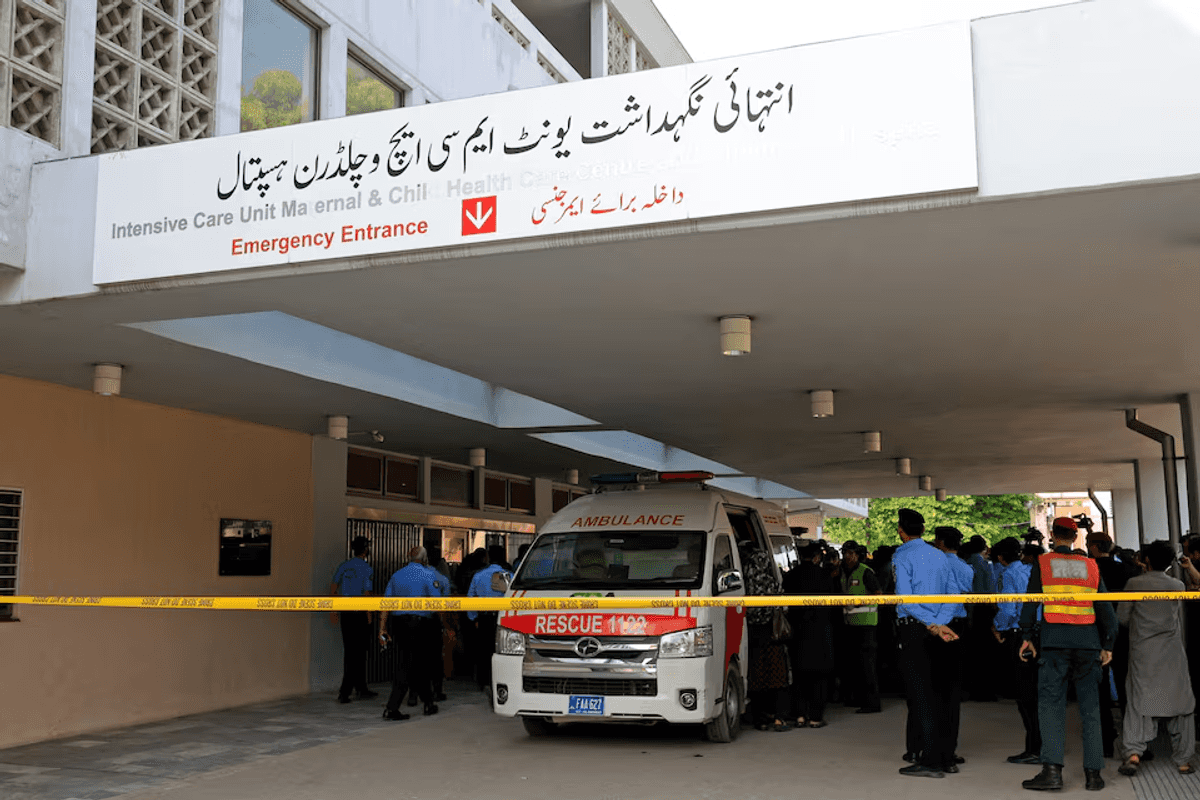
Fourteen newborns died in a fire at Pakistan’s largest public hospital this week, 18 months after 23 of its department heads formally warned authorities about failing equipment, security lapses, medicine shortages and what they described as serious management failures.
The Aug. 26 fire tore through a newborn nursery at the Pakistan Institute of Medical Sciences, or PIMS, in Islamabad. Officials said an air-conditioning unit sparked the blaze in a ward housing 15 babies. Only one survived.
Prime Minister Shehbaz Sharif dismissed the federal health secretary and ordered an inquiry into the fire.
The deaths have revived scrutiny of a formal complaint filed by the 23 PIMS department heads with the Senate’s health committee in October 2024. The doctors accused PIMS Executive Director Professor Rana Imran Sikandar of racism, nepotism, gender discrimination, workplace harassment, misuse of power and mismanagement that they said was putting patients at risk.
The complaint was expanded in a follow-up submission the following spring. Among other concerns, it cited failing equipment, unsecured hospital property and shortages of medicines.
The documents do not establish that any of those allegations caused the nursery fire. A government-appointed inquiry has said it is too early to determine whether an aging air-conditioning unit was responsible for the blaze.
Missing wiring, missing oversight
The doctors’ complaint raised questions about PIMS’ physical infrastructure and how it was being managed.
It alleged a wave of thefts of government property during Sikandar’s tenure, including heavy copper cabling from operating theaters, air-conditioning equipment and oxygen pipes, as well as staff vehicles and personal belongings.
According to the complaint, police reports, known as first information reports, were filed against employees of Belfort, the hospital’s private security contractor, over the theft of air-conditioning copper wiring and other property.
The doctors said Sikandar nevertheless supported an extension of Belfort’s contract without resolving questions about camera coverage, how large stolen items were removed from the hospital or whether the contractor was liable for the losses.
The theft allegations are based on the complaint and have not been independently verified. Sikandar has not publicly addressed them.
The concerns about missing or poorly maintained electrical and air-conditioning infrastructure have drawn renewed attention after the nursery fire. But officials have cautioned that no direct connection has been established between the complaints and the deaths.
A death in the maternity ward
The complaint also revisited a 2022 incident in PIMS’ maternity and gynecology ward, when Sikandar was head of the hospital’s anesthesia department.
According to the doctors, unsafe clinical practices and the use of a banned anesthetic drug resulted in the death of a patient and left two others in serious condition after cesarean-section deliveries.
Pakistan’s health ministry issued Sikandar a formal explanation notice over the incident and opened an inquiry, according to the complaint. No public findings from that inquiry have surfaced.
The complainants said the case had never been properly resolved and that lessons involving clinical protocols, oversight and drug safety in high-risk wards were not adequately addressed by hospital management.
Health insurance program under strain
The complaint also raised concerns about PIMS’ handling of the Sehat Sahulat health insurance program, a government initiative aimed at providing health care to low-income patients.
That portion of the complaint is supported in large part by contemporaneous records and reporting.
State Life Insurance Corp., which administers the program, warned PIMS management in mid-2024 that medicines supplied to health-card patients were coming from lesser-known local manufacturers and, in some cases, were more expensive than products from established multinational companies.
State Life recommended that PIMS switch to medicines from internationally reputable manufacturers and gave the hospital a deadline to comply.
When PIMS did not act, State Life suspended Sehat Sahulat coverage at the hospital except for cardiac, dialysis and intensive-care patients. The suspension was reported independently at the time.
Hospital pharmacists also filed a complaint with the Federal Investigation Agency over the issue, while the Public Accounts Committee later ordered a review of PIMS records related to the program.
Other scandals on the file
The doctors’ complaint also revisited a 2023 admissions-corruption scandal at the hospital’s nursing college. The health ministry suspended an entire intake after allegations that interview scores had been manipulated in exchange for payments.
A similar allegation involving postgraduate medical training surfaced the following year and was independently reported by Pakistani media.
The complainants separately alleged that Sikandar oversaw the illegal promotion of a junior administrative employee, Abu Bakar, from grade 9 to grade 16. They said the promotion violated an Islamabad High Court order requiring it to be reversed and that the order had been ignored for two years.
That allegation, like those involving the security contractor, has not been independently verified beyond the complaint.
Sikandar has denied the allegations. In a formal response to the Senate committee in November 2024, he described the complaint as a collection of sweeping, unsubstantiated claims by disgruntled employees. He said some of the complainants were unhappy after being told to vacate housing they had obtained outside the merit system.
He has repeated similar denials since, most recently in December 2025 in response to separate allegations concerning vacant deanships.
Ten job titles, one spokeswoman
The doctors also questioned the number of responsibilities assigned to Dr. Aniza Jalil, PIMS’ deputy executive director.
According to the complaint, Jalil has simultaneously held several positions, including assistant professor in the general medicine department; deputy executive director for the hospital’s “IH” and non-medical, or “NM,” portfolios; waste-management officer; official spokesperson; postgraduate hostel warden; in-charge of the Sehat Sahulat program; focal person for the Wafaq-e-Mohtasib, the federal ombudsman; minute-taker for key meetings of the executive director; and a recurring member of internal inquiry committees, including panels responsible for counseling senior officers.
The complainants argued that the range of duties, many outside clinical medicine, exceeded what her original promotion notification envisaged.
Jalil, who is also PIMS’ public-facing spokeswoman, rejected that characterization in comments to Nukta.
“No. I am DED, and Assistant Professor,” she said.
She said a deputy executive director at PIMS has almost always also served as spokesperson, citing former DED Dr. Ayesha Isani as an example.
Asked about the Senate complaint, Jalil said the matter had been referred by the Senate committee to the health ministry for an inquiry. She said a ministry committee headed by an additional secretary had found no substance in the allegations.
Jalil said she did not have copies of the official letters documenting either finding when asked to produce them.
Sikandar also holds an additional role, serving as executive director of PIMS’ coronary care unit alongside his position as head of the hospital.
Questions over the Senate review
The Senate panel that handled the doctors’ complaint decided it was administrative in nature and referred it to the health ministry rather than investigating it directly.
The panel is chaired by Sen. Amir Waliuddin Chishti, who is also chairman of Darul Sehat Hospital and its affiliated Liaquat College of Medicine and Dentistry, private institutions in Karachi.
Chishti’s hospital has its own accountability history. In 2019, he and the hospital’s vice chairman were booked by police after a nine-month-old patient died in a case in which the family alleged improper treatment. The two left a courtroom after their bail applications were rejected before the case was later settled out of court.
That history does not establish any connection to the PIMS complaint. But it raises a broader question about the review process: A senator who chairs a private hospital was involved in deciding whether complaints against a public hospital warranted a full inquiry.
What happens now
Investigators are still trying to establish exactly what caused the Aug. 26 fire. Officials have warned against attributing the deaths to any single failure before the investigation is complete.
PM Shehbaz has ordered a high-level investigation into the fire, while Sikandar’s resignation is reportedly under consideration.
For the 23 PIMS doctors who signed their names to a warning about the hospital’s management 18 months ago, the central question is now whether their concerns were adequately investigated.
So far, they have pointed to no public findings from that complaint.
The hospital’s newborn nursery has 14 fewer babies than it did before the fire.


Comments
See what people are discussing